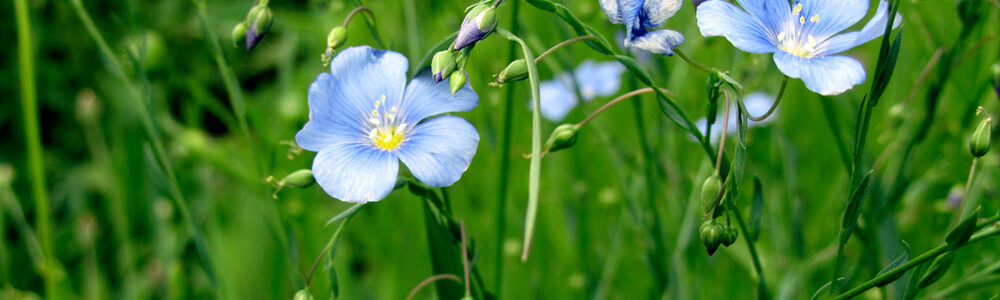
We have collective nouns for animals, like “a gaggle of geese,” “a pride of lions,” and “an exaltation of larks.” So why not collective nouns for plants? How about a “greasing of palms,” or a “pursing of tulips”? Also, the difference between further and farther, the proper use of crescendo, how Shakespeare sounded, and why a child’s runny nose is sometimes referred to as lamb’s legs. This episode first aired November 20, 2010.
Collective Names for Plants
 Why not have collective nouns for plants, like a “greasing of palms,” or a “pursing of tulips”? Martha shares some others collected on the site of food writer Gary Allen.
Favorite Spoonerisms
Reverend William Archibald Spooner was known for transposing sounds, like raising a glass “to our queer old dean” instead of “to our dear old queen.” A caller shares some favorite spoonerisms.
Pannas
Boil up some pig neck bones, add some liver sausage and buckwheat, mold it in a loaf, then slice, fry, and serve with syrup. Some folks call that scrapple, but a Milwaukee woman’s family calls it pannas.
Snap, Crackle, Pop
A listener asks: “Does the phrase ‘snap, crackle, and pop’ need a cereal comma?”
Anagram Word Quiz
Quiz Guy John Chaneski has a puzzle about anagrams.
How Shakespeare Sounded
What did Shakespeare’s plays sound like in his day? An acting teacher with an interest in dialects wants to know how researchers reconstruct Elizabethan speech.
Whisper Down the Lane
A Pennsylvania college student remembers playing a game called “Whisper Down the Lane.” She’s surprised to learn that her fellow students call the same game “Telephone.”
Further vs. Farther
What’s the difference between further and farther?
Mommy of Poppies
Martha shares more clever collective plant names, including a “mommy of poppies.”
Typefaces in History
Pity the poor typeface designer, always seeing anachronisms in movies and television. Imagine how painful it must be watching a World War II movie only to see a document printed in Snell Roundhand Bold, a font invented in 1972. Here’s typeface expert Mark Simonson’s analysis of the lettering on “Mad Men.” More about the life of font designers in the new book Just My Type by Simon Garfield.
Scots-Irish “Whenever”
Some speakers of American English use the word whenever to refer to a single event, as in “whenever Abraham Lincoln died.” This locution is a vestige of Scots-Irish speech.
Proper Use of Crescendo
A professional musician maintains that many people use the word crescendo incorrectly.
Lamb’s Legs
A father of two small children says his Indiana family referred to a child’s runny nose as a “lamb’s legs,” as in “We need to wipe the lamb’s legs off.”
This episode is hosted by Martha Barnette and Grant Barrett, and produced by Stefanie Levine.
Photo by Rachel Kramer. Used under a Creative Commons license.
Book Mentioned in the Episode
| Just My Type by Simon Garfield |
Music Used in the Episode
| Title | Artist | Album | Label |
|---|---|---|---|
| I Can Dig It | Booker T and The MG’s | Doin’ Our Thing | Stax |
| Spanish Hustle | Fatback Band | Raising Hell | Event |
| Agbara | The Soul Jazz Orchestra | Rising Sun | Strut |
| The Bamboos Theme | The Bamboos | Rawville | Tru Thoughts |
| Expressway (To Your Heart) | Booker T and The MG’s | Doin’ Our Thing | Stax |
| Oakland Blackouts (Instrumental) | Hieroglyphics | Third Eye Vision | Hieroglyphics |
| On The Sly | The Bamboos | 4 | Tru Thoughts |
| Let’s Call the Whole Thing Off | Billie Holiday | All Or Nothing At All | The Island Def Jam Music Group |