

As a kid, you may have played that game where you phone someone to say, “Is your refrigerator running? Then you better go catch it!” What’s the term for that kind of practical joke? Is it a crank call or a prank call? There’s a difference. • If someone has a chip on his shoulder, he’s spoiling for a fight — but what kind of chip are we talking about? Potato? Poker? Hint: the phrase arose at a time when working with wood was more likely. • A conversation with an expert on polar bears leads to a discussion of history and folklore around the world. • Plus noon of night, omadhaun, chicken lights, choke-and-slide, tragomaschalia, another think coming vs. another thing coming, and bada bing, bada boom.
This episode first aired June 24, 2017. It was rebroadcast the weekends of January 8, 2018, and July 8, 2019.
Transcript of “Noon of Night (episode #1474)”
You’re listening to A Way with Words, the show about language and how we use it. I’m Grant Barrett.
And I’m Martha Barnette. A couple of weeks ago, we had a caller from Mammoth Lakes, California, who was telling us about her father giving her this advice to use small words, but he gave the advice in the form of really big words. It started with promulgating your esoteric cogitations and it went on from there. Yes, or articulating your superficial sentimentalities, blah, blah, blah. But it basically boiled down to eschew obfuscation. Don’t use long words. Don’t use big words.
Yes, exactly.
And that prompted a memory from Tommy Cogswell, who listens to us in Tallahassee, Florida. And he recounted a story where he was going to the store every day and he would run into this older bully who would give him a hard time by using all these words that he didn’t understand. And so Tommy went back to his mom and dejectedly told her that there was this guy giving him a hard time with all these big words. And so she gave him something to say back to this guy. It goes, do you have the audacity to doubt my veracity or even to insinuate that I would prevaricate while I’ll thrust my phalanges into your physiognomy with such intensity that it will horizontalize your perpendicularity?
So, in other words, I’m going to punch you in the face and knock you down.
Yes, if you keep doing that.
If you keep calling me a liar.
Yeah.
And so the next day he goes to the store, runs into the guy.
Is he a kid?
He’s a high schooler.
And Tommy at the time was 9 or 10. And so Tommy responded to the kids taunting with that phrase. And the kids said, where did you learn that? And he said, my mama told me to tell you that, Luther. But it turns out that this was a little ditty that was going around in those days. Very similar to the long word thing.
Yeah, that’s cool.
Yeah.
It was the meme of its era, as we said in that last call.
I know, right?
Fight back against those bullies.
Well, this show is about all things related to language, and a lot of it has to do with memory and family and history and culture.
Email words@waywordradio.org.
Talk to us on Twitter @wayword.
And join us on our Facebook group.
Hello, you have A Way with Words.
Hi, this is Storm calling from San Antonio, Texas.
Hi, Storm, welcome. What can we do for you?
Well, we need an expert in opinion on a debate we’re having in my family. My son and I were having a discussion, and he used the term prank call. So I corrected him saying, no, no, no, dear, you commit a prank. But if you want to prank someone using the phone, that’s a crank call. So my son, who is almost 15, looked at me like I was crazy and said, Mom, that’s not even a word, meaning a phrase. So I Googled crank call and then swaggered over to him to show that crank call is indeed a term. But I was shocked to find that crank call was the less common version and that it had somewhat of a more negative connotation than prank call. I checked with my parents who are in their late 60s, and they’ve heard of both terms but state that a crank call is different. My mother used the word insidious and dangerous.
Ooh, nice.
And in asking friends, I find there’s a mix of crank versus prank. Some say crank call is a more old-fashioned term. And I was wondering if you could weigh in on this and let us know a little bit more about the derivation. I don’t find that there are real regional differences with my friends that I’ve asked. Is it a generational thing? When did crank become bad?
You’ve done such fine work there so far.
Yeah, you’ve done your homework, Storm. You’ve come very close to the end on this. A couple things here. Obviously, the rhyming of the two words, prank and crank, has to have something to do with the confusion. So let’s just acknowledge that I could easily see somebody confusing them. But they are different words and they have different histories and they do mean different things. And if you wanted to be specific, you might choose one word over another. For example, a crank call.
Was it your mother or your mother-in-law?
My mother.
Your mother, yeah. I think she’s right. A crank call tends to be the heavy breather or the one who says, you know, offensive things or the people who call you and then hang up and they do it repeatedly. Or the ones who say mean gossip about you or your neighbors on the phone. And their goal is to make themselves feel superior, but they’re not trying to get a laugh, really. They’re not trying to just do a joke. It’s not the is-your-refrigerator-running style of call. So it is insidious and dangerous. Was it insidious and dangerous? Is that what she said?
Yes, those were some of the terms she used.
And I think of my harmless crank calls from when I was young, and, you know, I had no idea I was referring to something so dangerous or that I was doing something. But there’s definitely some overlap where people have just used crank call to mean prank call. And a prank call is a prank. You’re doing it as a goof, a laugh to make you or your friends giggle or you’re trying out these old favorites. Or a prank call, you know, I think of the Jerky Boys when I was coming up in the world. Do you guys remember these? Google it. They did classic prank calls where the whole thing is just to put on and they do voices and set up these weird scenarios and these poor operators or whoever they talk to just fall for it again and again and again. More of like the morning show style of call, you know, where they call the wife’s husband at work with some meetup story and she’s giggling on the line. That’s a prank call, right?
So was there a particular time that crank became bad? I mean, was this, did this happen around the time like when methamphetamines were, like they referred to as crank?
No, those are separate.
Or when the term crunk came along and, you know, sort of having a good time or getting drunk?
Those are all etymologically distinct, very different from each other and their origins. Crank is a negative thing, goes back way before even the telephone.
Right, I know a person can be cranky or can be a crank. Crank as in someone who sends you these insidious and evil email or postal mails. We have crank letters in print. The word crank letters, the phrase crank letters from the 1800s where people talk about receiving crank letters. There’s one story I read of an editor at a newspaper talking about how he divides his mail into four stacks. The bills to pay, the letters to the editor, the letters some people would want to cancel a subscription. And then the fourth one is the crank letters. And these are the ones who suggest plots of the government or who suggest that the newspaper is in bed with the local politicians or that sort of thing.
Yeah. And you think of a crank as a person, a particular kind of person. Like, oh, he’s a crank, but you don’t say, oh, he’s a prank.
Right. And so that crank, as in the person who’s got some ulterior motives and they’re out to make a point and not get a laugh, does come from cranky, though, meaning ill-tempered or foul-tempered. And that, in turn, comes from Dutch and German. The word’s krank or kronk, which means sick. So imagine how you’d act if you were sick. You’d be really hard to please and to get angry at a moment’s notice.
So it sounds like what you’re saying is that krank is more insidious than a simple krank.
And has been for a very long time.
Well, I had no idea, and I won’t refer to the harmless calls of my youth as krank calls anymore. Let anyone think I was up to something nefarious.
Well, thank you so much for weighing in on this debate. This has been enlightening and a lot of fun. Your show is one of the few radio shows my children and I enjoy listening to together.
Thank you very much.
Fantastic.
Thanks for calling.
All right.
Thanks a lot, Storm.
Bye-bye.
Bye-bye.
We do occasionally get prank or crank calls on the toll-free line, but don’t do that.
Call us with something real, 877-929-9673, or email us, words@waywordradio.org.
Hello, you have A Way with Words.
Hi, this is Frank from Richardson, Texas.
Hello, Frank. Welcome to the show.
Hi, Frank. What’s up?
Well, my son and I were on the way to school a couple days ago, and we heard this funny story on the radio about a Dallas Cowboys football player who had recently tweeted out a picture of a tattoo that had a number, 189, which was his draft number, and a potato chip.
And with that picture, he had tweeted the statement, been playing with a chip on my shoulder ever since high school.
And the guys on the radio and my son and I got a pretty good laugh about that story, thinking, well, surely it’s not a potato chip that that term refers to.
But then it left us with the question, what kind of chip is it that is referred to in that phrase? So we thought that’s a perfect question for Grant and Martha.
It is.
What kind of chip is on your shoulder if you have a chip on your shoulder, Martha?
Well, in the olden days, it was just a chip of wood or maybe even a little stone.
So like leftovers from a sawmill or chopping wood in the back or something like that?
Yeah, something like that. Yeah. And if you had a chip on your shoulder, you would literally do this, you know, when little boys were going to fight or something, one would put a chip on his shoulder and dare the other one to knock it off. It’s like the line in the sand with your toe, right?
Yeah. Yeah. Or challenging somebody to a duel. Smacking in the face with the gloves.
Yeah. Yeah. Like I dare you to do this. And if you knock this chip off my shoulder, then we’re going to fight. Right. And you come in close enough to do it, they can slug you pretty good.
Yeah. But it was basically a dare. Like you knock this chip off my shoulder and you’re going to get punched.
So Frank, it’s weird because potato chip is the ubiquitous chip for us, except for maybe the computer chip, right?
That’s right.
We cycled through all the chips that we knew, like poker chip or chocolate chip chip, and we knew those weren’t in the right answer.
We figured it had to do with something like wood, but we couldn’t figure out how the chip got on the shoulder in the first place.
So this makes sense that somebody put it there as a dare or a challenge to somebody else.
Right.
Yeah.
And so if you have a chip on your shoulder as you’re going through life, you’re sort of, you know, churlish or daring people to cross you.
You have a grudge or something.
What do people do? Boys on the playground, they’ll just say, like, bring it and put up their dukes? How does that go?
I don’t even know.
I don’t know.
What does your kids say?
I don’t know.
They probably just text something to each other at the end of it.
Don’t send me that emoji.
How dare you?
Great.
Well, thank you, guys.
I knew you’d have the answer, and you delivered.
Awesome.
Thanks for calling, Frank.
Thank you so much for calling.
Really appreciate it.
Bye-bye.
So the descriptions of boys doing the challenge with the chip on the shoulder date back to like the 1830s or earlier.
Yeah, yeah.
But the figurative expression about he’s walking around with a chip on his shoulder is until later, like the 1880s, right?
Right.
Something like that.
Right.
But it’s funny that the expression is disconnected from its roots so that we have to – it’s a real puzzle.
That’s why we do the show, but – right?
Right.
To reconnect the present language with the past history and go, oh, there was a time when woodcutting was so common that you could say chip and everyone understood you meant wood chip.
Well, maybe you know, maybe there’s a thing that’s now said to challenge another boy at a fight on a playground.
The young women never did it at my school. They would just go at it and you could never see it start.
Let us know if you know that language, 877-929-9673, or tell us the story in email to words@waywordradio.org.
Not often that I’m reading a newspaper article that sends me running to the dictionary, but I had to recently for the word Amadon.
O-M-A-D-H-A-U-N.
Amadon.
D-H-A-U-N.
Is that a Gaelic word?
It’s partly from Irish, partly from Manx, and it means a foolish man or boy.
Amadon.
Amadon.
Yeah.
So it was an editorial.
Where did you find that?
You were reading Irish newspapers?
Actually, it was in Esquire. It was Charles Pierce writing a very opinionated piece, as only he can do, and he was talking about Amidons.
He’s got an ear for an eye for dialect and good words.
He’s got the same thing that Stephen King has. He just knows it and collects it and then knows how to spin it out so it feels authentic.
Yes.
Yes.
Amidon.
Email words@waywordradio.org.
This is a show about language examined through family, history, and culture.
Stay with us.
You’re listening to A Way with Words, the show about language and how we use it.
I’m Martha Barnette.
And I’m Grant Barrett.
And on the line is the hero of the hour, John Chaneski, our quiz guy.
Hi, John.
Oh, boy, I’m the hero.
Thanks, Grant.
Hi, Martha.
Hello.
Now, you know what goes along well with words is music.
Yeah.
And this week’s quiz is very simple.
I’ve added a letter to the name of a famous recording group, and then I’ve described the new group or their change of occupation or their oeuvre.
You tell me who they are now.
Oh, boy.
Okay?
Okay.
Let me give you an example.
Okay.
Billy Joe Armstrong, Mike Durnt, and Trey Kuhl are trading in their instruments for a lime-colored delivery truck.
Now they’re known as Green Dray.
Oh, no.
Wow.
Green Dray.
Yes.
Okay.
Okay.
So an extra letter any place in the name.
Is that right?
That’s right.
One extra letter.
I’m predicting a lot of silence.
Well, we’ll see.
We’re just going to add one letter to each band name.
Here we go.
Okay.
Let’s hear it.
Did you get a stain on your baggies? Is your bushy, bushy blonde hairdo not blonde enough?
Then you should call on these former surfer dudes, dude.
So Beach Boys.
The Bleach Boys.
The Bleach Boys.
Yes.
Very nice.
If you check the appropriate box on your driver’s license, like this 60s band, we’ll love you madly.
Your organs could save a life.
60s bands, so something about the doors.
Oh, if you take it.
The donors.
I was going to say the donors.
The donors, yes.
Great.
Mick and the boys are spending all their time trying to get a rise out of people on the Internet.
Don’t give them the satisfaction.
The trolling stones.
That’s them, the trolling stones.
Hell’s bells.
This Australian band is taking the beltway to hell.
They’re forming an organization to pool campaign contributions somewhere in our nation’s capital.
Akadeka.
That’s what they’re sometimes called, Akadeka.
ACDC becomes…
Oh.
So it’s a PAC?
It’s a PAC DC?
Oh.
PAC DC, yes.
Nicely done.
Well done.
They’re one of the most influential rock bands of the 60s, and you can still see them performing today.
But now they’re embracing their roles as pedantic linguists, constantly correcting folks on their usage of subjective and objective pronouns.
The whom.
The whom.
Yes.
So strange, but kind of right, I guess.
I don’t know.
Sad to say, this 70s, 80s art pop and new wave band have stopped stopping Making Sense and have opted to hang out at their ex-girlfriend’s place of work and send her unsolicited messages.
Stalking heads.
The stalking heads, yes.
Very sad.
Donald Fagan and Walter Becker’s group are reeling in any expletives in their songs to a sort of Ned Flanders level.
Steely dang.
Pretty good.
I was going to go with steely darn.
Steely darn, okay.
Steely dang works just as well.
I certainly will.
Well, I’ll see you guys in the front row at the concert.
Thanks so much.
You did great.
Oh, that’s nice.
Thank you.
Talk to you next week, John.
See you then.
That was a good one.
Thanks, John.
Bye-bye.
Bye.
We do more than just goof off on this show.
We talk about all kinds of language.
So give us a call, 877-929-9673, or send us an email to words@waywordradio.org.
Hello.
You have a way with words.
Hello, Martha.
This is Jim Sobeck.
Hi, Jim.
In McCordsville, Indiana, which is a bedroom community out on the northeast side of Indianapolis.
Okay.
Okay.
Welcome.
What can we help you with?
Well, I do accident reconstruction work for an engineering firm, and many of the cases I get involve lighting and visibility.
In fact, people ask me what I do in my work, and I say, oh, I play in traffic in the dark.
Okay.
And that’s pretty much what I do.
A lot of my work is involving nighttime visibility issues.
Many of the cases involve heavy trucks.
And every so often we will get a truck that has this string of yellow or amber lights all along the side.
You’ve probably seen them.
They’re really, really highly decorated.
They’re almost always a privately owned truck, what we refer to as owner-operators.
And there’s a jargon term that I was writing into a report the other day, and I put it in quotes.
Those lights are called chicken lights, just like the bird.
And I thought, where did that term come from?
I asked a few people that I know who are in the trucking industry, and they didn’t know.
They just know that’s what they’re called.
I did a little online research and couldn’t find the origin, and so I thought, I know who I’ll call.
So you want to know why these bright lights decorating tractor trailer rigs are called chicken lights?
Yes.
They’re always amber lights, and they may be all across the front and the sides, never on the back.
Okay.
Because I’ve done the same kind of deep dive on the Internet that you did.
And also, I talked to my sister in Missouri.
She’s a dispatcher for a trucking company there, and I had her ask some of the drivers and the people in the office.
And this is a, there’s such a culture of driving and drivers and trucking in this country.
It’s one of the most common professions, actually, is truck driving.
I thought for sure she’d come up with something.
And the only thing that she could come up with was the same thing that I found on looking online, which has something to do with the drivers who used to drive only chickens.
Did you hear that? Did you see that?
I did not run across that. I suspected it.
But I couldn’t think of any reason why that particular part of the culture would decide on those kinds of lights.
All right. So I pieced it together from some comments from people who’ve been driving since the 70s and a couple newspaper articles.
And the theory that I have, and this is just a theory, is it has to do with Frank Perdue, as in Perdue chickens.
In the early 1970s and the mid-1970s, he started this series of radio commercials featuring Gene Clavin, who was a WNEW radio personality in New York, doing the voice of a truck driver called the Hard Driver.
And the whole idea was in these radio commercials was that Purdue chickens were rushed to market at super speed, so they were absolutely fresh, and da-da-da, and you knew you were getting high-quality product, right?
But the other thing there, the other part, this is where the penny dropped for me, was that somebody swears in one of these discussion forums that Frank Perdue insisted that his drivers put brightly colored yellow lights on the front of the vehicles.
And therefore, they were very recognizable on the road.
And you would know that that was a Perdue truck either hauling frozen chickens or live chickens.
Interesting.
Yeah.
I think we have worked on cases involving Perdue.
Yeah.
And I might be able to find somebody within that corporation and actually have them go back and figure that out.
Yeah.
You want to look probably early 70s, maybe 74 through 78, something like that.
That’s the data that I found.
The best place to talk about this, by the way, is the forums of the American Truck Historical Society.
And if that name doesn’t give you shivers, you’re not a true American.
It makes me want to stand up and salute.
Thank you for bringing me my stuff.
Yeah, right?
There’s a bunch of real fun guys having goofy conversations about the inside business of being a driver.
It’s really cool.
But they talk about this, and I read so many pages of this to try to piece that story together for you.
But I want to leave you, Jim, with one more theory, which is a lot simpler.
And you know this show, and you know that the simple theories are usually the right ones, right?
That’s correct, yes.
The theory is that the amber lights that are wildly decorating these trucks look a lot like the lights that keep chickens warm.
Oh.
That’s it.
Some people are just saying it’s nothing more complicated than the amber lights.
They look like the heat lamps that you put over chicks.
Oh, I thought you were going to say.
That makes a whole lot of sense.
Yeah.
I thought you were going to say they look like yolks.
That’s what I’ve been thinking the whole time.
No, they do.
They look a lot, but they’re smaller, but the color’s about the same as a heat lamp.
Some varieties of heat lamp, right?
They are, yes.
My brother used to catch chickens as a summer job, and they had these lamps in the coops.
Oh.
And they were amber?
They were amber, yes.
That’s cool.
There you go.
Well, here’s what we’re going to do, Jim.
Obviously, a lot of our listeners are going to call us and email us with their ideas on this.
But if you do talk to the people at Purdue, I insist that you call us back and tell us what they said, all right?
I will absolutely do that. I love this show, and I know that there have got to be a lot of truckers in the industry who listen to it, because when you’re on the road, it gets pretty boring just listening to the CB.
We know they listen. They call us and email us. They listen on podcast, and they said, I had to pull over to ask you this question.
Outstanding.
Thanks, Jim. Take care now.
Bye, Jim.
Thank you very much.
Bye-bye.
Grant, I’m sure you can guess what this term means.
Noon of night.
So midnight?
Yes.
I came across that in a poem by Edward Bish recently.
‘Twas ebbing darkness past the noon of night.
So if you are a night owl, it’s your midday.
Yeah.
When you have your lunch.
Yeah.
Which reminds me, I’ve always loved that about night shifts.
They still call the mid-shift meal their lunch, even though it’s not happening in the middle of the day.
I used to work 11 to 7 in the psych unit at a hospital.
Welcome to A Way with Words.
Hi, this is McPaul calling from New York City.
Hi, McPaul from New York City. How are you doing?
This is just a thing that popped into my head a little while back.
It’s about a piece of slang phrase, like a slang expression that used to be like a very kind of common in my life, which now I don’t really ever hear at all anymore.
And it goes back to when I was in sort of middle school and high school, and I grew up in Erie, Pennsylvania.
The slang that was used among, you know, all my contemporaries for a peanut butter sandwich was, it was referred to as a choke and slide.
A choke and slide?
A choke and slide, yeah.
That’s what you would call a PB&J.
Like if you’re in the lunchroom and you’re engaging and trading, it’d be like, all right, I’ll give you this choke and slide for that ham and cheese kind of thing.
It’s a fun expression.
I like how descriptive it is because choke and slide, right?
Peanut butter is sticky and the jelly is slippery.
And it’s the kind of thing where it would have been a normal expression that anybody in my whatever eighth grade class would have totally understood what you were saying.
But now I really never hear it at all.
And I’ve asked my kids who are, you know, just sort of just out of high school, and they really had never heard that expression at all either.
And I just was wondering, like, was it only like a regional expression?
When were you in the eighth grade? What year were we talking about?
Oh, this would have been like the mid 70s.
I think it was in eighth grade in like 75, 74, 75.
Okay.
-huh. Yeah.
I haven’t heard it.
I sure didn’t hear it growing up.
It reminds me of a lot of other regional expressions that have to do with how you consume the food, like gap and swallow, which is a kind of cornmeal mush, or slick and go down, which is a kind of, I think it’s a kind of dumpling in the Appalachian region, or slip go down.
Oh.
Yeah.
And I think you’re right about the origin, that it’s choke being the peanut butter, which sort of sticks to the roof of your mouth, and the slide being the jelly that just slips on down.
Grant, do you have a sense of it being regional, though?
No, no.
There’s a tiny bit of evidence that it may be African American.
I see it pop up in Google Books and a few black romance novels that have different author names, though they all could have been the same author writing under different pseudonyms.
But I do find it in a novel from 1959 by Doris Miles Disney, not related to the Disneys as far as I know, a mystery novel called Did She Fall or Was She Pushed?
And she’s not African American.
Yeah, she’s not African-American.
She’s from Connecticut.
And so we least know that the expression existed in 1959 in Connecticut.
Yeah, and I associate it with an earlier era.
Yeah, I thought it might be an African-American thing just because I definitely, like, it wasn’t something that was in my world until I got to, like, middle school.
And I had been in, you know, really, like, sort of an all-white, you know, elementary school.
And then when I went to middle school, it was a much more mixed population.
And so I thought, well, it’s probably like a piece of slang that sort of moved from, you know, one group into sort of general use, you know.
Well, now a lot more people are going to know what a choke and slide is.
I should point out, by the way, that the and is often abbreviated just as an in.
So if you’re looking around online for more information, look for choke, the letter in, and slide.
Sometimes hyphenated, sometimes not.
So I do like how descriptive it is, and it also gets you down to sort of three syllables from seven, you know.
Sure, yeah, choke and slide.
So it’s like peanut butter and jelly.
It’s going to say choke and slide.
I hadn’t thought about that.
Yeah, choke and slide.
Our trick was to make it more palatable was they often served applesauce at the same time they served the peanut butter at the school lunches.
You put the applesauce on top of it as well, so inside the sandwich.
So it was much easier to swallow.
The applesauce on peanut butter is amazing.
It’s very good.
Is it?
Yeah.
That’s like a choke and slide and slide.
Yeah.
Choke and slippery slide.
Yeah.
All right, McPaul, thank you so much for your call.
I really appreciate it.
Great.
Thanks.
It’s fun to talk to you.
I love the show.
You too.
Take care.
Good talking with you, McPaul.
Bye.
Bye.
You know, there are a lot of foods that are named for what they do.
I’m thinking of saltimboca.
Oh, it makes your mouth jump, right?
It jumps into your mouth.
Jumps into your mouth, okay.
It’s kind of an Italian dish that jumps into your mouth.
What other ones are like that?
Let me see.
There’s tiramisu.
Tiramisu, which it comes from an Italian dialect term that means pick-me-up, I think.
Oh, interesting.
Well, pick up the phone.
Give us a call, 877-929-9673.
Send us your jives and requests and answers and information on Twitter @wayword.
And talk to us on email, words@waywordradio.org.
Hello, you have A Way with Words.
Hi, this is Jennifer calling from Toledo, Ohio.
Hi, Jennifer. Welcome. What can we do for you?
I have a question about a phrase that I grew up using.
I’m originally from South Central Minnesota.
And the phrase is to yet, so T-O-O and then yet.
And I never realized that it was not universal until I was a little older.
And I’m finding that it’s actually not used very commonly.
So I’m wondering if you all know anything about the phrase, its origins, where it’s used, how common it is, things like that.
So to yet, T-O-O-Y-E-T, two words, right?
Mm—
And how do you use it in a sentence?
There seems to be about three ways that it could be used.
So one would be to say in addition, but with an air of dislike.
So I could say, I’ve been to the grocery store and the bakery, and now I have to go to the dry cleaners too yet.
So it’s sort of redundant with two, except it automatically gives the idea of, I don’t like this.
And then another way would be if the outcome of something is unfavorable, but it started off okay.
Like, my dog vomited all over the kitchen floor, and I had just scrubbed it too yet.
And it could also sometimes be used for something good.
Like, if I’ve had a student who struggled all semester, I might say at the end, oh my goodness, you made it, and with a B too yet.
Those seem to be the ways that it’s used.
Most of the uses that we find of this recorded in the sociolinguistic texts and the dialect texts point to it being really common in Michigan.
And a few occasionally popping up in Iowa, but mostly in Michigan.
So to get a field report of this from you from Minnesota is a really nice treat.
So happy to have that.
And the strong conviction by sociolinguists and people who study dialect is that it comes from a Dutch heritage.
There is an expression which literally translates as and yet in Dutch.
It’s kind of a tag to a sentence.
It’s exactly the same way that you’re using it in English.
The pronunciation is something like ochnok, something like that.
And it means and yet.
It literally is and yet.
And we find uses of this in print at least back to the 1940s.
There’s an article in the Journal of American Speech by Peter Veltman from the 1940s where he goes into Holland, Michigan, which is literally named after, you know, Dutch country.
And he studies the language and talks about the linguistic artifacts that are left and talks about how he thinks that they’ll be handled in the future.
And one of the things that he says about and yet is worth repeating here.
He believes that and yet is going to be stomped out by the schools.
He says, perhaps the most prevalent of Dutchisms in Holland, meaning Holland, Michigan, it is constantly attacked in the local schools.
Oh.
Yeah.
Ouch.
Yeah, but the thing is that you’re still saying it, so we know that it hasn’t been stomped out yet.
That’s really interesting.
And especially, you know, the town that I grew up in is very, very German.
I am wondering if there is an equivalent phrase in German that somehow also was calked.
That’s the word for it in linguistics, calc, when you literally translate words from language A to language B.
I wonder if German has a very similar expression that was also calked separately.
Something like that, yeah.
I love this little phrase.
I would probably not use it correctly, so I probably shouldn’t try it.
It’d be like somebody my age using slang from really young kids.
It took a while to teach my husband how to use it correctly.
He’s from Ohio.
So he would just tack it on at the end wherever he wanted, and I would say no.
No.
No.
Well, thank you so much for calling us about this.
We really appreciate it.
And if anything else from your Minnesota heritage comes up, give us a call about that too, all right?
Thanks so much.
Bye.
Bye-bye.
We know that you, listening, probably have a few of these of your own.
You got them from Grandma.
You got them from an aunt.
Something in your community says it.
It’s interesting and cool.
Bring us those linguistic heirlooms.
Bring us those things.
Email words@waywordradio.org.
You’re listening to A Way with Words, the show about language and how we use it.
I’m Grant Barrett.
And I’m Martha Barnette.
In Latin, the word ursus means bear, and it’s in our word ursine, which means bear-like.
And it’s also the root of the feminine name Ursula, which means little bear.
Oh, I didn’t know that.
Good.
And it’s in the name of the constellation known as the Big Bear, which is…
Ursa Major.
Ursa Major, right.
And it’s in a bunch of Romance languages.
French is Urs.
Okay.
O-U-R-S.
Looks like the English word hours.
Okay, there you go.
Spanish oso for bear.
And it’s a distant relative of the ancient Greek word for bear, which is arctos.
And the Greek word for bear, arctos, is inside of the Greek word for north, which is arcticos, which literally means of the bear.
And it’s a reference to that same constellation, Ursa Major, which is the most notable constellation in the northern sky.
And so the Greek word for bear, arktikos, gives us the word… Arctic.
Arctic.
Yeah.
Isn’t that cool?
That’s really cool.
There’s another thing about bears, which is that they’re so fearsome that over the centuries people have superstitiously referred to them not directly, but with what we call taboo variants.
Because they’re just so scary.
And there are lots of different names for bears in lots of different languages.
Like in Sweden, they used to use a term that translated as golden feet or 12 men’s strength.
And the Laplanders used to use a term that translates as the old man in the fur cloak rather than refer to a bear.
And in Ireland, sometimes the Irish would refer to a bear as the good calf.
What does that mean?
It’s a euphemism, you know, rather than talk about this thing with gnashing teeth and big, you know, sharp claws.
Sure, yeah.
They would call it the good calf, or in Welsh it was called the honey pig.
The honey pig.
Yeah, and in Russian, as a matter of fact, it goes by a name that translates as honey eater.
And that word is medved, you know, you see that a lot as a name, right?
Oh, yeah, we know famous people with that last name, and now it clicks, right?
Right, right, and the med is related to English mead, which is made with honey, blah, blah, blah.
I’ve been exploring this whole tangle of words that are related to bears because of a conversation I had a couple of weeks ago with Stephen Amstrup, who is the chief scientist for Polar Bears International, which is a nonprofit dedicated to the preservation of polar bears and their habitat.
And we had this whole other conversation about polar bears and the different words for polar bear in different languages.
For example, the scientific name of the polar bear is Ursus maritimus.
So sea bear.
Exactly.
Right.
And in Denmark, it’s East Bjorn.
Something bear.
-huh.
Yeah, the Bjorn is bear.
Oh, what’s the east part?
The east part is ice.
Ice bear.
Yeah.
So I think it’s interesting that its scientific name is sea bear, but I don’t know.
Will we have the Danish name as just a relic in the future?
I love this discursive stuff.
I really do.
And taboo variant is a great linguistic term that people should know.
A lot of languages, for example, have taboo variants for the devil.
They never name him directly.
They refer to him as something else.
Right.
That’s cool.
I thought you’d like that.
I did like that.
I really enjoyed that.
A little etymological meander.
Which is perfect.
I loved it.
Yeah.
It took us where we needed to go.
Well, we’re going to end with your name.
Grant.
No.
Which possibly relates to French meaning large, which I’m getting there.
Barrett possibly means Bear King, but I don’t trust any of the name history books.
Most of them have stolen from each other for so many centuries that what they have to say is unbelievable.
I’m over here nodding my head, but it’s a possibility.
Possibility, yeah.
Same with the name Arthur.
So Great Bear King welcomes you to call the show at 877-929-9673.
Or send us an email to words@waywordradio.org.
He’s a teddy bear.
Hello, you have A Way with Words.
Hi, this is Alice from Iron Mountain, Michigan.
Hello, Alice.
Hi, Alice.
What’s up?
Well, I grew up on the north side of Chicago, and when someone came with a new haircut, a child came with a new haircut, we would stand around him and point fingers and say, Baldy Sour, Baldy Sour.
And I thought it was a neighborhood thing, but then I talked to my friend who grew up on the south side of Chicago.
And I said, do you know what a baldy sour is?
And she said, sure, it’s a kid with a new haircut.
So my question to you is, where did it come from and how far did it go?
Oh, I love this.
Baldy sour.
Baldy sour.
So it’s just the kid with the haircut or the haircut itself or both?
Well, the kid with the haircut, it was teasing, you know, and laughing.
And was it a particular kind of haircut?
No, it was just a short haircut.
Now, this was 80 years ago.
80 years ago?
Yes, and kids had short haircuts in those days.
Wait, so we’re talking the 1930s?
Yeah.
1930s, 1940s?
40s, yeah.
40s, okay.
Wow, baldy sour.
All right, there’s not a lot on this, but I love this term, and we’ve got some listeners who now have their ears perked up because it’s common enough that you do find it used in fiction and writing, but rare enough that I know of no dictionary of slang or dialect or regional expressions that includes it.
Not a one.
Wow.
And you will find it again and again from as far back as the 1940s, which is why I want to nail that down with you, to mean a crew cut or a very short haircut or a flat top.
A short hair?
Yeah, very short.
And you’ll find again and again people talking about joining the army and lining up for their baldy sour that they’re going to get from the barber.
And you’ll find kids talking about having lice in school and coming home, and their mom or their dad give him the baldy sour haircut, or a certain amount of stories being told, like you said, to where the kid would come back from being away, and they’d have a short haircut or a haircut that wasn’t fashionable, and people would taunt them with baldy sour, baldy sour.
Well, interesting. I didn’t know it went as far as the Army.
But I guess it is a common term then.
Yeah, well, common enough that it shows up in print over a long period of about 70 or 80 years.
But the origins are still indistinct, as you’ll often find with a lot of slang.
I have one theory about this.
In the 1870s, there was a bit of doggerel, like this kind of rhyme, I think, set to music, that was being passed around.
And it was called the Band of Baldy Sour.
This is 1878.
And it’s about a marching band with instruments and the whole thing trying to cross a body of water, a lake, I believe, on a canoe and falling in.
And it’s very much this farcical bit that I can imagine being recited, say, at Boy Scout camps or at school or just as a goof like at the lodge hall or that sort of thing.
I suspect that this may be the start of the popularization for as little as popularization as there was of the term Baldy Sour.
But there’s no connection to haircuts in there.
So I’m not 100 percent sure.
At the same time, just about the same period, there was a mine, a gold mine, that was established in Nevada in 1872 or so called the Baldi Sour Mining Company.
And it was in Treasure Hill, White Pine County, Nevada.
And they used the name with no explanation whatsoever.
But my theory is that Baldi Sauer was making the rounds during the 1870s, either as a joke or a comic character or something that people were seeing on stage or from one of the groups doing the tours of the country, doing the small town halls, that sort of thing.
But I haven’t nailed it down.
It’s definitely in my file for more work needs to be done.
Well, I didn’t realize it was that widespread.
That’s interesting, right?
Yes, it certainly is.
Alice, what a great question.
Well, thank you. Thank you for doing the research.
Yeah, sure.
Well, happy to solve an 80-year-old mystery.
Well, we’ll let you know and everyone know if we find out more about baldy sour, meaning a short haircut, okay?
Okay.
Take care now.
All right, bye.
Bye-bye.
Hello, you have A Way with Words.
Hello.
Hi, who’s this?
Hi, this is Sam Ford from Bowling Green, Kentucky.
Hey, Sam.
What’s up? How can we help?
I am very interested in a question that has been plaguing me for years in conversations with people, and it all revolves around the phrase, if that’s what you think, comma, you have another blank coming.
Huh, another blank coming.
And what would you put in that blank?
I would put the word think, P-H-I-N-K.
Huh.
I found that there’s two types of people in this debate.
There are the people who dislike grammatical errors, for which T-H-I-N-G, thing, seems to be the preference.
And then there are people who are focused on logical wordplay, for which the grammatical inconsistency is part of the fun of the phrase, in which case T-H-I-N key think seems to be the better choice.
But I’ve found no real consistency in conversations over the years.
Half the people I know seem to use one and half the other.
So, Sam, your argument is that it should be parallel.
If you think this, if you think verb, then you have another think that is a noun coming, right?
Exactly, that you need to rethink your thought.
It’s a paradigm shift.
You need a paradigm shift in your mind.
Yeah, the wordplay of if you think X, then you’ve got another think coming.
Yeah.
But now people drop off that first part before the comma and they only do, well, you’ve got another thing coming and they don’t really get the joke anymore.
They don’t get the wordplay.
Right.
Well, that makes sense.
I do wonder, because we don’t use think as a noun, if part of the dropping off of the first half of the phrase came from the fact, because that’s what I’ve heard people express, is you’ve got another think coming is not a, you would say, thought.
Right?
Right.
I’ve heard, but of course, that wouldn’t be very fun wordplay.
No.
In the original phrase.
Right.
But another thing coming is grammatical, but it’s nonsensical in my mind.
It doesn’t make any sense.
What thing?
I mean, that’s so vague and irrelevant.
It makes no sense.
I’m thinking of like a comic book character, the thing.
That’s all I think of.
I think we’re overthinking it.
Well, you know, it is true.
We almost always have another thing coming in general.
Yeah, one after the other, right?
Until the last days.
Yeah, that’s what I always pictured was another thing kind of coming around the corner.
You know, you’re thinking this way, but there’s another issue that you have to deal with that’s just around the corner.
But I think Grant has keyed in on something, which is that sometimes that first part of it falls away, and people just say, well, you have another thing coming.
I hadn’t thought about that, but it makes sense.
Do you all have any idea?
How old is this phrase?
It’s pretty old.
What, at least 100?
At least 100 years.
Yeah.
We can find both another thing coming and another think coming from the early 1900s.
Now, we find another think company from far earlier because it was the original form, but they are both so common now that they continue to battle it out for supremacy, and neither is really coming to the fore.
Brian Garner, who is a linguistically conservative language expert, and I mean linguistic and not politically conservative, he actually ranks this as a four out of five on his language change scale, and that means that he thinks the change is almost completely done, where there are a few quibblers who dislike another thing coming.
But they might as well just give it up because it’s going to be permanent before too long.
I refuse to. I’ve got to hold on to this phrase.
The wordplay is too rich to let go of think.
Well, and the nice thing is if they don’t get it, the wordplay feels all the sweeter, doesn’t it?
Exactly. It gives you even more pleasure.
Well, if people think this phrase is going away, they have another think coming.
We’ll do it right there. That’s a perfect close, Sam. Thank you so much.
All right, Sam. Thank you.
Thank you all.
Take care.
Okay. Bye-bye.
Bye-bye.
There’s always another think coming when you listen to A Way with Words, 877-929-9673.
Email words@waywordradio.org.
And talk to us on Twitter @wayword.
I came across a medical term that looked vaguely familiar.
It’s tragomascalia.
Not even going to try on that one.
No, I wouldn’t.
The trago is familiar, but I don’t know why.
Well, it comes from the Greek word for goat.
Like the tragus is that little flap over your ear.
Okay.
With the little triangular piece in the front there that kind of barely blocks the hole?
Yes.
That’s called the tragus because particularly in elderly men, it gets kind of hairy like a goat’s beard.
I wouldn’t know anything about that.
Right.
I mean, that’s kind of cool that that’s called the tragus, and for that reason.
So what’s the rest of the word?
Well, Mascala, I was looking at this and thinking this word has got to be from Greek words that mean goat armpit.
But what is that about?
And so I looked it up, and it’s brumadrosis of the axilla.
Something with your ankle?
No, it’s basically odorous perspiration from the armpit.
Oh, that’s nice.
Comes from all these Greek words.
I don’t expect to hear that in an Axe commercial anytime soon, but it would be cool if they did.
I don’t think that’s the same target market.
The overlay between 13-year-old boys who steam up their room with ax spray and the people who enjoy weird words.
That Venn diagram does not work.
Hello, you have A Way with Words.
Hi, this is Amy Shesby calling from Abilene, Texas.
Hey, Amy, welcome.
How are you doing? What can we do for you?
I’m great.
I have a question about a word that I recently heard.
My husband and I are preparing to move up to the Northeast, and we’ve been on the phone with a lot of different realtors.
And one of the realtors that we recently spoke with, her name was Linda, and she was talking to us about the process of applying to different places that we were interested in.
And she said, okay, Amy, here’s the deal.
You need to fill out a lot of paperwork.
But once we get your paperwork processed, bada boom, bada bing, you’ll have a place in no time.
And my husband and I just totally died laughing because we’ve never heard anybody say bada boom, bada bing outside of like a movie or a TV show.
And it made me wonder, where did that come from?
So, yeah, you nailed part of it.
The Godfather is the movie that brought this expression to the attention of most people.
There’s a scene in this 1972 movie where Sonny Corleone, who is the older, more aggressive, kind of more brutish brother, is talking to his brother Michael, who’s the college boy, who’s a little quieter, a little more disciplined about having to go shoot a police captain.
And I won’t read it here because it’s a little violent, but he does say, he says, you got to get up close like this and bada bing, right?
And then do the act.
But the thing is, that’s not the first use that we know of that expression in print.
It wasn’t in Mario Puzo’s book, The Godfather.
But there’s some other archives of songs and different kinds of things that have this from the 1960s, where the full expression, bada bing, bada boom, appears.
And there are something like 30 or 40 variant spellings of this.
And they all somehow suggest, they suggest like the ta-da or the presto chango of like the magician’s act.
Or even better, they suggest like the drum kit doing the little at the end of a joke or the end of a moment or like when the rabbit comes out of the hat and the girl steps up.
Yeah, like bada bing.
Yeah, bada bing.
And the girl comes out from behind the curtain, that sort of thing.
Okay, so it’s not the sound of gunfire.
It’s not the sound of gunfire.
It’s just about like the moment at which the act happens.
That’s kind of the flourish.
Ta-da.
Ta-da.
Yeah.
Yeah.
You do it.
I’d looked up the term and one theory I saw dated it back to like vaudeville days.
When, like, the magic act would happen and then the drum kit would go, bada-ching.
Yeah, it’s possible, however, when we look at the origins of words, we can only go by the spellings, and even though there are 30-some-odd different spellings of this, we haven’t found it earlier than, I say we meaning people who study word histories, we haven’t found it earlier than, like, the mid-1960s.
So it’s possible that it’s older, but if so, we haven’t found it.
That’s so cool. That’s really interesting.
Well, Amy, good luck with your move.
Thank you so much.
Sure.
Take care now.
Safe travels.
Bye.
Bye-bye.
So we know that you’re hearing words and phrases all the time that catch your ear and you start wondering about them.
Why not call us 877-929-9673 or send them an email to words@waywordradio.org.
Want more Way With Words?
Listen to years of past episodes at waywordradio.org or find the show in any podcast app or on iTunes.
Our toll-free line is always open, so leave us a message at 877-929-9673 and we’ll take a listen.
We’d love to get your messages at words@waywordradio.org or hit us up on Twitter @wayword and look for us on Facebook.
This program would not be possible without you.
Grant and I are out to change the way we listen and think about language, and you’re making it happen.
Thanks also to senior producer Stefanie Levine, director and editor Tim Felten, director Colin Tedeschi, and production assistant Emma Kelman in San Diego.
In New York, we thank quiz guide John Chaneski and that master of keeping it real, Paul Ruist at Argo Studios.
A Way with Words is an independent production of Wayword, Inc.
From the Recording Arts Center at Studio West in San Diego, I’m Martha Barnette.
And I’m Grant Barrett.
So long.
Bye-bye.
Thank you.
Horizontalize your Perpendicularity
 After our conversation about a verbose admonition to use short words, a Tallahassee, Florida, man called with a version he learned as a boy: Do you have the audacity to doubt my veracity? Or even to insinuate that I would prevaricate? While I’ll thrust my phalanges into your physiognomy with such intensity that it will horizontalize your perpendicularity.
Crank Call vs. Prank Call
There’s a difference between a crank call and a prank call.
Chip on the Shoulder
If one has a chip on one’s shoulder, they’re spoiling for a fight. The phrase derives from the old practice of literally putting a chip of wood or other small object on one’s shoulder and daring an adversary to knock the chip off. The gesture indicates that a line has been crossed and the opponent is ready to fight.
Omadhaun
In Ireland, the word omadhaun means “a foolish person.”
Add a Letter to Form Different Bands Word Puzzle
Quiz Guy John Chaneski’s puzzle this week involves adding a letter to the names of famous bands to come up with entirely new ones. For example, Billy Joe Armstrong, Mike Dirnt, and Tre Cool are trading in their instruments for a lime-colored delivery truck. What are they known as now?
Chicken Lights on Trucks
Those strings of amber lights on 18-wheelers are known as chicken lights. But why? Although the term’s origin is unclear, a participant in a discussion forum of the American Historical Truck Society suggests they may have been originally associated with trucks hauling Frank Perdue chickens.
Noon of Night is the Middle of the Night
Noon of night is an archaism, a poetic way of saying “midnight.”
Choke and Slide
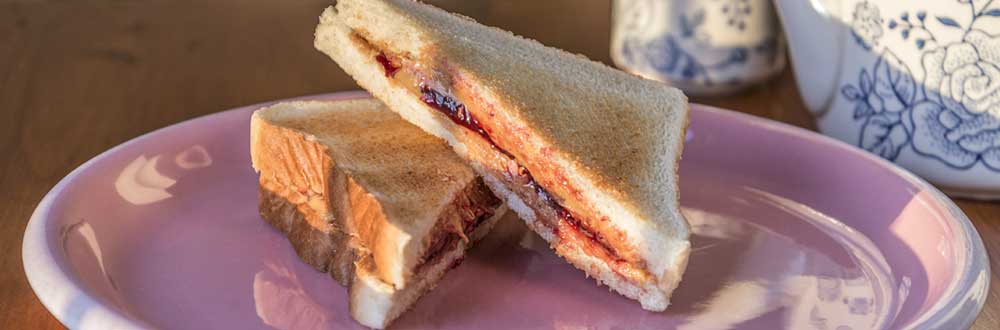
A New York City listener recalls that as a youth in Erie, Pennsylvania, he and his peers referred to a peanut butter and jelly sandwich as a choke-and-slide or choke-n-slide. It’s a reference to the qualities of the sticky peanut butter and the slippery jelly. The colloquial names of some other foods also refer to how they make their way down the throat, including gap-and-swallow and slick-and-go-down or slip-go-down. Other foods named for action associated with them are saltimbocca, literally “jump into the mouth,” and tiramisu, from Italian for “pick me up!”
Too Yet
A woman who grew up in south central Minnesota grew up using the phrase too yet, which can have various meanings at the end of a sentence, usually with some negative sense. An article by Peter Veltman in American Speech suggests that the tag too yet used this way is a calque from Dutch.
Polar Words
A conversation with a leading expert on polar bears has Martha thinking about several bear-related words, including the term arctic and the feminine name Ursula.
Baldy Sour
In the 1940’s, kids might tease a playmate who got a short haircut by calling them “baldy sour.”
Another Think Coming vs. Another Thing Coming
A man in Bowling Green, Kentucky wonders: is the correct phrase “you have another thing coming“? Or is it “another think coming“?
Tragomaschalia
The medical term tragomaschalia means “smelly armpit sweat,” and derives from Greek words that mean “goat armpit.”
Bada Boom, Bada Bing
A woman from Abilene, Texas, is preparing to make a move to the US northeast, and was amused when a realtor in her new hometown used the phrase “bada boom, bada bing,” a phrase she’d heard only in movies. It’s possible that this term is older than the 1960’s, although so far no such record has been found.
This episode is hosted by Martha Barnette and Grant Barrett, and produced by Stefanie Levine.
Photo by Matias Garabedian. Used under a Creative Commons license.
Music Used in the Episode
| Title | Artist | Album | Label |
|---|---|---|---|
| After You Done It | James Brown | Ain’t It Funky | King Records |
| Why Am I Treated So Bad | James Brown | The Popcorn | King Records |
| Move Move Move | Alan Parker, Alan Hackshaw | Music For A Young Generation | KPM Music |
| Soul Pride | James Brown | The Popcorn | King Records |
| Girl At The Top | Alan Parker, Alan Hackshaw | KPM Music | KPM Music |
| Who Knows | Beau Dollar | Who Knows 7″ | King Records |
| Volcano Vapes | Sure Fire Soul Ensemble | Out On The Coast | Colemine Records |
