

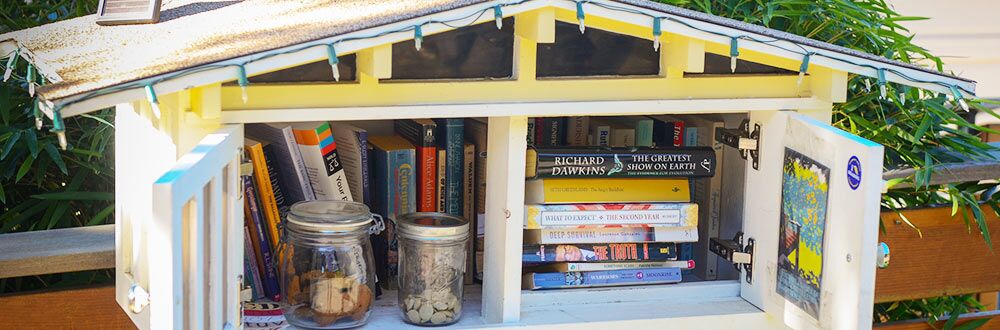
Books for sale, books for free, and wisdom passed down through the ages. Libraries aren’t just repositories for books — they’re often a great place to find gently used volumes for sale. Or you can always visit a “little free library” — a neighborhood spot dedicated to recycling your own books, and picking up new ones for free. Plus: “When two elephants fight, it’s the grass that suffers” — weighty proverbs from East Africa. Finally, the United States and the UK are separated by more than a common language: the way we talk about numbers is also surprisingly different, depending on which side of the pond you’re on. Also: “I don’t know him from Adam,” stargazy pie, “my dogs are barking,” and cheiloproclitic. Ruminate on that!
This episode first aired July 12, 2016. It was rebroadcast the weekend of April 17, 2017.
Transcript of “Punch List (episode #1451)”
You’re listening to A Way with Words, the show about language and how we use it. I’m Grant Barrett.
And I’m Martha Barnette. I saw the most amazing play the other day.
Oh, yeah?
It was called Our Lady of Kabeho.
Kabeho.
Kabeho, which is in Rwanda. And it’s based on the true story that takes place in the 1980s of these girls at a Catholic boarding school there in the town of Kabeho. They start having visions of the Virgin Mary, and eventually they become local celebrities.
And they start having these darker visions, and they could be interpreted to have been a premonition of the genocide in 1994.
And I have to say, Grant, the play itself is thrilling.
It’s astonishing.
It’s gorgeous, as was the production here at Moxie Theater in San Diego.
It just ended its run.
And the playwright, Katori Hall, spent a lot of time in Rwanda researching the play.
And I bring it up because there are several times in the play, Our Lady of Cabejo, where the characters speak in Proverbs.
And that reminded me of discussions we’ve had here before about how in a lot of cultures, Proverbs are much more woven into the fabric of everyday conversation.
And so I got a copy of the script and I wanted to share a couple of the Proverbs there that I really like.
A lot of them in the play are about power.
And this one goes, a flea can bother a lion, but a lion cannot bother a flea.
A flea can bother a lion, but a lion cannot bother a flea.
That’s a good one.
Yeah, something that’s small can be really irritating to something much larger, but not necessarily the other way around.
And then the other one that I really liked was, when two elephants fight, it is the grass that suffers.
Oh, I’ve heard that one before, yeah.
Yeah, isn’t that a good one?
The bystanders, there’s always, right, the bystanders get affected.
Right, or the poor in the middle of all this other conflict.
So I’ve collected some more East African Proverbs, and I’ll share them later in the show.
Very good.
Well, you’re listening to a show about words and language and communication and speaking and writing.
Give us a call, 877-929-9673.
Email us, words@waywordradio.org, or talk to us on Twitter @wayword.
Hello, you have A Way with Words.
Hello, this is Kirby Schmidt calling.
I am calling from Deer River, Minnesota.
Well, welcome to the show.
What’s going on, Kirby?
Well, I am a high school agriculture science and FFA advisor in Deer River.
Nice.
And in my topic of agriculture and myself growing up on a farm, one specific word that’s always come up is the word ruminate.
And a ruminant is specifically an animal that has a four-chambered stomach, like deer, cattle, sheep, goats.
And they chew on a cut. And when I’m working with my students in class, instead of saying, hey, I want you guys to think about this one for a while, I instead say, I want you to ruminate on this.
Or I’ve been in conversations with people, and they’ve asked me something. I said, can I ruminate on that one for a little bit? And I’m just curious if there’s anyone else out there that uses ruminate like this, or if it’s a word that’s just specific to the ag industry.
So, yeah, that’s the word I’m kind of curious about.
So when you say that you’re going to ruminate, you don’t mean you’re going to bring up breakfast and re-chew it.
No, although sometimes I kind of feel like I want to.
But, no, it’s just like an animal spits up its food.
I, myself, it’s like I need to eat, like I’m such a deep thinker.
And I’ve had some people tell me, like, are you okay?
Because you look really concerned about something.
Like, no, I’m just really, like, mulling over this.
Like, I’m ruminating on my ideas.
And so I’ve got to think about it, and then I’ll spit up my ideas later.
Okay, you’re a very literal guy.
But, you know, the truth is that plenty of people outside the agricultural world use the word ruminate to mean to think about something.
I mean, maybe they don’t have quite that sharp an image or picturesque an image as you have.
Actually, in English, it seems that ruminate has meant to think over for hundreds of years.
In fact, the citations that we have for it come before citations for ruminate used for chewing in animals.
And I think that probably the reason is that if you go all the way back to the Latin, ruminatio, already in ancient Rome, the term is referring to either chewing cud literally or turning something over in your mind again and again.
Interesting.
Yeah, right?
So even before English, it had the two meanings.
Yes.
Well before, centuries.
That’s so cool.
The truth is cattle do look thoughtful when they’re chewing their cud, right?
They’re staring off in the distance like they’re considering their prospects.
That’s how I look when I eat.
You know, it’s interesting.
I think a word that’s maybe gone a little bit farther from its roots that’s sort of got the same sense is the word browse.
Oh, yeah.
Yeah.
In English, originally, we talked about browse, meaning a cow going from bush to bush eating something or an animal going from bush to bush.
But then that’s become more abstract, and we don’t really associate those two together at all now.
Shakespeare used it that way, talking about sheep browsing the ivy.
But we don’t talk about browsing.
So the figurative use became the new literal use.
That’s what I’m trying to say.
And the old literal use fell away.
Exactly.
That’s what I’m trying to say.
Cattle browsing the fields.
Yeah.
Yeah, because we define, like, we’ve got browsers and grazers, and goats are primarily a browser because they’re going along to trees and they’re biting off branches, and they’ll eat more, like, sticky, more deciduous, more woody plants versus a grazer.
Like, cattle and sheep are going to be more particular to eating grasses themselves and aren’t going to be chomping on and ruminating on shrubs and bushes.
Yes, and isn’t that crazy?
Now we have internet browsers, and we don’t even think about animals going bush to bush.
So ruminate on that, Kirby.
I definitely will.
Thank you so much for your call.
Thank you, Kirby.
Yeah, have a great day.
Okay, thanks. Bye-bye.
Thanks.
This show is about words and language and what you do with them.
Email words@waywordradio.org.
Try us on Twitter @wayword.
Here’s an East African proverb I really like.
Two lions cannot rule one valley.
Isn’t that the truth?
Yeah.
Two big shots.
You can have two leaders, right?
Right.
Two egos chafing against each other.
Or as I like to put it, a throne is sized for just one butt.
Which isn’t necessarily true, actually.
They’re quite large, some of them, right?
You could fit a couple kids alongside.
-huh.
-huh.
Is that an actual proverb?
No, no, I just made it up.
Or does that come from the country of Grant Barrett’s brain?
Yes, that’s right.
I like it.
The strange nation.
Strange nation.
Not a strange notion.
Strange nation.
Hello, you have A Way with Words.
Hi, this is Sylvia calling from Las Vegas.
Hello, Sylvia.
Hi, Sylvia.
Hi, how are you guys today?
All right, what’s up?
What’s on your mind?
So, a while back, I was at work, and I was having a conversation with one of my co-workers.
And we were talking about another person, not poorly or anything, but we were discussing another person.
And I used the phrase, well, I don’t know him from Adam.
And my coworker looked at me and she just said, who’s Adam?
And so I had to explain the whole idiom to her and everything.
And then it did make me kind of wonder, who is Adam?
And if you’re talking about a female, do you still use the name Adam?
Good question.
Wait, so she never heard the idiom?
No.
English is not her first language.
Okay.
Very good.
What is her first language?
Her first language is Russian.
Russian.
Okay.
I find myself explaining a lot of idioms.
I’ll bet.
I’ll bet that’s very cool, right?
Yeah, that’s nice of you.
That’s really generous.
Yeah.
I’m going to help the people who need it.
What makes you interested in idioms?
How do you know so much about it that you can explain them to a foreign language speaker?
Well, my father was a writer, a journalist, and a radio man himself.
And so language was kind of a big thing in our house.
And so I got exposed to a lot of phrases.
Oh, okay.
A radio journalist.
Anybody we know?
Yes.
In fact, yes.
He actually called into your show about six years ago.
Oh, awesome.
Yeah.
What’s his name?
His name was Alex Burton.
Oh.
And he was the founder and one-time full member of the Society for the Protection of the Definite Article.
That’s right.
He called us about the use of yee, as in, like, yee only.
I remember him.
Yeah, he’s pretty famous in Dallas, right?
Am I hearing past tense here?
Yes.
Unfortunately, he died about four years ago.
Oh, I’m sorry.
But the funny thing about his call-in was that that program aired the day before my wedding.
Oh, my goodness.
When I discovered that, it just made it a little more sentimental for me.
Yeah.
Oh, that’s really sweet.
That is really sweet.
Yeah.
But it was great hearing him because it was definitely my dad.
He was one to pontificate.
Oh, that’s right.
When it sounds like he’s passed on the language interest, which is a real plus.
Right.
Yes.
I remember.
He was delightful.
Well, it’s great to meet you, Sylvia, over the phone.
And Adam, I mean, I’m assuming that you have a pretty good guess about which Adam it is.
Well, my first guess was Adam from Adam and Eve, which made me wonder if you’re talking about a female, would you use the word Eve?
Right.
Or the name Eve?
Right.
Right.
And that is correct.
You’re talking about if you had two people side by side, you wouldn’t be able to recognize the person, even if you were comparing that person to somebody who is so remote, so far back in human tradition, that you wouldn’t recognize either Adam or that person.
That expression has been around since the 18th century, as I recall, Grant.
And it’s applied to women far less.
I don’t know her from Adam, but because because it’s become sort of a stock phrase, such a cliche that people don’t really analyze it that much.
But sometimes when somebody says that about a woman, I wouldn’t recognize, you know, I wouldn’t know her from Adam.
Then, then you know, they might jokingly add or Eve.
Right. But it’s not. They don’t usually start with Eve.
Right. Right. It’s an afterthought.
So you can use either either one and the idea comes across.
Yeah.
Yeah, exactly.
I don’t know her from Adam is what you’re going to hear first.
Yeah.
Okay.
I mean, that’s really, they don’t have a resemblance at all, you know?
The guy with the fig leaf and that one.
I mean, you don’t know her at all.
In the Judeo-Christian tradition, Adam may be the one name that you can bring up that everyone has heard of, right?
Right.
Right.
Yeah, more so than a bed and a go, probably.
Well, Sylvia, it’s a delight to talk with you.
Oh, it was wonderful getting to speak with you and carry on the tradition.
Thank you so much, guys.
Bye-bye.
Okay, thanks, Sylvia.
Bye-bye.
Have a good one.
We know that language interest is intergenerational,
And we know that you sit at the table or on the couch or in the car
And you talk with your family about things, funny things, language things.
Share those with us.
We’d love to hear about them.
Email words@waywordradio.org.
Here’s a proverb from Nigeria.
Tomorrow is pregnant.
Who knows what it will deliver?
That’s great.
It’s true.
I took it as things may seem really grim right now,
But you just never know what’s going to happen tomorrow.
There will be new opportunities.
Yeah.
New things happening tomorrow.
When you wake up in the morning, you have no idea how that day is going to go.
Man, you don’t.
Definitely.
Email words@waywordradio.org.
You’re listening to A Way with Words, the show about language and how we use it.
I’m Martha Barnette.
And I’m Grant Barrett, and here he is, our quiz guy, John Chaneski.
Hi, John.
Oh, hey, Grant.
Hey, Martha.
Look, it looks like you’re intruding on my family reunion.
Oh, sorry.
Look, if you guys don’t want to get thrown out of the place, we better pass you off as family.
Oh, okay, sure.
Look, we’ll say you’re my cousins, but in order to really sell it, you’ll have to greet my aunties, okay?
They’re really, really quirky.
Here’s one now.
Hello, dear.
I work at the company that makes Rolaids.
Oh, yeah, that’s right.
This is my…
Anti-acid?
Anti-acid, right.
I’ll tell you what.
Here’s what we’ll do.
Let’s eavesdrop on my aunts and my aunties.
We’ll overhear information about them, and then you’ll have to greet them by name or the jig is up.
Okay.
Oh, boy.
All right.
Here we go.
Oh, Cousin Grant, Cousin Martha, look who’s here.
I just got back from a six-month stay at a research station at the South Pole.
Well, nice to see you, Antarctica.
Yes, very good. Nice to see you, too.
I’ve just published an article in a journal about the U.S. before the Civil War.
Congratulations, Antebellum.
You’re looking great.
Thank you.
I worked in Alexander Fleming’s laboratory when he discovered penicillin in 1928.
Antibiotic. How nice to see you.
To see you?
What’s the matter, dearies? You look ill.
Have you been poisoned? No worries. I have just the thing right here in my purse.
Antidote. Thank you.
You’re welcome.
Oh, you look so cold, dears.
Here, put on this sweater or you’ll get frostbite.
Auntie, freeze. This is a beautiful sweater.
Thank you. You’re welcome. I made it myself.
Hi, I’m back, guys. It’s me.
I’ve just found a purse here, and I’m wondering who it belongs to.
I’ve looked inside, and there are some photos of an archipelago in the Caribbean.
I think it’s my…
Oh, it belongs to Antilles over there.
It’s my Antilles. Yes, thank you.
I’ll bring it back to her right away.
Oh, dear, I don’t want you to get your hair oil on the back of that chair.
Here, use this doily.
Thank you, Auntie Macassar.
You’re welcome, dear.
Ciao, cuginos.
Here, let’s have an appetizer of soppressate and olives and pepperoni and mushrooms and cheese.
And the pasta.
Very nice.
You must visit my shop.
I buy, sell, and collect old and rare books and other objects.
Antique, you’re looking great, as always.
Well, I’m mostly known as antiquarian around the shop, but that’s fine.
Antique, my nickname is antique.
And finally, oh, here comes the last one.
Oh, yes, I’m in Belgium now.
I live in a beautiful port city on the River Scheldt.
Antwerp, what’s going on?
Hi, very good.
Okay, guys, that’s all of them.
Now, I was going to introduce you to my auntie social, but she’s actually sort of annoying.
I’ll have to see you next year at the next reunion.
Thanks, John.
We’ll talk to you next week.
John.
See you next week.
Bye.
Bye-bye.
This is a show about words and language and a little bit of goofing off.
Emails words at wewordradio.org.
Hi, you have A Way with Words.
Ahoy, this is Jim Markley from Coeur d’Alene, Idaho.
Ahoy, sailor. How are you doing?
I’m doing great.
Welcome to the show. What’s up?
Well, I have a question.
I’m an engineer, and when you’re doing big public works projects,
Big engineering projects, at the end of the project,
There’s a list made of the final things that have to happen
Until the project’s completed.
It’s called the punch list.
And it doesn’t make a lot of sense to me why it’s called a punch list.
I’m hoping you know.
So at the end of a project, you’ve got a bunch of things left to do.
In my experience, a punch list is a corrective list.
It’s the things that aren’t quite right, like you’re doing a home renovation
And you’re working with the contractor.
You’re like, look, the baseboard isn’t flush here, or that wall’s the wrong color,
Or you forgot to put an outlet on that wall.
Is that how it works in the engineering field?
No, it’s corrective stuff and things that just aren’t finished.
Okay, gotcha.
It’s the last details.
Towards the end of the project, the contractor will say,
You know, I need my punch list, I need my punch list.
And when it’s down to its manageable size,
The inspector will say okay,
And they’ll sit down and write out every single thing that needs to be done
And give it to them in writing.
In writing.
And it’s kind of a checklist.
Right.
When you do these things, it’s time to get paid.
That’s very interesting to me.
I guess I’ve been using it wrong all these years.
Well, or differently.
Yeah, differently.
The engineering usage.
I mean, the home reno usage that I know is always corrective.
It’s not usually like the unfinished stuff.
Or if it is unfinished stuff, it’s because that’s a corrective where they forgot to do it, and that’s why it’s unfinished.
Not because they just haven’t gotten to it yet.
Yeah, I guess I and other people I talk with use it just as a to-do list.
Just kind of generalize.
I can see generalizing that.
Like, oh, we have this problem.
Let’s put together a punch list.
And in some ways, it’s like, I just want to punch it because I have all these things to do.
Well, that’s interesting.
Is it?
Because Jim and Martha, I did an entry for this in my old dictionary website in 2004 in the double-tongued dictionary that I used to keep and has now been merged with the radio show website.
But at the time, I did some digging in it and wasn’t really happy with what I found.
I’ve looked into it since.
And it turns out that you can find some uses of this term as far back as the 1930s and 1940s.
It’s almost always a list of to-dos generally.
Sometimes it’s a list of things that need to be remedied, like I was saying, a corrective list.
But there are two prevailing theories about why it’s called a punch list.
And this is the part where you wanting to punch the list comes into play here.
The first theory, which what it’s worth, suggests that apparently at some point there’s a tradition or habit of marking a page of things to do when they were done by hole punching them.
So you have a list of things and you hole punch next to the things that are finished.
Now, why there’d be a hole punch on a construction site or an engineering site, I don’t know.
It’s not really standard fare.
There have been various cases in the legal world where you punch pages in a certain way to show that they belong together,
Or that you can match up the holes and da-da-da, or maybe even do like the notary,
Which is kind of a form of punching and different things like that, maybe.
The theory that I like more, even though there’s also no evidence for this,
Is that instead of checking, you actually put a hole in the page with your pen next to the item to show it’s done.
That way you’re not crossing it through to making it illegible, but you are indicating purposely that I’m putting a hole next to this thing because it is finished.
Oh, I just meant I want to punch it because it exists.
Oh, I see.
I’ve got all this work to do.
You can just throw it.
You know, if it’s your list, you can just throw it out.
Well, those are much better theories than the ones that I have.
What’s your theory?
Well, and I have no evidence at all, but I was wondering if it tied into like a time clock that you punch out.
Oh, that’s interesting.
So you put it in the machine to put a stamp it with a date and time, and that’s it.
Well, no, I was just thinking of a parallel.
Oh, I see.
You’re punching out of the project like you would a time clock.
Oh.
There are also—
Oh, I like it.
It doesn’t have any evidence either, but I like it.
None of these really matter, but there’s a theory that I’ve come up with for what it’s worth,
And I’ve seen this on some larger construction sites.
When I was involved in information technology, we often managed facilities,
And at least once we had to like renovate like four or five floors.
And so the IT department was involved in wiring and directly involved in various facilities things.
And I would see these contractors walking around with these big fat clipboards.
And they have like the big arching metal loops on the top of it that you kind of pull them apart.
And there’s a real chunking sound that they make when you close those things, a real kind of chunk.
And it’s like a punch, you know.
And I don’t know.
I was imagining that maybe you had a page that was a list of to-dos that didn’t have the holes pre-punched.
And you just kind of force it with this big, sturdy clipboard.
And we’re talking like it looks like a catalog.
He’s got everything on this clipboard.
And it’s like a big upside-down U-shaped kind of metal, what would you call those, binder rings, basically.
Is this familiar to you? Do you have those on your worksites?
I’ve seen those, but not on worksites.
Okay.
Is this a national term or is it regional?
It’s national, yeah.
It’s widely used and it has been used in the construction world for, like I said, at least the 1930s.
That’s fascinating.
And Martha’s usage is very much conforms to the everyday usage for a lot of people, which is it’s like it’s not necessarily just your to-dos, but it’s like your high priority to-dos.
Like, you know, you need to go pick the kid up from school.
That’s on the punch list, but maybe the laundry can wait.
Yeah, I have a sense when I make a punch list that it’s things that I want to have happen in rapid succession.
You know, almost like Muhammad Ali, right punch, left punch.
So it’s your combination.
It’s your footwork and your punching.
Floating like a butterfly, stinging like a bee.
So, Jim, I think we have like seven theories without evidence.
I think this may be a record on our show.
I like them.
It’s a good collection of possibilities.
Well, thank you very much.
That’s a nice way to put it, a good collection of possibilities.
There are other words for that kind of malarkey, but we won’t say those on the air.
Jim, thank you so much for your call.
Really appreciate it.
Thank you. That was a lot of fun.
Yeah, take care.
All right. Thanks, Jim. Bye-bye.
All right. Bye-bye.
Call us, 877-929-9673, or send your emails to words@waywordradio.org.
And you can also join our active group on Facebook.
Hello, you have A Way with Words.
Hi, this is Alice calling from Tampa.
Hi, Alice from Tampa. How are you doing?
Very well, thank you.
What you got on your mind?
So I was listening to a podcast the other day, and it was a rebroadcast from an earlier episode.
And the person that was speaking, it was a much older episode, I think it was from 2003,
The person who was speaking has since passed away.
And as I was listening to his voice and listening to him talk, I had a kind of feeling of loss,
Kind of mixed with like a feeling of knowing that he wasn’t going to be doing this much longer
Because, you know, it’s many years later and he’s passed on in the interim.
And I was wondering if there was a word for that feeling, that feeling that you have like a sense of loss and also
Just like the sense of knowing, kind of how we have like deja vu for things that we feel like we’ve seen before.
So you haven’t come up with any candidates?
I haven’t.
I mean, there’s I think it’s on Tumblr, I think it’s called Other Wordly,
And they have all these different words,
And you can kind of search by meaning for words that come from other languages
That we don’t necessarily have in English.
And I can’t think of something that kind of pinpoints that knowing
And the loss at the same time.
So to recap, you heard a voice of someone that you knew was dead.
At the time they recorded it, they had no idea what was coming.
But now you’re listening after they’ve died, and you know what happened to them.
And you’re having strong emotions about that.
Right.
Exactly.
Yeah.
And you said they had no idea that they were going to die that soon?
No.
No, yeah, they didn’t.
And it was odd because he was doing a piece on something completely unrelated.
And he kind of mentioned, I think it was about fasting, and he mentioned, he’s like,
Hey, does David have cancer?
And that’s what he died from.
So it was very, very weird and surreal.
Yeah.
I mean, immediately I come up with the word foreboding,
But that’s not quite right.
All the words that I can come up with,
They all kind of suggest that you don’t really know,
But you suspect or you feel
Or you have some kind of extrasensory perception.
Foreboding.
Presentiment is another one.
Pre-sentiment.
A feeling that something bad is going to happen.
But the thing is, what you’re feeling has already happened.
Right.
Boating alone might work.
It’s an omen, especially of evil.
Okay.
Portentious, maybe?
But it also has to do with a portent or something.
All of these have to do with foreboding.
And you could just hear it in the name.
The fore part means that you know in advance.
And you kind of do, but it’s the time shifting that’s causing the problems here, right?
It is.
It is.
It’s completely time-bound.
Like, if I had heard it in 2003 before he died, I wouldn’t have had the feeling like, oh, my God, something terrible is going to happen to him.
It’s only many years later knowing that, you know, it’s kind of like when you see an actor in their last movie.
Right.
Yeah.
And they don’t know that it’s their last movie.
Yeah.
So it’s a kind of…
But by the time it’s released, you know it.
Yeah.
Yeah.
I mean, something with Philip Seymour Hoffman or something.
Oh, yeah.
Or in my family, we watched some Buster Keaton recently, which is still really hilarious.
And my son’s like, there’s a dog and he’s like, is that dog dead?
I’m like, that dog is dead.
I said, probably everyone in this movie, everyone on screen and off is probably dead.
Yeah.
Yeah.
So it’s a kind of sad anticipation, I guess.
Yeah.
You know, for some reason, I’m also being reminded of that interview that Terry Gross did with Maurice Sendak toward the end of his life.
I mean, he didn’t know, he knew that he was elderly and going to die, but not when.
But that was a real, that was one of those driveway moments.
Maybe we need a word for that.
I’m thinking that, you know, there’s the word prognosis from Greek words that mean to know before.
What about postgnosis?
Postgnosis.
Or something alga, you know, like nostalgia.
Right.
Postalgia or something.
I don’t know.
I don’t know that we have a specific word for it.
It’s interesting because the richness of English suggests to me that I just haven’t looked hard enough.
And yet we do find that English doesn’t provide a word that we want.
Yeah.
Yeah.
Well, I wonder if our listeners could.
Yeah.
I’d be interested in the word that already exists rather than a new coinage.
This is one of those things where the jokey portmanteau isn’t going to work.
Not that yours were jokey.
No, but yeah.
Yeah.
They’re inadequate.
Or maybe something in another language.
Yeah.
Yeah.
That’s very good.
Another language. What is the saddest language we know? Portuguese. Yeah, I was just going to say that.
I’ll have to quickly browse the lyrics for these sad Portuguese songs. Let’s browse them.
Well, Alice, we’re going to put this call out to the listeners and see if they can provide a word for this where you know something has happened to the person that you’re seeing or listening to, but at the time that they were recording the thing, they didn’t know that it was going to happen to them, right? Something, they were going to die.
Yes, exactly.
Well, thanks so much for the question. We’ll keep pondering it.
Thanks, Alice.
Thank you so much. Love the show. Thank you, guys.
Thank you. Take care now.
Thanks, Alice. Bye-bye.
Bye-bye.
If you have a suggestion for Alice, let us know, 877-929-9673. Send it an email to words@waywordradio.org, or throw it up on the Facebook group. You just look for A Way With Words, and you’ll find us and thousands of other people talking about language.
Hello, you have A Way with Words.
Hi, my name is Margaret Petriez.
I’m calling from Greendale, Wisconsin.
Hey, Margaret.
And I’m originally from Alabama.
My husband’s from Minnesota.
And he swears I keep coming up with new phrases that he’s never heard after 26 years.
So the latest one, and I tried to look it up and couldn’t find anything, was called, was smell the patching.
To me, it means when somebody is going to think they’re going to come home, you know, like if you’ve done something bad, it’s going to catch up with you.
But I couldn’t find anything online about that.
Smell the patching, and it means that you’ve done something wrong and it will catch up with you.
Amit, are you a Civil War buff or a reenactor, or do you watch the military movies or documentaries or anything like that?
I do not so much, but if you grow up in Alabama, you hear a lot about the Civil War.
Yeah, where in Alabama?
Yeah, where?
Gaston, Alabama.
Okay.
Gaston, all right.
The reason I ask is it doesn’t particularly date to the Civil War, but it certainly shows up in a lot of Civil War writing.
I have uses of it dating back to one of Davy Crockett’s books from 1835, and it’s probably older than that.
And the patching apparently was the cloth that you would use when you loaded up certain kinds of weapons with gunpowder.
It’s literally the cloth you might also use for patching clothing, and you shove it in there with the ball and the powder and stuff.
And so if you are close enough to smell the patching, you are near the fight.
You are near where the aggression is taking place, where the explosions are going on and people are getting hurt.
And so it has generalized over the years to move away from meaning, you know, he could smell the patching.
I mean, he was right there on the scene of the battle to meaning he could smell the patching, which he was right there in a place of big risk, a place where trouble could happen.
And so I’m pretty sure that’s the same smell of the patching that you have.
I would be pretty sure it would be just because of the Civil War connection, because when you grow up in Alabama, like I said, you hear a lot about the Civil War.
It sounds like it just happened, you know, two weeks ago or something sometimes.
Right.
That’s very interesting.
Yeah, that’s the thing about the Civil War.
Its history is close enough to us that we can talk about family that were in it.
We can talk about places that are still there.
We can talk. It’s like it’s not like the Revolutionary War where it’s far more distant and you’re and people don’t even look like you or maybe not even carry your own name.
And Margaret, how did you use it with your husband?
You know, I was trying to remember it came up that maybe with something to do with the politics of today.
And, you know, someone had done something. I said, if he’s not careful, he’s going to smell the patching, meaning these things are going to catch up with him.
You can just go so far. So I think it was in that context.
But it’s really funny because he swears that even after all these years, I still come up with something new all the time.
That’s great. It keeps your marriage interesting, right?
It really does. It does.
And he comes up with things, too, since he’s from Minnesota.
That’s a whole different language.
That’s a whole different country, right?
Yes.
Thank you very much for your call, Margaret.
Thank you so much.
Take care now. Bye-bye.
Bye-bye.
877-929-9673, or send your observations about language and regional dialects and language stories to words@waywordradio.org.
More conversation about what we say and why we say it as A Way with Words continues.
You’re listening to A Way with Words, the show about language and how we use it.
I’m Martha Barnette.
And I’m Grant Barrett.
You know, my house is one of those bookish houses, right?
Oh, what a surprise.
There are books everywhere.
You’ve come over for my son’s birthday and some other things.
My wife, my son, and I are all always reading something.
Yeah, it’s like those books are breeding in there or something.
And when you have three readers in the house, you go to the library a lot, right?
You get books at thrift stores, too.
And you go to the used bookstores also.
And you go to the independent bookstores.
And sometimes you even go to the chains, although you like to support the little guys, right?
Right.
My favorite way to get books, though, is the book sale at the library.
They take their withdrawn books.
They take books that have been donated.
They sell them for a quarter or 50 cents.
I can come home with stacks of books.
And I do, 12, 15, 20 books, more books than I can carry, multiple trips.
And it’s like $15, $11.
It’s always a tiny amount of money.
And then the book goes back to the friends of the library organization.
And they support the library in that way.
And I feel like I’m doing two good deeds, right?
Yeah.
On one hand, I’m getting books to read.
On the other hand, I’m supporting the library.
And you’re supporting bookshelf makers.
Well, that’s the problem. I’ve begun to worry about all these books in my house.
They say that Southern California is due for an earthquake, and my bookshelves are not anchored to the wall.
And they’re layers deep.
We’re not talking about one row of books. We’re talking about two or three, and they’re crammed in horizontally.
And I haven’t got to the point where books are on the floor. I at least have that bit of house pride.
But ultimately, the best solution that we found was the little free libraries. You know about these.
Sure. The little cute little libraries just there on the street.
Yeah. And if people don’t know what the little free libraries are, let me tell you, they’re the wonderful, cute little.
They look like mailboxes, except they look like little houses.
Some of them look like barns or they have glass fronts.
They look like china cabinets. Sometimes they’re made of stone or house siding.
They’re adorable. And they’re usually in somebody’s yard next to the sidewalk, next to the road.
And the whole point of it is, is that somebody puts their books out for you to take.
No charge, no cost. Hopefully you will bring some of your own books.
Maybe it’s a little bit of the leave one, take one.
Or in my case, the take nothing, leave 400.
Because what we did over the past couple months, we have been to little free libraries throughout San Diego.
And there are hundreds of them here.
And we’ve been shoving books into these to reduce the number of books that are in my house.
And I just love the idea that my books, the spy thrillers or the language texts that I have more than one copy of,
Or the thing that somebody gave me that wasn’t quite right for me,
Or the picture books that my son has outgrown.
I love the idea that these books now have a new life
In somebody else’s house and somebody else’s hands
And somebody else’s family.
In any case, my house is a little safer now.
A little slimmer.
A little slimmer.
I still haven’t anchored the bookshelves to the wall yet.
I will do that.
But I would like to point out their website
For the Little Free Libraries is littlefreelibraries.org.
And you can go there and they have a map.
You can type in your address
And it’ll show you all the Little Free Libraries near you.
Oh, I didn’t know that.
Yeah.
Oh, because I’ve seen some just driving along.
It sounds like you need to build one of your own, like a little McMansion library outside your house.
I was thinking I want to attach to the car.
So wherever I go, there’s a library.
Not quite a library mobile, a book mobile, but something like that.
That would be a trailer.
Maybe you could buy a van.
That’s ridiculous.
Yeah, I need to get a semi, I think.
In any case, the website for Little Free Libraries is littlefreelibrary.org.
Type in your address, look up the map, find a Little Free Library near you, leave a book, take a book,
But provide your community with more reading matter.
Hello, you have A Way with Words.
Hello, Grant.
Yeah, who’s this?
My name is Marv. I’m calling from Hartford, Connecticut.
Hi, Marv. How you doing?
Hey, Marv.
I’m all right. Hey, Martha. How you guys doing?
Doing well.
Good enough. Good enough. What can we help you with?
I had a question about probably about three years ago I was listening to the show,
And you had said a word, chiroprocliptic or chyloprocliptic.
I’m not really sure what the spelling was.
And I tried to investigate further on the Internet,
But I didn’t know the proper spelling, and there was no words that were actually kind of like it.
And that’s like, I know, like I tell people, that’s my favorite word,
And I don’t even know how to spell it because it was such a short, you know what I mean?
Like, I couldn’t really figure out the spelling or anything else,
So I just wanted to call and ask you, like, what the proper spelling is
And if that’s, like, indeed, like, the right definition for this word.
And, Marv, what does it mean?
An erotic attraction to lips is what I remember you guys telling.
An erotic…
Speaking. Okay. Yeah. That’s an important word to know, I guess, huh?
Well, I mean, I have,
You know, an erotic attraction to lips. That’s why I took to the word so much. Like, you know,
It’s like, I love a beautiful face, you know? So you want to tell somebody that you’re,
That you’re that word, an appreciator of lips.
Yeah. It’s just like a cool, a cool word to know,
You know, I don’t know if I’d use it in a sentence, but I know I’d be, you know,
There’s a word for that.
Oh, what’s the word?
Oh, chiroprocliptic, chiroprocliptic. You know what
I mean, like, I just rather have it in my Rolodex, you know?
Yes, you’re very, very close to what the word is.
And I will tell you what it is now, all right?
Thank you.
The word is chyloproclytic, and I will spell it.
Okay.
Yeah, it’s C-H-E-I-L-O-P-R-O-C-L-I-T-I-C.
Chyloproclytic.
Wow.
Okay.
And as you said, it means an erotic attraction to lips.
And it’s a word that you really don’t find many places.
I mean, as you said, you might not even use it in a sentence.
I mean, usually when you see it, it’s in collections of wacky words.
I’ll give you just a little bit of history on it.
It comes from Greek words that the kylos in Greek means lip.
And proclitic means to lean toward.
It’s related to the word incline.
So, chyloproclitic means having an erotic attraction to lips.
Well, thank you so much.
It definitely made my day, and I definitely love your show.
Keep doing what you’re doing, and I appreciate everything.
Hey, thanks a lot, Mark.
Appreciate the call. Take care now.
All right, you too.
Bye-bye.
All right, bye-bye.
There are a ton of these, though, right?
These words that are fun, they have a cool meaning, but we hardly use them.
Yeah.
They just kind of exist to exist.
Yeah.
I think one that I was surprised to find, you know, I’ve always used the French expression
Jolly led, which means beautiful, ugly. That’s like, let’s say a bulldog, like absolutely ugly,
But just adorable as all get out. Or E.T.
Yeah, E.T. Great. Yeah. And there’s a word for that,
Another word for that.
There is?
Yeah. It’s caca-calia. So the caca part, you probably
Remember, right? From bad.
Yeah, from bad. And so that’s actually, even though somebody is ugly,
They are really attractive.
Oh, how do you spell that?
Is it c?
C-A-C-O-C-A-L-L-I-A, cacacolia.
Oh, nice.
Yeah.
Very nice.
And that’s an interesting concept because one of the reasons these words click for us,
And it sounds like that was Marv’s case, it’s because we have the concept in us,
And to find it neatly wrapped up in a word is really appealing.
Oh, it’s always a thrill, right?
Right.
It’s like somebody has been here before me and had those same thoughts and same feelings.
And solves my problem for me before I arrived.
Exactly.
We’re all more connected than we realize.
That’s what this show is about.
All right.
She’s waving her hands, people.
She’s serious.
Email words@waywordradio.org.
Talk to us on Twitter @wayword.
Hello, you have A Way with Words.
Hello, this is Mark Elmer from San Antonio, Texas.
Hey, Mark, welcome to the show.
What’s up?
What can we help with?
So what I wanted to ask y’all guys about is whether or not y’all guys have heard about the differences.
And this is personally relatable to me.
I’m just about finishing out my math degree.
Whether or not you guys have heard about the differences between the way that people from America and from England use numbers.
And so what’s your interest in the British versus American?
Did you run up against this at a conference or something?
Friends and family of mine, particularly my current girlfriend, are actually from the UK.
So it kind of rubs up in that sense.
And also, it’s kind of an interesting thing because I spend my time looking about how people in different countries approach different numbers.
So it’s just something that I have personal interest in.
What did you notice so far?
Interestingly enough, and this is kind of one of those things where culture and language shape each other, American street numbers and British street numbers are very, very different.
So, for example, my address is 423, which is fairly high up in terms of numbers. And it’s because of the way that our road system works, because we have our cities on grids, right? So I live in the 400 block of my street.
Well, in Britain, a lot of these towns and cities predate the way that people set up grid systems. So people have addresses that are more like 1, 2, 3, 4, 5, and the grid system doesn’t actually affect whatever number you get. So it’d be like 5 Drury Lane or something.
Yeah, and it’s actually kind of amusing because I’ve never written an address to someone in America with a single number. Like, I’ve occasionally seen double numbers, like 52 Main Avenue or something like that, but I don’t think I’ve ever seen in my entire life someone with the address 7.
And amusingly enough, smaller addresses are actually, in some cases, they’re desirable. So the address 1 on a street is something that in the UK you can be proud about. So people will pay a lot of money to get the property that corresponds with 1 on a street.
You hear it on the news. Like, there was a shooting last night in the 7200 block of Main Street, right? And then you can actually supposedly figure out exactly where that was just by going counting over, counting down, and knowing roughly where that was.
Now, would a British speaker say the 7200 block? Oh, yeah, that’s another interesting part. Because we would say 7200, but British speakers are more likely to say 7200. I mean, you can even go a little higher than that.
Let’s just talk about the abbreviations for mathematics. The Americans say math and the British say maths. They keep the S from the original plural and we don’t.
Yeah, my friend Justin is a mathematician here in this country, but he’s from Britain. And he says that he’s just stopped saying maths because people misunderstand him all the time. They say maths. What? You’re studying to be a priest? What?
And of course, we’ve got problems with imperial versus metric systems, right? Well, and you talked about arriving at a building. And when you go into the first floor, you’re not really on the first floor.
Oh, yeah, the European system. Yeah. You have to go up a floor to go to the first floor. I learned that when I was in France. It took quite a while to get used to the idea that the first floor wasn’t the ground floor.
Yeah. But we’ve got other things on this as well. The way they say phone numbers, they cluster them in groups of two, right, which we don’t do here. I guess the double one, double two.
Right. Well, not only that, but our phone number for the radio show is 877-929-9673. In the UK, we might be more likely to say 877… We might cluster it a little bit so that you say 96 and 34 and things like that instead of pronouncing each number as an individual word.
Yeah, crazy. By the way, there’s a really great video series on YouTube, which I would highly recommend if you don’t know about it already, called, was it Numero File, I believe? P-H-I-L-E-S?
Oh, Number File? Number Files, yeah. I’m actually subscribed to that channel. Oh, yeah, they have a couple videos on British vs. American. It’s really cool stuff.
Besides the whole thing, it’s like a perfect companion only on the number side to this radio show because they just geek out a little bit about numbers and conflicts over number and histories of numbers and traditions of numbers. It’s funny because I think of math as being so empirical, but there are still all these differences that I didn’t realize.
Yeah, it’s really interesting. You have opened up a can of worms here, Mark. I know we can barely touch this whole topic, but thanks for bringing it up.
Yeah, not a problem. All right. Good luck with the degree. I’m glad to hear you’re finishing, and good luck with grad school.
Thank you very much. You have a great time. All right. Take care. Okay. Bye-bye. Bye-bye.
Call us at 877-929-9673 or send those emails to words@waywordradio.org.
You know, Grant, I could have gone a while longer without knowing what stargazy is. Do you know stargazy? Stargazy? Stargazy pie? Stargazy.
I don’t know what that is. Yeah. Well, you know, like stargazing is when you look up at the star. Stargazy pie is a kind of fish pie that’s traditionally made in Cornwall. And you can look it up on the internet. It’s a fish pie that actually has fish heads sticking out of it.
So the fish heads are gazing at the stars? Yes. Yeah. It’s really kind of creepy looking, but supposedly it’s really savory because the way the fish heads stick out of the pie crust. Those are like sardines or pilchards. You know, the juice kind of trickles down and infuses the pie.
Does like steam come out of their little mouths while it’s baking? No, I don’t know. I don’t know. It was sort of one of those things I wish I could unsee. I’m going to Google this and find out. I’m sure it’s in literature and places.
I would be interested in trying some stargazy pie. You probably would. I would not. It just looks, I guess some people really love it. Yeah. But maybe it’s like other regional dishes where you love it because it’s yours and not because it’s particularly good.
Yes. And we would love to hear from folks about their favorite regional dishes like that. Or whether you’ve had a great experience with stargazy pie. 877-929-9673 or send us an email. That address is words@waywordradio.org.
Hi, you have A Way with Words. Hello. Hello, who is this? Hi, you’re really happy. Hey. Yeah, I’m excited to talk to you guys. My name is William. I’m from Austin, Texas. And I think I got a good one for you guys.
All right, let’s hear it. Lay it out. Okay, so I work in the film industry here. And I was on a set a couple months ago. And it was after a really long day. And we were all chilling out afterwards. And I sat down and I said, oh, man, my dogs are barking. And I started taking my shoes off.
But everyone looked at me like they didn’t know what I was talking about. And I’ve grown up in Texas my whole life, and I’ve said my dog’s barking, which means your feet hurt as far as I know. But I don’t know why that is a phrase or a saying, and I was hoping you guys could shed some light on that.
A little bit. A little bit of light we can shed on dogs. Okay. All right. So we’ve got to separate the two words, the dogs and the barking, because the dogs came first. As early as 1913, dogs were slang for feet. And it actually popped up in the work of a well-known cartoonist called Tad, or T.A. Dorgan, who did cartoons for some New York newspapers.
And he’s got various connections to various etymological histories. He’s apparently widely read and widely appreciated and had a great sense of humor. But the first use that I know of was in one of his cartoons. And then it caught on. It starts to pop up in jazz songs and ragtime songs and again and again and again. And even now, I use it. I used it just last week, much to the mystification of one of my friends.
Did you? Yeah. I know the feeling. Yeah, they put their feet up, and I’m like, oh, I’ve got to arrest those dogs. And they’re like, what? They’re just giving me that blind. Yeah, one guy was like, why are your dogs barking? Like, I don’t actually have dogs. It’s my feet, you guys.
And so after the slang term for dog existed, slang for feet, people made the extra joke of their dogs barking, meaning that they were begging for some attention. Huh. Right? That’s it, man. That is no more complicated than that.
Although I should point out what’s really interesting. It did for a while there. It’s less common now. It also took on the meaning of shoes, not just the feet, but dogs could mean your shoes. Gotcha. Well, I also was wondering, because I’ve grown up in Texas my whole life, so this sounds like it’s all over then.
That’s right.
It’s not just like I’m, you know, some weird.
Well, you may be, but it’s all over also.
Well, Austin is weird, right? And you’re going to keep it that way.
Yeah, we keep it that way.
Okay, awesome.
Well, I’m happy to know that I’m not crazy, and I’ll actually meet you.
All right.
No.
Thanks, William.
Appreciate it.
Get some rest, William.
What are you working on?
What film are you working on, by the way?
You have to tell us.
Oh, well, I have another feature coming up.
It’s going to be a three-week low budget, but that’s all I can say.
I can’t give you any more of that.
Well, when it’s live, send us a link, and we’ll take a look at it, all right?
Well, thank you.
I appreciate the time.
All right.
Cheers.
Good luck.
Bye, William.
Have a good one.
Bye.
Take care.
Or send your emails to words@waywordradio.org.
If you want to get in touch with us really quickly, tweet us at Wayword.
We were talking earlier about the language that’s evolved in loud industrial situations where people are working out some kind of…
Like sawmills and places like that.
Yeah, sawmills, textile mills.
In this one particular textile mill, the word for boss was this pushing motion with the hands.
I just really appreciate that.
Because they’re pushing you to work or because you want to push them into a machine?
I think because they’re pushing you to work.
I’m sure in newsrooms it would be the sign for editor.
Yeah, I could see that.
Want more Way With Words?
Listen to years of past episodes at waywordradio.org.
Or find the show in any podcast app or on iTunes.
Our toll-free line is always open,
So leave us a message at 877-929-9673,
And we’ll take a listen.
We’d love to get your messages at words@waywordradio.org,
Or hit us up on Twitter @wayword,
And look for us on Facebook.
This program would not be possible without you.
Grant and I are out to change the way we listen and think about language,
And you’re making it happen.
Thanks also to senior producer Stefanie Levine, director and editor Tim Felten,
Director Colin Tedeschi, and production assistant Emma Kelman in San Diego.
In New York, we thank quiz guide John Chaneski,
And that master of keeping it real, Paul Ruist at Argo Studios.
A Way with Words is an independent production of Wayword, Inc.
From the Recording Arts Center at Studio West in San Diego, I’m Martha Barnette.
And I’m Grant Barrett.
So long.
Bye-bye.
East African Proverbs
 The stunning play “Our Lady of Kibeho”, set in Rwanda, includes some powerful East African proverbs gathered by playwright Katori Hall, such as “A flea can bother a lion, but a lion cannot bother a flea,” and “When two elephants fight, it is the grass that suffers.”
Origin of Ruminate
A caller from Deer River, Minnesota, has lots of experience raising ruminants and wonders if the word ruminate, as in “to ponder or muse about something” stems from the image of such an animal chewing regurgitated cud. Indeed it does. In classical Latin, the word ruminare could mean either “to chew cud” or “to turn over in one’s mind.” Similarly, the English verb to browse originally referred to the action of an animal feeding on the buds and leaves of trees and bushes.
I Don’t Know Him from Adam
The phrase “I don’t know him from Adam” suggests that if the person were standing next to the person in Western tradition thought to be earliest human being, the two would be indistinguishable. The phrase “I don’t know her from Adam” can be used to refer to a woman who is similarly unrecognizable, but it’s less common. Another variation: “I wouldn’t know him from Adam’s off ox.”
Auntie Word Quiz
Quiz Guy John Chaneski invites us to a party to meet all of his dear “aunties” — as in the “auntie” who makes sure your oily hair doesn’t mess up the furniture.
Etymology of Punch List
Since the 1930’s the term “punch list” has referred to a list of things to do, or a list of problems to fix. Although there are many proposed explanations for the origin of this term, none is definitive.
Postalgia
A caller from Tampa, Florida, talks about the eerie feeling she had when she heard an audio interview recorded with a speaker who at the time was unaware of his imminent death. She’d like a word to describe that feeling. Postalgia, maybe?
Smell the Patching
An Alabama woman says her Minnesota-born husband has never heard an expression she’s used all her life. The phrase is “smell the patching,” as in “If he’s not careful, he’s going to smell the patching.” The idea is that if you do something bad, it will catch up with you. In the early 19th century, patching was the piece of cloth used to tamp down gunpowder in firearms. If you’re close enough to a battle to smell the patching, you’re pretty darn close.
Little Free Libraries
The Little Free Library movement offers a great way to unload some of your old books and discover some ones that someone else has left for the taking.
Cheiloproclitic
A listener in Hartford, Connecticut, is sure he’s heard a word that means “an erotic attraction to lips.” The word is cheiloproclitic, from ancient Greek words that mean “inclined toward lips.” Grant offers a couple of other terms, jolie laide, French for “beautiful ugly,” and cacocallia, from Greek words that mean roughly the same thing.
Numbers: US vs. UK
Those of us in the United States and Britain may be separated by a common language, but we’re also separated when it comes to how we indicate numbers. A Numberphile video featuring linguist Lynne Murphy explains this in more depth.
Stargazy Pie
If you think stargazy pie sounds romantic, you’d better be charmed by egg-and-potato pie with fish heads sticking out of it.
My Dogs are Barking
My dogs are barking means “My feet hurt” or “My feet are tired.” As early as 1913, cartoonist Tad Dorgan was using the term dogs to mean “feet.” If your “dogs” in this sense are “barking,” it’s as if they’re seeking your attention.
Textile Mill Signs
In an earlier episode, we discussed visual signals used in deafening environments such as sawmills. One signal, developed in a textile mill, was holding up both hands, fingertips up and palms out, miming a gesture of pushing. That pushing motion translated to, of course, “The boss,” as in “The boss is coming, so look sharp!”
This episode is hosted by Martha Barnette and Grant Barrett, and produced by Stefanie Levine.
Photo by Franco Folini. Used under a Creative Commons license.
Music Used in the Episode
| Title | Artist | Album | Label |
|---|---|---|---|
| River Niger | War | Platinum Jazz | Island Records |
| The Cisco Kid | War | The World Is A Ghetto | United Artists Records |
| Lady, You Look Good To Me | Galt McDermott | Shapes of Rhythm | Kilmarnock |
| All Day Music | War | All Day Music | United Artists Records |
| Coffee Cold | Galt McDermott | Shapes of Rhythm | Kilmarnock |
| Juntos | El Chicano | Celebration | KAPP Records |
| Viva Tirado | Gerald Wilson | The Best Of The Gerald Wilson Orchestra | World Pacific Jazz |
| Volcano Vapes | Sure Fire Soul Ensemble | Out On The Coast | Colemine Records |

