


Why isn’t “you’re welcome” the default response to “thank you” for everyone? Plus lies that kids tell, Philadelphia lawyer, cowbelly, skutch, mind-bottling vs. mind-boggling, tsundoku, infanticipating, noisy piece of cheese, a word game, and lots more.
This episode first aired March 31, 2018. It was rebroadcast the weekends of February 3, 2020, and March 25, 2023.
Transcript of “Put on the Dog (episode #1494)”
You’re listening to A Way with Words, the show about language and how we use it. I’m Grant Barrett.
And I’m Martha Barnette. It’s not every day that I save a tweet and come back to it again and again.
But I have one from a public service assistant for the Toronto Public Library. Her name is June Hur.
And she tweeted this. At the library, a kid patron came up to me at the desk,
Asked me where she could find more mystery books, said she’d read her first mystery and had loved it
So much. So I led her over to the middle grade mystery series section. She placed a hand over
Her heart and whispered, oh my gosh. She was delighted to find the world had more of what
She wanted from it. Yes. Yes. And I can just relate to that on so many different levels. Just
That moment of realizing what a library contains. I remember very well going to the library and
Realizing you let me check out 12 books at one time so I could actually have enough to read over
The weekend. Check out 12 books on a Friday and you were set till Monday. Right? Yeah. Oh my gosh.
And I feel that way too about doing a show about language. You know, people think, oh, it’s about
Grammar and correcting grammar. No, there’s so much more. It’s about the possibilities of language.
How much there is in this big cabinet. Yes. And all the connections that are hiding right there
In plain sight. We’d like to share those connections with you. Everything in plain
Sight. We’ll reveal it and make it known. 877-929-9673. Email words@waywordradio.org or talk to us on
Twitter @wayword. Hello, you have A Way with Words. Hi, this is Michelle Walker. I’m calling
From Cardiff-by-the-Sea, California. Well, welcome to the show. How can we help you, Michelle?
Well, I was calling about something my grandmother used to say, and she used to say, putting on the
Dog. And it meant like getting like really dressed up, but maybe like just a touch of
Pretentiousness to it.
Putting on the dog.
So like when she was going out dancing or something like that, she might just dress
Up with extra special care?
Yes. Like she put on her like auburn wig and her mink coat and her pearls. But she’d kind
Of say it like a little self-deprecating, like, well, I’m really putting on the dog.
Or if she was talking about maybe one of her peers in some stories, she’d say, oh, well, she just really put on the dog.
So it was like fancy, but maybe like trying too hard.
Yeah, that’s an interesting expression that’s been around since the mid-1800s, about the time of the American Civil War.
What’s really interesting for me is that it used to just be put on dog, not put on the dog, without the article.
Most of the early uses have it that way.
I often put on dog when I go out for the grand review or that sort of thing.
There are a couple prevailing theories about what this dog is doing in this idiom.
One of them, which I like a lot, and I think most word historians think has a little bit of oomph behind it,
Even though we can’t prove it, is that after this American Civil War, lap dogs became a custom.
You know, these tiny, cute things.
So there were a couple kinds of spaniels.
I think one was a Blenheim spaniel and the King Charles spaniels that were known.
I guess we’d call them ladies who lunch today.
But the ladies who would go to all the soirees and go out and looking fine in their pearls and their best wig and their best gown would have these dogs.
So they would accessorize with the dog.
Yeah, accessorize with the beautiful animal, yeah.
Oh my gosh.
The dog was part of making them look fancy.
That’s right, yeah.
So that’s the best possible explanation that we have.
So, yeah, from about the 1860s or so.
Well, thank you so much.
I love that.
That’s really funny.
I actually have a French bulldog, so maybe I’ll carry him around.
Oh, there you go.
I think I’m putting on the dog.
Just drape him around your neck elegantly.
Yeah, what’s his name?
His name is Pierre, actually.
Oh, even better.
Classy.
I’m just envisioning him in a little bow tie.
Do you have an auburn wig?
Exactly.
An auburn wig.
Oh, my gosh.
And pearls on the dog.
Here you go.
It’s going to be a whole new look.
You’ll have to send us a photo.
Oh, I definitely will.
Thank you so much.
Thanks, Michelle.
Take care now.
Bye-bye.
Bye-bye.
Thanks.
Bye-bye.
Some people have speculated that the fox furs, where they keep the head somewhat intact and
Use that as a kind of a wrap or a stole, that that is the source of put on dog.
But there’s no more evidence for that either.
Oh, that’s good.
Yeah, the lap dog explanation is probably the best one.
Yeah, that makes sense.
A little fee-fee, a little malty poo, something like that.
Yeah, something.
You add a purse, you add pearls, earrings, the best shoes, and the finest dogs.
And you invest in lint rollers.
Call us with your language question, 877-929-9673.
You remember our conversation about all those words and phrases for being pregnant?
Yes, yes, as a matter of fact, they do.
Bun in the oven.
That’s right.
We heard from Doug Lester, who wrote us,
I grew up listening to Paul Harvey.
At the family business, I knew lunchtime was at hand when the radio came on.
One of his coined terms, which I use to the amusement of some, is his term for being pregnant.
Infanticipating.
I like that.
And that’s the rest of the story.
And now you know the rest.
Those were the days I miss Paul Harvey.
Yeah, that was something about my childhood, the AM radio and Paul Harvey.
And was it noon when they played it in St. Louis?
Well, that’s what he was saying, that he knew it was lunchtime.
Yeah, I think it was in Kentucky, too.
And he just had that smile in his voice.
And he told you the rest of the story, which we do on this show.
And you can call us and tell us your story.
It’s language, literature, books and writing, arguments at work about how to spell or put something on a presentation.
877-929-9673. Email words@waywordradio.org or talk to us on Twitter @wayword.
Hello, welcome to A Way with Words.
Hi there, this is Morgan in San Diego.
Hey Morgan, how you doing?
Hi Morgan.
Good, thanks.
Welcome, what can we do for you?
I have little dogs like the size of cats and when one of them is yappy and being loud,
I’ll sometimes say, you’re a noisy piece of cheese. And this expression, noisy piece of cheese,
I’ve never heard anyone else use it except for my dad. My dad would use it with us when we were
Kids. If we were being loud, he would say, you’re a noisy piece of cheese. It was always like used
Affectionately. And it wasn’t exactly a shushing, but sometimes it would like precede a shushing.
And I asked my dad, where did you get this from?
And he said, like me, the only person he ever heard say it was his dad.
So that’s kind of like the end of the line.
That’s as much as we know about where this phrase noisy piece of cheese came from.
For what it’s worth, I know that his dad came from Appalachia.
But that’s all we know, and I’m so curious, like, who says noisy piece of cheese and why?
What’s the origin?
Well, I love that you do, and I love that you say it to yappy little dogs.
What kind are they?
Three little loud terriers.
Okay.
Yeah, those are noisy pieces of cheese.
This is so interesting.
I’m not aware of any kind of written record that has the phrase noisy piece of cheese in it.
The only thing I can think of is that it’s just something so absurd.
I mean, it almost sounds like a dad-ism or a granddad-ism that you might pass down just because it’s so counterintuitive.
Something that should be quiet isn’t?
Yeah.
Yeah, something that, yeah, just something so nonsensical.
And I’m not aware of anything like of it being a translation from any other language.
There’s a couple other things come to mind.
You’re probably thinking what I’m thinking, as is everyone in Wisconsin.
They’re squeaking.
They’re squeaking at the radio right now.
Yeah, but they’re squeaking about curds, are they not?
Cheddar curds that squeak when you eat them?
Yeah.
Is that how that works?
Well, apparently there’s some kind of cheese.
I think it’s called squeaky cheese.
And it’s so fresh.
It’s before it ages.
It’s like it’s just been turned.
Yeah, that it actually squeaks against your teeth.
Oh, I didn’t know about squeaky cheese.
Maybe that’s it.
What I noticed about how my dad uses it is that you wouldn’t really use it with an adult.
You would only use it with like a kid or a noisy dog.
And it’s affectionate.
It’s endearing.
And yeah.
-huh.
And it’s always used in the context of noise.
It’s never just, oh, your little cheese or your little cheese ball or something like that?
No, no, no.
It’s always noisy piece of cheese.
You don’t pronounce the of.
You know, it sounds more folksy.
Okay.
One more idea for you.
Because you said it’s affectionate and it’s towards dogs and kids,
Do you think it’s a reference to cut the cheese, meaning to flatulate?
I don’t know.
Calling you a little fart?
A noisy fart?
I hope my dad wasn’t calling me a noisy little fart all of this time.
My dad never talked about it that way.
I’ll ask him if his dad ever, like, there’s any connection with that, but none that I know of.
Okay.
That’s so interesting.
I’m thinking about the word feisty now.
Oh, Martha’s on her.
Her eyes are rolling back in her head.
She comes up with this etymology for feisty.
Yeah, because feist means a little farting dog.
That’s where we get the word feisty.
Oh, interesting.
So, I don’t know.
Are your dogs feisty?
In more ways than one.
Do feed the cheese?
Sometimes they are.
Well, the nice thing about doing a national show about language is that when something is new to me and Martha,
Sometimes it isn’t to the rest of our listeners, and they’ll send us emails and make phone calls and let us know what they know about it.
So, Morgan, we’re going to find out if other people use this in their families or if it just belongs to your family.
I would love to hear about that.
Something I really love about this saying is that it’s like I inherited it from generations before me, so it feels really special.
I’d love to know if it connects me to more people.
Yeah, that’s cool.
Yeah, it’s like it was willed to you or something, right?
Yeah.
That’s nice.
A hand-me-down.
That’s great.
And now you’re popularizing it, too.
Yes, before long, everyone will be saying it.
A noisy piece of cheese.
Morgan, you have been a delightful piece of cheese, and we’re happy to have you on the show.
Thank you very much.
I appreciate it.
All right, take care.
Bye-bye.
Thanks.
How are the dogs?
Bye-bye.
All right, here’s the call-out.
If you know what Morgan was talking about, if you know something about noisy piece of cheese
Is a thing to call a kid or a dog when they’re being a little loud,
Let us know, 877-929-9673,
Or email words@waywordradio.org.
On Facebook, Lindsay Lachelle posted the question,
What’s a good mnemonic for remembering the difference between palate, like the palate in your mouth, and palate, like the palate in an artist’s hand?
Okay.
Any thoughts about that?
No.
It’s not a problem for me, but maybe she has a problem with it?
Yeah, and apparently other people do, and they suggested something interesting to me,
Which was that you can remember the palate in your mouth by thinking about the past tense of eat.
Oh, because eat is in palate, the part of your mouth.
Right.
Perfect.
So your palate in your mouth is P-A-L-A-T-E.
The palate in an artist’s hand is P-A-L-E-T-T-E.
This show is about language examined through family, history, and culture.
Stay with us.
You’re listening to A Way with Words, the show about language and how we use it.
I’m Grant Barrett.
And I’m Martha Barnette.
And it’s time for our quiz with our quiz guy, John Chaneski.
Hi, John.
Hi, John.
Hi, Martha.
Hi, Grant.
I have some good news.
I just started working on a new comedy game show for TruTV called Paid Off with Michael Torpy.
Oh, cool.
So congratulations.
I’m very looking forward to it.
I thought it would be fun to look at one of my favorite game show style games for today’s quiz.
So this is something you may have heard of.
It’s called Google Feud.
In Google Feud, you’re given the start of a common Google search.
And it’s up to you to guess the top 10 words or phrases that Google would auto-complete that search.
Okay.
For example, it might say, why does my arm blank, blank, blank, blank.
And the top 10 answers are hidden beneath the question.
You have to guess how Google would auto-complete it.
Now, the top three answers to why does my arm are?
Hurt.
Hurt is number one, yes.
Ache is number three.
And Twitch is number two.
And there’s 10.
And sometimes they’re very funny and weird and strange.
Sometimes the answers are very surprising.
Let’s try a few.
Now, you guys can sort of write down your answers separate and compare them if you want.
Here’s the first one.
Do fish ever blank?
Walk?
Sleep.
Sleep is the number one answer.
There we go.
Martha’s got it.
Do fish ever sleep?
And I’ll tell you the rest.
Do fish ever get thirsty?
Do fish ever drown?
Oh, my Lord.
Okay.
Valid question.
I’m totally Googling all this later.
You realize you just wasted half my day.
Right?
Yeah, it’s true.
Here’s another one.
Why did they build the blank?
Pyramids.
Yeah.
Pyramids is number one.
Any other guesses?
I would say pyramids too, yeah.
Great Wall, probably.
Great Wall is in the top ten.
However, number three is Panama Canal.
Okay, good.
Number two is why did they build the Titanic?
I thought there’s actually a good reason for that.
They kind of wanted to get from one place to the other.
Yeah, number two, Panama Canal, that has a lot of people doing homework.
Yeah, exactly.
When is a good time to blank?
Think about life moments on this one.
Get married.
Buy.
Buy a house, yeah.
Buy a house is number three.
What about buy plane tickets?
A lot of those might be up there, but I only have the top couple in front of me.
Here’s a good time to give you the answers.
When is a good time to buy a house?
When is a good time to have a baby?
When is a good time to buy a car?
Okay.
That’s similar to your plane ticket one.
People want to know, you know, when’s a good time.
Is it safe to eat raw?
Fish.
Shrimp.
Salmon is number four.
I’ll give you that one.
Okay.
Beef.
Or meat.
No.
Meat, yeah.
No.
Tuna.
Puffer fish.
No.
Carrots.
No.
Is it safe to eat raw potatoes?
That’s number three.
Is it safe to eat raw cookie dough?
That’s a very valid question.
Sure, yeah.
Is it safe to eat raw eggs?
Oh, of course.
Nice.
Everyone knows the answer to cookie dough is yes.
Just don’t Google it.
Yeah.
That’s our quiz for this week.
You guys were fantastic.
Thank you, John.
That was fun.
Thanks, John.
Really appreciate it.
Take care, everybody.
Thanks, guys.
If you’ve got questions about language, give us a call, 877-929-9673.
Or email us words@waywordradio.org.
Hello, you have A Way with Words.
Hey, Grant.
Hi, who’s this?
This is Kay. I’m calling from Lantana, Texas.
Lantana, Texas. Welcome to the show, Kay.
Hi, Kay. What’s going on?
Well, I have noticed a trend of, particularly when I see people in the media, radio or television,
And the host will thank a guest, and the guest, instead of saying, you’re welcome, just says, thank you right back.
And I don’t understand how we’ve gotten away from saying you’re welcome.
Because like we teach our kids, you know, when someone says thank you, say you’re welcome.
And we kind of don’t have that give and take, it seems, as much anymore.
Yeah, you’re certainly not the only person who’s mentioned that.
Yeah, we’ve got, if I search our inbox and our voicemail for this,
We’ve probably received questions about this 50, 60 times over the last few years.
That’s amazing.
Yeah.
Let me ask you, when it happens on the radio,
Does the second person who says thank you, do they emphasize the you?
Do they say thank you?
I bet they do.
Yeah, that sounds right.
So it’s the reciprocating the thanks because they see it as a mutual opportunity there, right?
The radio show gets the guest on who talks about a topic that they want to cover.
And the guest gets their book or product or company talked about.
So it’s like an exchange of equals.
I almost feel like it’s a generational thing where more and more younger people are saying, there’s something a little bit pompous about saying you’re welcome, like you’re so lucky to speak to me.
You’re welcome. Whereas Grant’s talking about a kind of leveling.
I mean, I’m just reporting this anecdotally, but I think there is a kind of leveling of communication.
Kay, when you and I were growing up, we couldn’t just tweet to a CEO or a famous politician or a celebrity and expect to hear back.
And a lot of kids do that these days.
You know, they expect a certain leveling of the conversation.
Well, with so much of that, like, political conversation going on, you know, when so many politicians and people of service are being interviewed, I just found that odd also that they say thank you.
Yeah.
But it almost makes sense that they’re getting their policies maybe highlighted.
Right, right.
They’re getting airtime.
When we get complaints about this, usually it isn’t in the media.
It’s usually about the day-to-day interactions that you have at, say, the grocery store where there’s a retail or commerce or hospitality component about it.
And there isn’t equilibrium.
There’s definitely one person is serving the other one.
And a lot of people who complain about you’re welcome apparently disappearing.
There’s a little asterisk there because it isn’t disappearing.
Feel that they’re being dishonored or that the other person isn’t respecting them in the way that they need to be respected by giving them the you’re welcome that they’re owed, which is really interesting to me.
Right.
Right.
We get complaints all the time about people saying no problem.
Yeah.
Because the person who says thank you is thinking, well, you work here.
Why would it be a problem for you?
You’re getting paid to deal with me.
But to take this even larger and talk about, I mean, I can talk about this as a really interesting topic.
Your welcome did not really become ensconced as the automatic reply to thank you until the 1960s.
Oh, that’s surprising.
Yeah, when we look in the historical record, even in books of manners and, you know, advice columns in the newspapers and the things that kids are taught in school,
It’s not until the 1960s that it’s like this automatic thing that’s expected of you, which is really interesting to me.
Wow.
But the number of other, like people do not at all, for example, has been a common reply to thank you for a very long time, hundreds of years.
Part of it, too, is when you’re in the service industry, you do get tired of saying the same thing over and over.
So you look for variety.
You could say, no worries.
The pleasure is mine.
Don’t mention it.
You bet.
Sure thing.
Think nothing of it.
There’s like, you know, dozens of these replies that lots of people use.
All of them are kind of discounted by the people who prefer your welcome.
Your welcome seems stultified or archaic.
I think your welcome is so rote and ritualized that it’s lost value and that maybe sure or no problem is more genuine, more authentic.
I don’t know.
I’m fine with your welcome.
What about you, Kay?
You know, I prefer your welcome.
In fact, this came up in a group that I attended last night.
We were talking about how hard it is sometimes to say thank you and accept somebody’s generosity.
To me, that’s respectful of somebody’s gift, whether it’s of service or, you know, borrowing something or a compliment.
You know, just saying you’re welcome.
I guess it’s what I was raised with, which makes sense because I was raised in the 60s and 70s.
I find that fascinating that y’all get so many calls on this.
Oh, yeah.
Oh, yeah.
You’re not alone.
And anytime it comes up anywhere linguistic-y on the internet, there are long, long comment threads on it.
And a lot of them are people who are aggravated.
But there is a clear age split on this.
The younger set doesn’t see the problem with saying no problem or something else, something other than you’re welcome.
And I think they’ve got a good case.
In my mind, you’re welcome kind of gets a pass.
I’m kind of siding with the people who are much younger than me.
I think you’re welcome.
Its days are numbered, and I’m just fine with that.
Wow.
I bet we’re going to hear from a lot of folks on this, Kay.
You may have stirred up a hornet’s nest.
Thank you for joining us today.
Oh, it’s my pleasure.
You’re welcome.
I was going to say.
See, it’s hard now, right?
Thank you, Kay.
It was fun, y’all.
I appreciate it.
Bye-bye.
Okay.
Bye-bye.
Oh, that’s great.
That’s perfect.
Isn’t it?
Yeah.
It’s a really good topic and we barely got into it, right?
For those of us who had that drilled into us, you’re welcome.
You’re welcome.
And that’s kind of what I wanted to zero in on is when we have anger about linguistic things, it’s often because the language is changing opposite to the way that we were taught.
And that anger perhaps is a valid initial response, but you do kind of need to move along and figure out why you’re getting angry about it and what to do about it other than be angry.
Yeah, and just notice how cool that is, that it’s shifting right under your feet.
There’s something cool about being able to observe that.
And I bet many of our listeners are going to want to weigh in on that.
877-929-9673 or email words@waywordradio.org.
I’ve been thinking about that call we had about the terms G and haw.
We heard from that dog sledder.
Yeah, the instructions, the commands that you give a dog for left and right.
Yes, and I had forgotten that the term Gigi means horse, G-E-E hyphen G-E-E.
And the reason that I thought about that was we got an email from Jackie Evans,
Who lives in the tiny town of Hope in North Wales in the UK.
And she wrote that as a kid, she used to hear this joke from her dad,
How do you spell a hungry horse in four letters?
How do you spell a hungry horse in four letters?
M-T-G-G.
Oh, yes.
M-T-G-G.
Very good.
Email words@waywordradio.org.
Hello.
You have A Way with Words.
Hi.
My name is Ethan DiBiaso.
I’m 10 years old, and I’m calling from Steem Up Springs, Colorado.
Well, welcome, Ethan.
What can we do for you?
I have a question about why, like, funner and funnest aren’t words.
Because if faster and faster and fastest are words, like, what is the rule about those two words?
And, Ethan, are you having a disagreement with somebody about this, or how did it come up?
I don’t know, but I, like, always say something about that, and people say that’s, like, not a word.
So, just asking.
Funner and funnest.
So, F-U-N-N-E-R and F-U-N-N-E-S-T.
People say that they’re not words.
Yeah.
Ethan, let me ask you a question.
Mm—
If you can say them and people understand what they mean and you can write them down, what are they then?
Words.
Yeah, exactly.
They’re words.
They’re definitely words.
Now, people might not approve of them, but they are words and they do a job and they’re understandable.
And anyone who tells you they’re not words is wrong.
Now, what they might actually be saying, though, is they don’t like them as words.
That they sound wrong or they’re, for some reason, they don’t think that you can have a superlative form of funner and funnest.
Yeah, they’re a little informal.
Yeah, they’re a little informal.
So if it’s a teacher who’s telling you that you prefer you not use it, then you probably should avoid using it.
You should say more fun.
Okay.
Or the most fun.
Does that work for you, Ethan?
Yes, thank you.
Thank you, Ethan.
Thank you for calling.
Really appreciate it, buddy.
Bye.
Thank you.
Take care.
Hello, you have A Way with Words.
Hello.
Hi, who’s this?
This is Saul Porzali calling from San Diego.
How are you?
Welcome, Saul.
What can we do for you?
So I have a question.
I am in local law enforcement here, and we get called all sorts of names to the point
That we are numb to them and kind of laugh at many of them.
But I was curious as to where the term pig came from, and that trickles down to bacon and so on.
But where the pig term came from as a slang for police.
Yeah, where does pig come from police?
It’s pretty straightforward, actually. It just goes back to a much older use of pig as a general derogatory word for someone who’s disagreeable or overweight or taking more than their share. It first appears referring to police or something like police in the early 1800s. So it’s got a long, long history.
And often over the centuries, the use of pig with police refers to graft and corruption or police taking things that don’t belong to themselves or getting kickbacks or that sort of thing.
Have you ever seen a hog go after acorns? There’s kind of a notion of pigs really digging into their meal.
Oh, fair enough. Yeah, we do dig in our job, and we have been known to, in some cases, be overweight. But we still laugh at it, and we’re never offended. I don’t know of anybody who’s offended by that term at this point. We sort of laugh and go about our day. My father was a cop for a long time, and you just kind of roll your eyes at it and go forward because it loses its sting real quick.
What he really paid attention to was when people called him sir because then that’s a relationship and a conversation that he wanted to have.
Oh, a thousand percent. Whenever we’re approached, well, we also approach those that I hold closely on the job. When we approach others with a level of professionalism and respect, it goes a really long way. And we try to reciprocate that, even if the person we are dealing with is on the wrong end of the work that we do.
Sure. That makes a lot of sense. You know, Saul, by the way, before we go, when I have gathered slang from high school students in San Diego, a lot of them use pig to refer to the police or know it as a slang term anyway. And they think of it as theirs. They don’t even realize that it’s several hundred years old. So pig is definitely current in the slang of the youth today. It’s something that they feel is a real part of their lingo and something that belongs to them.
It’s interesting. Huh. Yeah. So that’s sort of transcended generations, clearly.
That’s right. Definitely. Yeah, it’s kind of like the word cool. It just keeps sticking around and keeps being slang.
Well, that’s awesome. Guys, I really thank you for the chat and the information. I’ll still continue to laugh at the term pig. I do eat bacon and I do eat donuts. So I’m not going to stop doing any of those things. But thank you so much for taking time to talk to me and answer the questions.
Saul, thank you. Be safe out there.
Likewise. Have a great day. Take care. Take care, Saul. Bye.
The thing is that words and slang don’t carry their history with them usually. I mean, something like the bee’s knees, you kind of know that it’s dated and you say it ironically.
Yeah. But some stuff like cool and pig, there’s no extra baggage there. There’s nothing on the side that tips you off that it’s 200 years old. I was astonished when you said that. I associate it with the 1960s.
Yeah, the 1960s. That was a resurgence certainly in the use, but it’s been used repeatedly over the centuries. Fascinating. Without much gap in history.
Huh. Yeah. 877-929-9673. A new term for me that I just ran across is cowbelly, meaning soft river mud. Have you heard that?
Cowbelly. Nope, never have.
Yeah. Yeah, particularly in Louisiana. Cowbelly is a term for soft river mud. And cow bellies are the rough work shoes that you use to work in.
Is that also in Louisiana, the shoes?
Yes.
Oh, interesting. Yeah. Cow bellies. Isn’t that cool? Why do they call the shoes that? I can kind of get the river mud soft and maybe the texture or even color of a cow belly.
Yeah. I don’t know if it’s because those kinds of shoes are particularly, they stay on your feet better if you’re in that kind of mud. They don’t get sucked down by the muck.
Yeah. Okay. Yeah, and speaking of mud, I’ve got a great passage that describes cowbelly mud. It’s by a Missouri writer, Conger Beasley Jr. He writes,
It is along the banks of slow-moving creeks where the current slackens completely that the very finest particles of sediment settle out of the water. A barefoot wader stepping tentatively into the shallows from the bank here feels no suggestion of the creek’s flow, only a change of temperature. At the boundary where the water becomes silt, the bottom is so plush, the sinking foot barely registers the new medium. Only a second change of temperature. Silt soft as a Holstein’s belly.
Oh, I know those rivers.
Right? I know those water courses.
Yeah. I’m thinking of the current river where I spent several weeks when I was 13.
Oh, yeah?
Yeah, down in southern Missouri, as a matter of fact.
No kidding.
Yeah, very beautiful, very green. But that feeling, right, of just stepping into it.
Yeah, and the change in temperature.
Yes. 877-929-9673. More of what we say and why we say it from A Way with Words. You’re listening to A Way with Words, the show about language and how we use it. I’m Grant Barrett.
And I’m Martha Barnette. One of the things that we do with language, of course, is lie. And I was thinking about this because of a great tweet recently where someone said,
Okay, tell me about the kid you knew as a kid who lied a lot.
And all these people weighed in. And it was really funny. Like the person who said that one kid said,
My great, great, great, great grandfather was Elvis.
This was said in the 90s. Okay, sure. Clearly the kid couldn’t do math very well. Or another kid at school claimed his turtle, Tommy the Turtle, regularly left his shell to play. I mean, it’s really interesting to think about kids as they start to use language and they start to get a sense of what they can and can’t get away with. And the lines between fiction and nonfiction aren’t necessarily clear. They maybe don’t have the customs and the manners that adults have when it comes to what’s a permissible lie and what’s an impermissible lie.
Yeah, they don’t realize what’s preposterous. Like, you know, my dad’s a dentist who files Stephen Tyler’s teeth or something. And they don’t know the rule about being over-specific. That’s how liars get caught the most. You could just say, one of my relatives is famous. I think he was Elvis. You might have gotten away with it.
Yeah, but the four greats, yeah. Did you have some lies?
Oh, I don’t have lies quite like that, but except for the one where my brother and I. So I grew up a twin, and first grade we tried to convince a girl in school that her dad worked at a gum factory, and we wrapped up a piece of clay in a gum wrapper and gave it to her, and she bit into it, and we thought it was hilarious. I’m sorry, Darla Watson. I apologize this many years later. 40 years later, I apologize.
Oh, my gosh. I just had a flashback to when Danny Bennett and I made this concoction in a bucket that involved grass from the lawn and lots of different other things that I won’t mention. And we told this other kid in the neighborhood that it was spinach because, you know, Popeye was really big in our crowd. And that if they ate it, they’d get muscles like Popeye. And did they eat it?
Yes. One bite.
Oh, and the night. Were you talking like doggy do was in there too? That’s the worst stuff in the yard.
Oh, my. Well, we know that when you were a kid, either you were the liar or you knew a kid liar, and they told some big ones. Share your whoppers with us, 877-929-9673, or email words@waywordradio.org.
Hello, you have A Way with Words.
Hi, this is Kathy calling from Hopkinton, New York.
What would you like to talk with us about?
I have a question about the words. We all agree that we call it a mountain, but the space between is called a gap in the south, and in the northeast it’s called a notch, and then in the west it’s called a saddle. So I was just curious how, you know, we still call it a mountain in Wyoming, Maine, but it’s got a completely different name for what’s in the middle.
So you’re talking that space between two peaks where you can cross over to the other side.
Yeah.
Oh, yeah. And I would throw one more term in there. I would throw in pass, P-A-S-S.
Yeah.
So gap, G-A-P, pass, P-A-S-S, saddle, like a horse’s saddle, and then notch, N-O-T-C-H.
Yep.
If you look this term up, if you look up GAP in the official documents of the U.S. Geological Survey, you will find an entry in there where they define these all as basically the same thing.
So your question is, why is it different in different parts of the country, right?
Yeah, kind of. It’s very regional.
Yeah, it is. And you nailed it, by the way.
All the different places that you said the term was used, GAP in the south and northeast is a notch and saddle in the west, are generally correct.
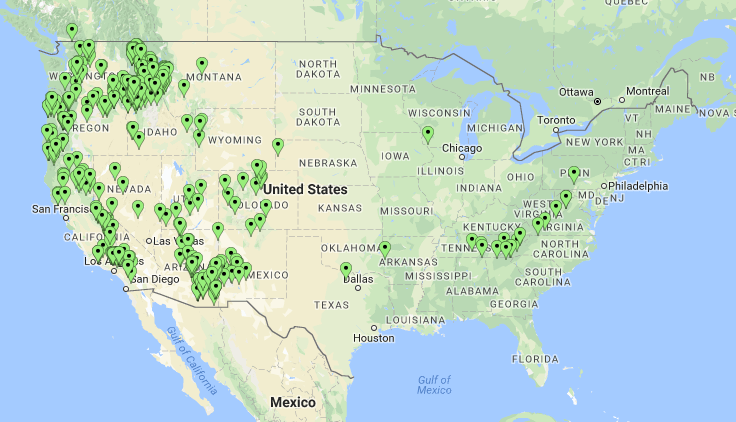
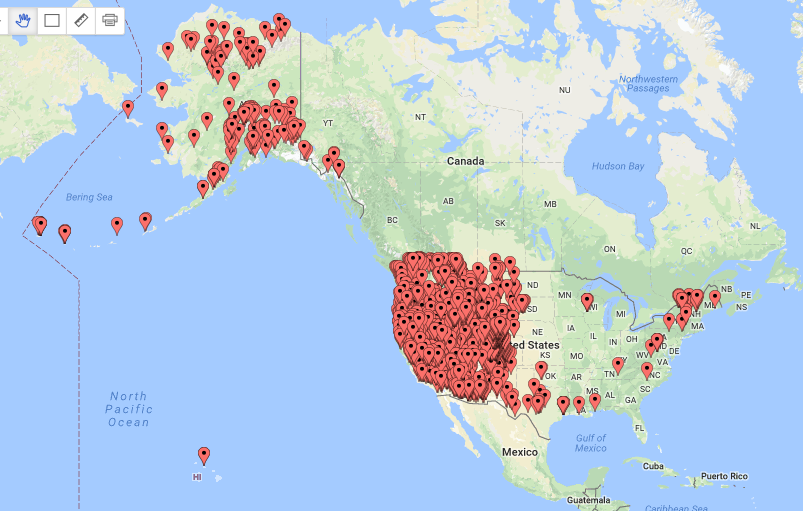
But gap is by far the most common word for this.
And it’s widely used in the south and west, but it’s interesting hardly at all in the upper Midwest.
Pass is mostly used in the west, and it’s an incredibly clear-cut line just east of the Rocky Mountains.
And the reason I know all this, by the way, is I downloaded the place name data set from the U.S. Geological Survey that has the name of every geographic feature in the country.
And I did a bunch of manipulation to the data to remove just the items that I wanted with their latitude and longitude.
And then I mapped all four of these terms for you.
Because this is what Grant does in his spare time.
We will put these maps online later, but it’s really, really interesting stuff.
Saddle is mainly used in the American West, but there is a string of saddle place names in the Appalachians.
You know, it wasn’t the purpose for me hiking the Appalachian Trail.
Yeah.
And I didn’t pay attention when I did it.
You did it?
Wait.
In 1994, I was 36, and I hiked from Georgia to Maine.
Wow.
That’s cool.
I didn’t think a thing about the names, really.
I was more on a, you know, figure out the meaning of life walk.
Yeah.
What is it, by the way?
I never figured it out.
All I ever thought about was food.
Food and blisters, yeah.
You and the bears.
Yeah, I had blisters for 300 miles.
Oh, my gosh.
But, yeah, food is pretty key.
So what I want to do for you, Kathy, is I’m going to put these maps up on the website so everyone can look at this data.
And you’ll see that there is a regional difference.
And the explanation is that we are not linguistically monolithic.
That is, we don’t all speak the same English.
We have different English traditions.
It’s been a number of years, but I believe we talked about this on the show maybe 10 years ago.
The same thing happens with the name for small water courses.
So creek versus branch versus brook, and I think there are a couple others.
I could do the exact same analysis with this data set from the U.S. Geological Survey.
And we could show that creek is more common in one part of the country and brook in another and branch in another.
Wow. I’m impressed. That’s an awesome amount of work. I’m looking forward to looking at that.
Hey, it’s not hiking the Appalachian Trail, though.
No, that’s true.
That is pretty darn awesome.
I have no blisters on my fingers for doing this.
But, Kathy, thank you for your call.
We really appreciate you bringing this to our attention and giving this opportunity to find out more.
And now the whole country will know.
All right?
Thank you very much.
Your show is awesome.
Take care now.
So are you, Kathy.
Take care.
Bye-bye.
Bye-bye.
Bye.
Oh, my gosh.
We have twin passions here.
You’re crunching data, and I’m thinking about hiking the Appalachian Trail.
You know, there’s a point in your life when you get old enough that the only thing that excites you really is a big pile of data that needs to be analyzed.
Speak for yourself.
Email us words@waywordradio.org.
A lot of neologisms are just here today and gone tomorrow, but this one I hope sticks around.
It’s plogging.
Have you run into this one?
Plumber’s blogging?
I don’t know what that is, blogging.
No, but it is a portmanteau.
It’s a combination of a Swedish term, plakaup, which means to pick up, and jogging.
So this is this craze that’s now making its way through your…
So you jog and pick up trash?
Yes.
Okay.
Do you have the grabby hands?
That’d be the best part of it, right?
The long ones with the levers, and they have the little claws, the pincers on the ends?
Yeah, that would look really cool coming down the street.
But apparently there are all these people in Europe who are running down the street with plastic bags and pausing to either squat, which would be really good for you, or bend over and pick up trash.
And they’re plugging groups here in the U.S., apparently.
And I read about a group in Tennessee that has trasher size.
So picking up trash while you jog or exercise.
Yeah.
Sounds perfect.
Yeah, maybe hikers.
I don’t know.
Maybe we go pliking.
I don’t know.
It reminds me of David Sedaris picking up trash in the UK where he lives.
And I remember there was a story in one of the local papers about the local man who picks up trash.
He didn’t happen to mention that he was incredibly well known.
Best selling author.
Yeah.
No mention of that, really.
Yeah, exactly.
You know, I said that I hope that plugging has a long life, that this idea has legs.
But actually, I hope it only lasts as long as people…
Stop throwing trash out the car windows.
Until they do.
Hello, you have A Way with Words.
Yeah, this is Louis Varney.
I live in Ralston, Nebraska, which is the Omaha area, surrounded by Omaha.
I think it was my grandmother used to say about the little boy that kept asking his grandma questions, and finally she got tired of it, and she said, you ask more questions than a Philadelphia lawyer.
What do you think she meant by Philadelphia lawyer?
Well, a lawyer has to ask questions and find out about cases and everything, but I just would be kind of interested how that saying originated.
Probably she picked it up from, my grandmother picked it up from somebody else.
Yeah, more than likely.
It’s got an old history, Lewis.
It goes back a couple hundred years at least.
There are two possible origin stories for the Philadelphia lawyer.
It at least goes back to 1788, by the way, which is really interesting.
Wow.
Yeah, but it was used by somebody in London saying that about Americans, which I find really interesting.
That is.
The first use was in London.
People have speculated that they were referring to the long history and knowledge of Benjamin Franklin, who lived and worked in London three different times in his life.
He lived there last between 1764 and 1775.
They had an article on the TV the other night about the house that Benjamin Franklin lived in when he was in London on public television.
Yeah, I believe that.
So when he lived in London, the last time he was there, he fought against the Stamp Act.
And if you remember, the Stamp Act imposed taxes on certain goods and services in order to pay for the military defense of the colonies.
And so apparently Benjamin Franklin was very verbose on this subject and very eloquent on this subject and did all the diplomatic things he needed to do as a representative of the U.S. Government to try to persuade the king and the British political establishment not to do this.
And ultimately, of course, we know what happened.
We had a revolutionary war and we broke away from them because they would not agree to this.
But the other possible story about who might be the Philadelphia lawyer in question is this guy by the name of Andrew Hamilton, not Alexander Hamilton, but Andrew Hamilton of Philadelphia.
He defended this German-American printer, somebody just printed pamphlets and newspapers, named John Peter Zinger, who would print these kind of underground documents accusing the English colonial government in New York of corruption and graft and all kinds of misdeeds.
Well, the English colonial government sued him, sued John Peter Zinger, and then Andrew Hamilton came up from Philadelphia to defend his case successfully.
And is one of the earliest clear-cut cases of the idea of freedom of speech, which we now have ensconced in the Bill of Rights.
So we’re talking about a lawyer who’s very, very talented and very, very articulate.
And he, from Philadelphia, went out of his way to take the trouble to go to New York to defend this printer in order to establish these basic principles of what the Americans should be allowed to print in their newspapers.
So, Lewis, those are our two best theories right there.
Thank you for calling us. We really appreciate it.
Yeah, I appreciate that. Thank you.
Take care now.
All right. Bye-bye.
Bye-bye.
So the names of that last case, just so people can Google it,
Because there’s a ton of really wonderful work that has been done on this.
It’s John Peter Zenger and Andrew Hamilton.
Just Google Zenger Hamilton case, and you’ll come up with this really interesting stuff.
And law students love this story because it predates the Bill of Rights.
But it’s all about the freedom of speech and the freedom of the press that we now take for granted.
Is there a word or phrase that’s caught your ear?
We’d love to hear about it.
877-929-9673 or send us an email.
That address is words@waywordradio.org.
We’ve talked about
Egg corns on the show before. This is where
Somebody gets a phrase wrong, but
The thing they get it wrong as kind of makes a little bit
Of sense too. Yeah, like spreading like wild
Flowers instead of wildfires. That’s right.
So this one is mind bottling
B-O-T-T-L-I-N-G instead
Of mind boggling.
And it was used, I think, in a Will Ferrell
Movie so that it’s got a little bit of
Impetus and oomph on that. But you do
See people saying mind bottling
And not realizing that it’s incorrect.
It should be mind boggling. Oh, man.
A mind-boggling error.
Like it closes up your mind and makes you not think of the true answer.
I don’t even know.
It’s kind of a mind-boggling term.
I love it.
Mind-boggling.
Hello, you have A Way with Words.
Hi.
How are you?
Excellent.
Who’s this?
My name is Jen Guzman.
I’m calling from Denton, Texas.
Welcome to the show.
What can we do for you?
Thank you so much.
So I have a question about a word that I heard growing up a lot.
I grew up in upstate New York, and both of my parents grew up in Brooklyn and then moved upstate,
And they always used the word skutch.
And it was used in a way where if we were bothering, I was bothering my brothers,
Or they were bothering me, or we were bothering my parents, they would say,
Don’t be a skutch, go do something else, or something along those lines.
And so I grew up in New York hearing that all the time, and then when I moved to Texas for school,
I tried to use that same word with my now husband, and he just looked at me with a question,
Like, is that a real word? And so I realized that it was not used all over the country. And so I was
Calling today to see if you could tell me anything about the word scooch. Yeah, we sure can. And we
Can also tell you that you’re not alone. We have this experience all the time where people call up
And they say, I moved across the country and I use this word and people looked at me like I had two
Heads. Yeah, that’s exactly it. So your husband was being a scooch? Yes, he usually is being a
So I use that word pretty frequently.
Oh, really?
How would you spell it?
In a playful way.
Okay.
I would spell it S-C-U-T-C-H.
Okay.
S-C-U-T-C-H.
That sounds about right.
Yeah, that’s pretty close.
I more often see it as S-K-U-T-C-H, pronounced scooch, like you said.
And apparently it does come from an Italian word, scochiare, which means to annoy.
It may go back to an earlier term meaning to break.
But yeah, to annoy.
And so somebody who’s being annoying is a scooch.
That sounds about right.
I think the nice thing is that it always felt like a playful word.
It was never a big insult.
It was just kind of a light reminder, like, you know, stop being a pain in the butt.
Right, so you kind of grab his nose and tweak it or something.
Yeah, exactly.
Don’t be such a scooch.
That connects then strongly to the Italian history of Brooklyn when it was a lot more Italian.
But I would think of places more like Bensonhurst than I would Williamsburg being Italian.
That makes a lot of sense.
I’ll have to spread it throughout Texas.
Yeah, spread it throughout Texas and say hi to that scooch for us.
Yes, I will.
Thank you guys so much.
Cheers.
Take care.
All right.
Bye-bye.
All right.
Take care.
Bye.
Oh, those little remnants of the past that are sprinkled like jimmies on the top of a cupcake, right?
Oh, yeah.
Or hidden like gems inside a geode.
I don’t know.
Block that metaphor.
Email words@waywordradio.org.
If you love books, then chances are you’ve had the experience of buying a book and then leaving it there unread and then other books piling up around it.
We don’t really have a word for that in English, but there is a word in Japanese for that.
Oh, I think I know it. Or I did know it. I don’t know it anymore. What is it?
Sundoku.
Oh, yeah. There we go. Yeah. Sundoku.
What surprised me about this word is that it’s really old. It goes back to the 19th century.
They had the problem of books being piled up around them.
Imagine that.
I believe it.
I heard there were Sendoku support groups online.
Sendoku support groups, yeah.
I saw a cartoon recently that had the different strata of the books,
The sad ones at the bottom that you’ll never get to but you can’t remove
Because of the support foundation for the ones above.
At some point it just becomes sediment, right?
The books aren’t books anymore.
Oh, my gosh.
They’re structural.
I actually have a pile just like that on my bedroom floor.
Want more Way With Words?
Listen to years of past episodes at waywordradio.org
Or find the show in any podcast app or on iTunes.
Our toll-free line is always open,
So leave us a message at 877-929-9673 and we’ll take a listen.
We’d love to get your messages at words@waywordradio.org
Or hit us up on Twitter @wayword and look for us on Facebook.
This program would not be possible without you.
Grant and I are out to change the way we listen and think about language,
And you’re making it happen.
Thanks also to senior producer Stefanie Levine,
Director and editor Tim Felten,
Director Colin Tedeschi,
And production assistant Emma Kelman in San Diego.
In New York, we thank quiz guy John Chaneski
And that master of keeping it real, Paul Ruist at Argo Studios.
A Way with Words is an independent production of Wayword, Inc.
From the Recording Arts Center at Studio West in San Diego,
I’m Martha Barnette.
And I’m Grant Barrett.
So long.
Bye-bye.
Thank you.
A Sense of Library Wonder
 A young patron’s sense of wonder at what the Toronto Public Library can offer her is super adorable. Libraries!
Put on the Dog is About Dressing Up
To put on the dog refers to ostentatious behavior and, in particular, to dressing in a flashy way. What do dogs have to do with stylish clothing?
Infanticipating
Our discussion about the many ways to say someone is pregnant prompts a listener to share another one he picked up from broadcaster Paul Harvey: infanticipating.
A Noisy Piece of Cheese
A woman in San Diego, California, says that when she was making too much noise as a youngster, her dad would gently reprimand her by saying, “You’re a noisy piece of cheese.”
Palate vs. Palette
Need a mnemonic to remember difference between the spelling of the palate in your mouth and an artist’s palette? Associate the one in your mouth with the past tense of the verb to eat.
Autocomplete Word Game
Quiz Guy John Chaneski, who also writes for Paid Off, a television game show starring Michael Torpey, offers a game-show style puzzle. For example, what are the top three most likely responses from Google’s autocomplete feature if you type in the question “Why does my arm…”?
You’re Welcome
Why do some people not say “you’re welcome” in response to “thank you”? A Lantana, Texas, woman observes that during media interviews, people will often respond to a “thank you” by saying “thank you” themselves.
Hungry Horse Pun
A listener in Hope, North Wales, points out that there’s punny way to spell a hungry horse in four letters. (Hint: one particularly British synonym for horse is gee-gee.)
Are Funner and Funnest Words?
A 10-year-old in Steamboat Springs, Colorado, says friends correct him whenever he says funner and funnest. Are they really words, and if so, is it okay to use them?
Pig, Slang for Police
A law enforcement officer says he and his colleagues are curious about how the word pig came to be used as a derogatory term for police. This use has a long history that goes back more than two centuries.
Cowbelly
The term cowbelly is used in Louisiana to mean both a kind of work shoe and soft river mud. This kind of silt has been described evocatively by writer Conger Beasley, Jr.
Whopping Lies Kids Tell
A tweet soliciting the biggest lies people heard from other kids while growing up turns up some whoppers, like the boy who claimed his great-great-great-great grandfather was Elvis.
Gap, Notch, Saddle, and Pass
What you call the space between mountains depends on which part of the country you’re in. The word gap is used more in the Southern United States, notch in the Northeast, and saddle or pass in the West. See Grant’s analysis of place names on the maps below.


Ploggers
There’s a word for those noble souls who’re picking up litter while they jog. They’re ploggers. The neologisms plogger and plogging are a combination of the English word jogging and Swedish plocka upp, which means pick up.
Philadelphia Lawyer
A listener in Omaha, Nebraska, says that when he was being particularly inquisitive, his grandmother would exclaim, “You ask more questions than a Philadelphia lawyer!” This term for a particularly shrewd attorney goes all the way back to the late 18th century, and may be a reference either to Ben Franklin or the Philadelphia attorney Andrew Hamilton, who successfully defended German-American printer John Peter Zenger.
Mind-Boggling vs. Mind-Bottling
The term mind-boggling describes something that has a powerful effect on the mind. Sometimes it’s misunderstood as mind-bottling, an eggcorn popularized by a Will Farrell movie.
Italian-American “Skutch”
The Italian-American slang word skutch refers to someone who’s being annoying and derives from the Italian word scocciare, which means “to pester.”
Tsundoku
The Japanese have a term for the act of buying books but letting them pile up without reading them. It’s tsundoku.
This episode is hosted by Martha Barnette and Grant Barrett, and produced by Stefanie Levine.
Photo by John Picken. Used under a Creative Commons license.
Music Used in the Episode
| Title | Artist | Album | Label |
|---|---|---|---|
| Power Montage | Keith Mansfield | Flamboyant Themes | KPM Music |
| Utility Cue | Keith Mansfield | Life Is For Living | KPM Music |
| Spark Plug | Melvin Sparks | Spark Plug | Prestige |
| Barrio Bueno | The Cabildos | Cross Fire | Vroommm |
| Phase Out | Dave Richmond | Contemporary Styles In Electr0-Pop | KPM Music |
| Coming Along | Duncan Lamont | Links, Bridges, and Stings | KPM Music |
| Borderland | The Cabildos | Cross Fire | Vroommm |
| Perpetual Shake | Paolo Zavallone | Music For Dancefloors | Strut |
| Fugitive On The Run | Peter Sander | The Super Sounds of Bosworth 2 | Trunk Records |
| Hang Loose | Max Harris | The Super Sounds of Bosworth | Trunk Records |
| Volcano Vapes | Sure Fire Soul Ensemble | Out On The Coast | Colemine Records |

