

We all lead busy lives—so are speed reading courses a good idea? Plus, if you hear someone speaking with a British accent, do you tend to assume they’re somehow more intelligent? And some common English surnames tell us stories about life in the Middle Ages. Plus, a 29-letter word for the fear of the number 666, games and riddles, military brats, knocked for a loop, the first dirty word, and book recommendations for math lovers.
This episode first aired December 21, 2013. It was rebroadcast the weekend of June 8, 2015.
Transcript of “Thrown For A Loop (episode #1386)”
You’re listening to A Way with Words, the show about language and how we use it.
I’m Grant Barrett.
And I’m Martha Barnette.
The other night I went to a performance at a theater here in San Diego.
And a few minutes before the lights went down, I thought, well, I’ll check in on Facebook and see if I can connect with people here.
And so I got all absorbed in doing that, and then I glanced up, and I realized that every single person in my immediate proximity was all absorbed in looking at their smartphones.
And I just thought, there’s something wrong with that.
You know, I mean, here’s this communal situation, and we’re all staring at our phones.
And the next day, we got an email from Gina Conti.
She’s in Santa Monica, California.
She had the very same experience, and she coined a word that she’d like to popularize.
It’s tech-gather.
Tech-gather.
Tech-gather, you know?
We’re all tech-gather in this situation where we’re all these little human silos, you know?
And next to each other, communing with somebody in a device, but not the people sitting next to you.
Exactly.
Little glowing screens.
For the people whose very breath that you are about to inhale because they just exhaled it, you’re not participating in it otherwise.
But this reminds me of one of my favorite practices that I’ve seen people do now is that when everybody comes to a party or dinner, they stack their phones.
And the first one to reach for their phone pays.
Oh, that’s nice.
The phone stack.
Is there a word for that?
The phone stack?
It’s phone stacking.
I don’t know.
But yeah, the first one to reach for their phone pays.
Okay.
Well, the problem is that means you can’t leave because you’ve got to reach for your phone to leave.
I like that.
If you’ve got a word for what happens when we’re all sitting together in a room by ourselves, but together, looking at our phones, give us a call, 877-929-9673.
Email us, words@waywordradio.org.
We want to talk to you about language, speech, grammar, dialect, slang, jargon, you name it.
Hello, you have A Way with Words.
Hi, this is Tony Friedman from St. Louis, Missouri.
Hiya, Tony. Welcome.
Hi, Tony.
Hi.
Well, I had a question.
It’s not exactly a word question, but it’s one that’s been bothering me for some time.
The question is this.
Are speed reading courses and speed reading techniques worthwhile, or are they a waste of time?
Oh.
Have you taken some?
Are you looking into it?
I have not, and I have looked into it, and I have only been more confused the more I look into it.
There’s a lot of claims out there, and it seems to me that a lot of them have to be bogus,
And I just don’t want to go down the rabbit hole if it is not worthwhile.
What are the bogus claims?
The bogus claims are that they can increase your reading speed to something upwards of 1,000 or 2,000 words a minute.
Whoa!
That’s fast.
You can read a novel in an afternoon.
Wouldn’t that be incredible?
Yeah.
And that would be worth a speed reading course if it were true.
I have experience doing this.
I took a speed reading course many years ago, and it may work for other people, but it really messed me up.
What happened?
I have to say.
I got so—
Does this explain all your problems?
It explains certain problems, yeah.
I got so caught up in just the technique of it and thinking about all the things I was supposed to do
And how fast you were supposed to move your hand down the page.
And I just found it physically impossible, and then I would get frustrated.
You know, it sort of reminds me of, do you remember when all those apps started coming out
That would help you organize your time and organize the tasks that you were going to do?
Yeah, the getting things done kind of stuff, the GTD stuff.
Yeah, and I got so caught up in the method that I just sort of forgot.
I just got messed up.
I couldn’t do it.
And honestly, this bee reading course that I took, I have to say, not only did I put out a bunch of money, but it messed me up for years.
Are there residual effects, any positive residual effects?
Only that I’m more selective in what I read.
But no, I was just thinking too much about the technique, and it didn’t help me.
Tony, is that some of what you were finding when you were looking around?
You know, that’s a lot of what I was finding, although I’ve never heard that you would need to unlearn what you did learn in a speed reading course.
So that makes me a little bit more nervous about looking into one.
Yeah, I found that people have these various techniques that they tout as the best solution.
Some of them involve moving your finger down the page or some of them training yourself to stop vocalizing internally the words as you read them.
And, you know, what it boiled down to me, it seemed like they were advocating an approach that is more like skimming text and reading text.
Bingo. That’s it. You get the gist, but not the particulars. Exactly.
Yeah, I think if you’re going to read well, you have to focus.
And I couldn’t focus because I was focusing so much on the technique itself.
Tony, but it sounds like we’re in sync. I’m skeptical as well.
I’ve done similar digging that you’ve done.
I’ve looked at the professional journal articles on this, and they agree that you can skim faster.
You can learn to skim very well, basically, is what’s happening.
To call it reading is a misnomer because you are not reading. You are skimming.
And there are some things that it’s totally fine to do.
If you’re, for example, reading an autobiography, which is filled with anecdotes, and there’s kind of like the setup, and then the story, and then the follow-up, and they’re kind of more or less repeating the same themes over and over, skimming’s just fine.
If you’re reading dense legal text, forget it.
This is not going to work for you.
You cannot speed read dense legal text and get the gist.
I mean, maybe you can read the subject headers or the page headers or the section headers, that stuff.
But the main problem with this, in my eyes, is to think of it as reading because it isn’t.
Right.
Okay.
Well, that makes sense.
So maybe I shouldn’t waste my time then trying to go through a speed reading course.
It seems like at some point you will hit a wall where you just physically can’t move your eyes at that.
Exactly.
Let alone your brain comprehending what’s going on.
What I’d like to see is a speed comprehension course, and that’s the place that we should be going.
How can I comprehend more better?
That’s right.
I mean, I’d like to speed read faster in order to read novels for pleasure.
And then in my work, I’m an attorney.
I’d like to read legal text and be able to comprehend everything.
But skimming is an important skill, and I think I’ve developed that skill well enough.
I might not be able to go much further with that, but they’re both skills, and I think you’re absolutely right.
Speed comprehension is really what I’m after, not necessarily speed reading.
Exactly.
But we’ll put the word out and see if our listeners have different points of view, because I know this is kind of contentious.
You probably saw that as well.
There are some people who are probably already dialing the phone, sending the email.
Anyway, Tony, thanks for calling.
Really glad to hear from a St. Louisan.
Yeah, great speaking with the both of you.
Great fan.
Thanks a lot.
Take care.
Thanks, Tony.
Bye-bye.
Well, let’s hear from you, 877-929-9673, or send an email to words@waywordradio.org.
I was reading a news item online the other day, and I came across a word that has 29 letters, Grant.
It was in a news report.
What is it?
It’s hexacossioi hexekontahexaphobia.
And was this a stunt word or is this a real word they just kind of mentioned in passing?
Well, it made it into a whole lot of news reports because hexacossioi hexekontahexaphobia is the fear of the number 666.
Oh, I see.
You hear all the hexes in there, like hexagonal, right?
And there was a cross-country athlete in Kentucky who was going to be running a race, and they gave her that number, 666, and she refused to run in the race.
Oh, she didn’t just turn it upside down?
Make it 999.
Come on, lady, get with it.
Grant, you have an answer for everything.
That’s perfect.
I know my wife says that, but she doesn’t laugh.
If you see language in the news that catches your eye, call us about it, 877-929-9673, or send it an email to words@waywordradio.org, and we’re all over Facebook and Twitter.
Hello, you have A Way with Words.
Hi, this is Shay in Jacksonville, North Carolina.
Hello, Shay. Welcome to the show.
Hi, Shay.
I was talking with my parents about two weeks ago, and my mom asked my dad the pronunciation of a certain word, the word being schadenfreude, when you, you know, you kind of get a secret pleasure out of someone else’s pain.
And I’d never heard of it, or so I thought, you know.
And then within that week, three times I heard it on NPR, I heard it on a podcast I was listening to, and I saw it online, like in an article title.
So obviously that word is out there.
I had assumed it was not as common, and I’ve had that happen many times before.
And I think it’s just, I guess, you know, we sort of have the tendency to gloss over things, use context clues, and it’s almost like my brain wasn’t registering the word until I knew its meaning, and then I became aware of it.
And I was wondering if there’s a term for this phenomenon.
Mm—
Yeah, there are a couple of terms for that.
And it’s a cool feeling, isn’t it?
Yeah.
And it’s cool, but also like, how did I miss this, you know?
Right.
Well, probably the best term for it is the frequency illusion.
And it has to do with the selective attention that you have when you notice something for the first time, and then you’re kind of on the lookout for it.
And then you get this confirmation that it’s out there more than it really is.
Because you’re primed to be looking for it.
And Shay, you hit on something really important.
After we reach a certain level of literacy, we do start to gloss over words.
We absolutely do.
And we only need the barest hints that context can give us about meaning in order to just move along and not look a word up.
And so you really nailed it.
That’s what’s happening.
You are seeing a word, defining it, and then it suddenly becomes activated.
It has evolved from a non-functioning word to a functioning word for you.
Okay. I really hadn’t considered what Martha said.
Like, I figured it was somewhat related to the idea of confirmation bias, but the idea of timing, that makes sense.
You know, like, your brain’s sort of, I guess, trying to lock in this new information.
Like, oh, yes, I know this.
Yeah, yeah, and confirmation bias is certainly a factor there.
You have that right.
Yeah, because you’re constantly seeking information to confirm the things that you’ve just learned.
Right, right. Our brains are always looking for patterns and that kind of thing.
Yeah. All right. Thank you so much.
Thanks, Cheryl. Really appreciate it.
Okay, have a word for it.
Yeah, you do. Take care now.
Excellent. Take care.
Thanks. Have a good day.
Bye-bye.
Bye.
You know, Grant, some people call it synchronicity, but it’s not, I mean, it’s maybe a form of synchronicity.
I think of synchronicity more like if you dream about somebody and then they call you the next day or something like that.
Right. That was the Carl Jung’s thing, right?
Yeah.
Yeah, it’s not quite synchronicity.
Right.
I mean, you might have circumstances that are both.
Right.
But it’s more your perception.
It’s not things that happen.
And there are occasions, we should say, where a word does just kind of pop onto the scene and you do see it everywhere.
Yeah, that’s true.
And it’s not just you.
That’s true.
But think about twerking in 2013.
Or not.
Let’s not think about it.
We’d love to hear from you any little thing, any big thing at all, 877-929-9673.
Or send your questions about language, literature, speech, and writing to words@waywordradio.org.
A couple of listeners have sent us this riddle.
What has two hookers, two lookers, four stiff standers, four diddle-danders, and a wig-wag?
Oh, this is about letters, right?
So lookers are O’s.
Can you go through it again, please?
Okay.
What has two hookers, two lookers, four stiff standers?
Are lookers Q’s or G’s?
I don’t know.
What is it?
It’s a word, isn’t it?
No.
No, it’s not?
What is it?
It’s a cow.
Oh!
I was thinking that, like, the hookers were Gs or Qs, and the standers were Ts or little Ds.
No, it’s a cow.
Two hookers, two lookers, four stiff standers, four diddle-danders, and a wigwag.
Outstanding.
I’m sharing that with my son.
I’ll be the hit of the six-year-old party.
Indeed, you will.
You can tell that one, and he can tell this one.
What has four dilly-danders, four stiff standers, two lookers, two hookers, two flip-flaps, and a fling-by?
Same thing. Cow.
Those are awesome.
If you’ve got a riddle that you want to share, give us a call, 877-929-9673, or email words@waywordradio.org.
Stick around for more of the joy of Lex as A Way with Words continues.
You’re listening to A Way with Words, the show about language and how we use it.
I’m Martha Barnette.
And I’m Grant Barrett.
And there’s John Chaneski.
Hi, John.
It’s our quiz guy.
Here I am.
What do you got there?
You got a quiz?
I want to do a quiz.
Yeah, you know, you guys, you and I hardly ever get a chance to just hang out.
So, you know, I thought we would take a trip to the zoo.
Why don’t we try what I call the human zoo?
Ooh.
Okay.
The human zoo.
As you walk around, we can see a lot of well-known people who represent animal terms for people.
For example, who do we have here?
Oh, let’s see what the little plaque says.
Oh, it’s Henry Hill.
He was a former member of the Lucchese crime family, turned FBI informant, and now he’s, quote, a member of the animal superfamily, Murodia, and a person regarded by some as despicable, especially a man who has been deceitful or disloyal.
He’s a rat.
He is a rat.
Dirty, dirty rat.
Well done. Nice.
Okay, let’s tour the zoo. Here we go.
Here we have two guys, and they’re both ship captains.
One was a captain of the Costa Concordia.
The other was captain of the Oceanos.
Both their ships sank, and both of them deserted their post before the passengers were off the vessels.
Now, you might think of them as rats, but according to the plaque, they are, quote, Gallus Gallus Domestica.
Chickens.
Persons who are afraid, yes. They’re chickens.
You know, you’re giving Martha the leg up because you’re using the Latin names, right?
No, as soon as you say that, I’m like,
Here we have a quintessential man of letters, Louis Lapham, former editor of Harper’s Magazine and founder of Lapham’s Quarterly.
He’s written numerous books.
The plaque says he’s, let’s see, quote, Pantheraleo and a person of outstanding interest or importance.
He’s a literary lion.
He’s a lion, yes.
There we go.
Next we have Charlie Parker, pioneering saxophone player and jazz composer.
Now, you might know him by his nickname Bird, but the plaque says he’s, quote, Felis Silvestris, I can’t make out the species, a player and devotee of jazz.
He’s a cat.
He’s a wild cat.
He’s a cat.
Oh, right here, the species is Catus.
Yes, very good.
It’s funny how I couldn’t read that at first.
We have a few historical figures here.
Here are Henry Clay and John C. Calhoun.
Now, both of these gentlemen favored war with Britain in 1812.
The plaque says they are, quote, members of the family Aksipitajay and persons who take a militant attitude and advocate immediate vigorous action.
Yes, they are hawks.
They are hawks, a supporter of war or warlock policy.
Good.
Here are a couple of brothers.
Their names are Homer and Langley Collier.
If you had a messy room in the 50s and 60s, your mom might have compared you to the Collier brothers.
Their Harlem brownstone was found to have over 140 tons of stuff they had collected.
The plaque says they are members of the species Neatoma, people who collect or hoard especially unneeded items.
Pack rats.
They are pack rats.
Now, finally, this is the exhibit of one Rudolph Wanderone.
He was an excellent billiard player.
You might know him by his nickname, Minnesota Fats.
The plaque says he’s classified in the clade Salachomorpha.
And a crafty person who takes advantage of others through devious means.
Sly fox?
I don’t know.
How are you spelling that?
S-E-L-A-C-H-I-M-O-R-P-H-A.
Wow.
Slycomorpha.
Like a pool shark?
He’s a shark.
Yes, very good.
Very good.
I did not know that one.
So we’ve got barracudas and tigers and bears and dogs and snakes in here, but that is all we have for today.
Nicely done, you guys.
Oh, thank you.
Very good.
Very good.
If you’ve got an idea for a quiz on the show, give us a call at 877-929-9673, or send it to words@waywordradio.org.
Hello, you have A Way with Words.
Hi, this is Bill from San Antonio.
Welcome, Bill, from San Antonio?
San Antonio, Texas, yes, ma’am.
All right, well, what’s up?
Well, I was just calling, I was, you know, sometimes when you’re talking, until you write it down, you don’t really realize the phrase or the word, you know, just kind of when you write it down.
So when I was writing down, I’ve said military brat all my life. You know, I’m 56, and I never thought it as a negative thing until I wrote it down the other day.
And I just thought, wow, that kind of has maybe a bad connotation. And I’ve always thought it was a good thing.
So I was kind of wondering, you know, I’m in San Antonio. We’re kind of military base of the world here. And just thought I’d see if you guys got something. I didn’t Google it or anything. I just thought I’d let y’all fill me in.
You thought you’d come straight to us, huh?
Well, I have to ask, are you a military brat?
I am, yes. My dad was in the military 30 years. I was born overseas. And, you know, we moved around. I was the youngest of the four boys, but they moved around quite a bit. I didn’t move around quite so much, but I did move around, you know, Virginia, Denver, Kansas, Ohio, and then San Antonio. So moved around a decent amount.
Okay. And so it never occurred to you that it might be negative until you wrote it down, right?
I mean, I know brat is, God connotes a negative meaning, but I just for some reason thought, I said it proudly, I guess that’s what, I guess I said it more just out of pride.
I thought it was, I’m sticking to it as a good thing.
Yeah, the word brat has been kind of contemptuous since the very beginning of the word going back hundreds of years.
Yeah, I have two older brothers and I got called the brat all the time.
Right, they don’t mean it kindly usually.
But, you know, the subject of a term of contempt can own that term. And it sounds like that’s what you’re doing. You just kind of took it even though you knew there might be a little bit of a negativity to it.
Yeah, I think people tend to claim it proudly.
At least in the military, right?
Yeah, yeah.
And frankly, I don’t know about you, but military brats tend to be kind of exceptional people. They often have interesting backgrounds. They lived in Okinawa. They lived in Germany. They speak a variety of languages. They know things about the world that other people their age don’t know.
And when they arrive at a school, sometimes they’re the most exceptional person there. And maybe calling them brats is a way of kind of demonstrating how offset their personality and character is.
Well, and if you meet somebody else who’s one, then you have a certain solidarity. I mean, I grew up as the daughter of a seminary professor, and I was proudly referred to as a faculty brat. I referred to myself.
And, you know, when I met other faculty brats, you know, we had a certain camaraderie. I’d be interested to know if our listeners think of it as a pejorative or as a positive thing.
I think of it as positive, actually.
Yeah, if you grew up as a military brat of any kind, Army, Navy, what have you, let us know, 877-929-9673, or email us about it, words@waywordradio.org.
So, Bill, we’ll hear from a lot of your fellow military brats, I’m sure.
Awesome. Well, that’s great. I appreciate you taking my call, and y’all have a wonderful day.
Thanks, Bill. Really appreciate it.
Thanks, Bill. Bye-bye.
Thanks so much. Bye-bye.
Take care.
Hello, you have A Way with Words.
Hi. My name is Rikki Mazzini. I’m calling from San Diego.
I’m an attorney in downtown with Zeldes Hayquiston Eck. And I have a question about occupational surnames.
Okay.
They’re very common in English, and I’ve always kind of had a bit of a hobby sort of collecting them. And a lot of them are very obvious, such as Butcher and Miller and Baker.
When I came to shoemaker, it was a bit of a question for me because normally in English, the word for the profession is cobbler. And here I was not finding many people who have the last name of cobbler, a lot of people with the last name of shoemaker, which is more of a descriptive.
And when I compared it, for example, to the German, the word in German for cobbler is Schuster. Well, that’s used as a last name, and so is Schumacher.
And Schumacher. And when you look at a last name such as Chandler, which is Candlemaker, you don’t see people called Candlemaker. You do see them called Chandler.
So I was looking at Shoemaker and saying, why? Why not Cobbler?
Well, that’s an interesting question. And there are a couple of things to say about that.
First of all, shoemakers and cobblers technically do slightly different things.
Aha.
A shoemaker traditionally has been somebody who makes shoes and might also repair them. But a cobbler specifically repairs shoes. So they’re two different professions for one thing.
Interesting.
I mean, just looking at English last names is, I enjoy it too, because they’re really echoes of conversation, everyday conversation in the Middle Ages, right? I mean, as you suggested, every town is going to have a miller, right, somebody to mill the grain. And every town is going to have a smith, of course, to work with metal.
And it’s interesting because back then the word tailor meant something a little bit different from what we think of it to be today. Today it’s sort of a luxury to be able to go to a tailor. But back then tailors had a much larger function. They were involved in actually the creation of clothing, cutting whole cloth and that kind of thing.
Tailors, for a long time, took over the task of making shoes or what passed as footwear in those days. So, tailors are a little bit older than the term shoemaker.
You’re getting at the heart of something really important here, which is the tradition of creating surnames in the first place kind of happened before some of the new language came along.
So we are kind of stuck with these words for these old words for professions.
Exactly.
So you might have we don’t have modern surnames like Webcoder, you know, Joe Webcoder or Jane Barista. We don’t do that anymore.
And I know that they arose out of the Middle Ages because you really normally didn’t have surnames at that time. You were either a landholder or you were a serf, in which case you just had your first name. And that as the trades were established, as the middle class started to arise, sort of, in the Middle Ages, they were identified by their trade.
Exactly.
And those became their surnames.
Right, but there were multiple naming traditions happening at once. So some people were named according to their nickname, the color of their hair or their gait. Some people were nicknamed according to by names because they lived near a body of water or they were in a particular dell, that sort of thing.
Yeah, or they were somebody’s son. Somebody’s son or somebody’s daughter in rarer cases, but it does happen.
Do you know the book The Surname Detective?
No.
I would highly recommend this. The Surname Detective. It’s called Investigating Surname Distribution in England. I highly recommend it.
And there’s one more I would recommend to you. Do you know the Dictionary of English Surnames? It’s not just a list of names. It’s got a full history of the Middle Ages, and they’ve gone back to the old census records and taxpayer records, and they’ve really done a great job in figuring out why these names survived, where they come from, and how we still hang on to them.
What about your last name?
My last name is Maviti, which is M-A-V-E-E-T-Y, and that is Scots-Irish.
We’re related to the McVitties.
Okay.
So it’s a clan name, but Irishized and kind of modified over time.
But that’s the same family, and it’s spelled 92 different ways.
Well, that takes me back to your original question about shoemaker versus cobbler.
We could have had a lot of Chaucer’s because the name Chaucer actually means shoemaker.
It’s just an accident of history that we ended up with more shoemakers than we did Chaucer’s.
Well, I’m wondering if Chaucer might be the old English then for cobbler, in which case that’s why I can’t find cobbler.
I highly recommend these books.
They’re going to give you a lot of answers for these questions.
It sounds like you’re well on the way to understanding this more than the average Joe or the average Ricky.
Thank you.
Thanks so much for calling.
Take care now.
You’re welcome.
Bye-bye.
Bye-bye.
This is great stuff.
It is really good.
And I want to mention those book names again just so people have a place to go.
A Dictionary of English Surnames by P. H. Reney and R. M. Wilson,
And The Surname Detective by Colin Rogers.
Both of these books will give you a really good, very comprehensible background
On why we’re named the things we’re named.
Call us with your language questions, 877-929-9673,
Or send them an email to words@waywordradio.org.
Grant, here’s a proverb I know you will appreciate.
Okay.
The face of a child can say it all, especially the mouth part of the face.
That sounds like a Jack Handy.
It is.
How is it?
I knew you would appreciate it.
I knew you could elaborate on it.
That’s fantastic.
Give us a call if you’ve got something funny to share, 877-929-9673, or email us, words@waywordradio.org.
Hello, you have A Way with Words.
Yeah, this is Travis from San Antonio, Texas.
Hi, Travis. Welcome to the show.
Hello, Travis.
During a Thanksgiving dinner last year, or a couple years ago,
And we were playing a game called Balderdash,
And the question was, what would you call more than one moose?
Okay, if a goose is a geese and a group of moose, would it be mooses or meat?
Mooses or meat.
This is the predicament we were in, because you’ve got the two double O’s, and that sounds better for a singular noun.
But if you have the two E’s, that’s for a plural.
So why wouldn’t moose be called a meese?
It’s hard to imagine seeing a herd of meese, isn’t it?
That sounds tiny and small.
It sounds like insignificant creatures, not these giant lumbering beasts.
Yeah, the plural of moose is moose, right?
It’s like deer.
It goes back to etymology, right?
These have different origins, and so they’re not required by English,
The rules of English morphology to pluralize in the same way.
That’s a lot of the inconsistencies of English is because, as I’ve mentioned before,
English is not a planned language.
We didn’t, nobody sat down as a committee and said,
All right, let’s make this all conform to standard rules,
And everything is going to be exactly alike, and it’ll be consistent.
English is a mess.
That’s a mess.
Yeah, and goose comes from European languages, and moose comes from native language here.
Yeah, Native American languages, right?
Yeah, exactly.
And so it’s an anglicization of…
Abenaki word, I think.
It’s Abenaki.
I think it is.
Okay.
So the plural of moose is either moose or mooses, but most people say moose.
So if I’m going to go hunt, I would say I’m going to go shoot some mooses.
Yeah, you could say it.
Mooses sounds weird to some people’s ears, or they just say moose.
I’m going to shoot a bunch of moose.
With a camera.
With the camera.
Okay.
Well, I have a second part to that, too.
Okay.
This was a saying that me and my wife were talking about,
And she said, well, whatever’s good for the goose is also good for the gander.
I do understand what that means, but where did that even originate from,
Or is there origination to it, or was it just something somebody made up one day?
Travis, what do you understand it to mean?
Well, from what I understand, if it’s good for one, it’s good for all.
Mm—
Exactly.
And a gander is a male goose.
And the term goose is applied to female geese.
So it’s about gender equity, really.
Oh, is it?
What’s good for the goose?
From the 1600s, gender equity in the 1600s.
Who knew?
Well, yeah.
Yeah, the old phrase is sauce for the goose is sauce for the gander.
Which means they taste the same no matter which one you’re eating.
When they’re on your plate, they’re the same.
Well, I appreciate it, guys.
That was pretty fun, actually.
All right.
Oh, you sound surprised.
Yeah, you do sound surprised.
Always with the surprised tone.
Anyway, thanks for calling, Travis.
Give us a ring another time, all right?
All right, thanks.
You guys have a good day.
Take care now.
Bye-bye.
Thanks, Travis.
We’ll take your questions.
The funny stuff that comes up, the smallest thing that you mention at the dinner table,
Can turn into the most interesting radio call, and we really appreciate it.
Email words@waywordradio.org.
In an earlier episode, we talked about the game Duck, Duck, Goose and how in Minnesota they play Duck, Duck, Gray Duck.
And we got a great email from Elizabeth Conley from Minnesota.
She says that the advantage of playing Duck, Duck, Gray Duck over Duck, Duck, Goose is the opportunity afforded to tease and misdirect your opponent.
To play Duck, Duck, Gray Duck properly, the child who is it circles around behind a ring of seated children while touching each on the head
And pronouncing him or her to be a different colored duck,
Such as blue duck, orange duck, etc.
She says the color designation is critical to the subtlety of the game,
Which is manifested when it decides to dub someone green duck,
But draws out the grrrr sound for as long as possible,
Thus tantalizing the seated child with the possibility
That he or she might really be the gray duck.
This causes intense excitement,
Accompanied by squeals of anticipation from the other contenders.
What more needs to be said?
And Elizabeth concludes, clearly those of us born in Minnesota have been among the fortunate few to have had such spine-tingling excitement in our early lives.
I can see that totally working, 100%.
That’s a lot of Minnesota pride there, right?
877-929-9673 is the number to call to talk with us about language.
Or send your emails to words@waywordradio.org.
More of your calls and stories about language right here on A Way with Words.
Stick with us.
You’re listening to A Way with Words, the show about language and how we use it.
I’m Grant Barrett.
And I’m Martha Barnette.
We got an email from Samantha Minschel.
She’s a new graduate of Widener University just outside of Philadelphia.
And, Grant, she wrote us to share a story from her freshman year.
Wanted us to comment on it.
Seems her close friend Charlotte was raised in New Jersey, but her father is from England.
So Charlotte has sort of a half-British, half-American accent.
And after Samantha introduced Charlotte to her doormate Julie, Julie reacted by saying Charlotte sounded stuck up and snobby.
And Samantha thought for a moment and then said to Julie, oh, well, she’s not stuck up.
She’s British.
And they’ve all since become great friends.
But it’s left her wondering why it is that Americans often attach intelligence or snobbishness to a British accent.
And as it turns out, Samantha is a big Anglophile.
And so she’s familiar enough with the language of England to know that not all British accents reflect such a highly educated sound.
And so she’s wondering why is it that Americans tend to lump the Brits all together and assume that they’re smarter or snobby?
Well, there’s a couple of questions here.
Actually, instead of just one, the one question is, do Americans really lump them together?
And I think as we have more exposure to British media, particularly on television, lots of people watching Downton Abbey, for example, the new Doctor Who that has been on for a number of years now.
I think people’s understanding of accents in North America is a little more refined than it was.
A little, I think.
Right?
But the larger question is, why do some accents take on a little more prestige?
Exactly.
And maybe a third question is, why do we react to that prestige either positively or negatively?
So it sounds like in this case, she saw the accent as sophisticated and then decided that it was stuck up.
Right. Exactly.
And where some people might hear the accent, hear it as sophisticated and think, oh, wow, I want to be like that person.
Exactly.
I want them to be my friend.
Yeah.
And you and I, as people who talk about this on the air all the time, we kind of get versions of this question every week, don’t we?
About why some accents or even some word choices are put down or elevated above the others.
Yeah, good point.
Or different accents in this country.
Today on the show, you’ll hear us talk about prestige accents or received pronunciation.
These accents that belong to the educated class, the moneyed class, or the people with power and authority.
And we tend to look up to them and adopt their modes of speech.
And so in the United States, for a long time, that accent wasn’t American.
That accent was British.
And even today, even though Disney bad guys these days always seem to have a British, I’m thinking of Scar and the Lion King, and they seem to have a British accent, and the good guy has an American accent.
Even now, that bias still persists.
And yet, if you go to the UK and you live anywhere on the islands for a few months, long enough, you will soon drop that and think of the accents differently and think of them a little more like a local.
You will drop the idea that all of the people around you are somehow speaking a better form of English or that the accent is a clue to their intelligence.
Oh, interesting.
Well, I’m sure Samantha would be thrilled with that advice to go live in England for a while.
It sounds like she really likes it.
But, I mean, I know what she means.
I have a friend who has a British accent, and any time she talks, I think she’s smarter than I am.
And it’s sort of like when you say, oh, I could listen to that person read the phone book.
I mean, I could listen to a person with that kind of British accent read the phone book all day.
The larger question is, why do we do this and what does it take to overcome that kind of bias?
Because the bias almost always is undeserved.
You cannot use the broad brush of an accent or a dialect to paint an individual.
There might be things that are true for the group, but the individual should not be judged by that.
Well, that’s what makes this fun, right?
Just trying to figure all this stuff out.
We’d love to know what you think. You can email us at words@waywordradio.org or call us 877-929-9673.
And we are all over Facebook and Twitter.
Hello, you have A Way with Words.
Hello. Hey, I’m Lou Kulp from Indianapolis, Indiana, and I think I’m speaking to Grant.
You are, Lou. Welcome to the show. You sound very exuberant.
Well, I am. I am. And is Martha there as well?
I am right here, Lou.
Oh, hello, Martha. I love your show. I listen to it on a Saturday about 2 o’clock.
Yep, that sounds about right.
In Indianapolis, yes.
And I have a question to ask you.
Yes, please.
I had read a novel this summer called Cold Sassy Tree by Olive Ann Burns.
And I’m reading along. It’s a turn-of-the-century kind of novel.
Probably, it was written in 1984, but the drama unfolds when cars are being bought and that kind of thing.
So I would think late 1800s.
And I came upon a sentence that had the word one, O-N-E, the number one, after a comma, and then the period.
And I ran into it once, thought this is strange.
It didn’t even read very well.
Ran into it again a number of times, and total I found about four to five times when they have put the word one after a sentence, and it just simply didn’t make sense to me.
I could not even read it orally in a very smooth way.
Oh, really? Well, can you give us an example?
I will give you an example.
Loma was always making herself a bosom or a bustle one.
All right.
So that doesn’t make sense to you up there in Indiana.
But it would make sense in the South.
It does make sense in the South?
Yes.
Yes, it does.
I’ve heard it many times.
It’s actually elliptical for one or the other.
Okay.
That was my only explanation.
Like an either one.
Exactly.
Exactly.
You know, I’m going to quit or get fired.
One.
Okay, well, that does make sense.
I would like to hear how it is spoken, though.
What would Aunt Maiso say, Martha?
What would Aunt Maiso say?
W-W-A-M-S.
Yeah, she would say, I’m going to make a bosom or a bustle, one, like that.
Oh, I see.
You’d put…
Yeah, so it’s a kind of stress.
It’s not like you’re raising your tone on that word, right?
You’re just emphasizing it, right?
Yeah.
You’re just basically dropping off or the other.
But I love the fact that, Lou, that you weren’t able to hear this in your head because it was foreign to you.
Yeah.
And you need to hear it.
It was very foreign to me.
You need to hear it authentically said.
Yeah, I can see how seeing it on the page would be really confusing.
So, Lou, mystery solved.
Mystery solved.
I now know.
And I thank you kindly.
You’ll now probably see it everywhere.
Yes, I probably will.
Thanks for calling, Lou.
Thank you. Bye-bye.
Bye-bye.
The mysteries of American English run deep.
The mysteries of English as a whole are even deeper.
Give us a call, 877-929-9673.
Email words@waywordradio.org.
Hello, you have A Way with Words.
Hi, this is Rich Grant calling from Dallas, Texas.
Hi, Rich. Welcome to the show.
What’s up? What can we help with?
Well, I had a question I want to ask about dirty words.
Not the actual words themselves, but kind of like the concept.
Like, how did the first person to ever use a dirty word know that it was a dirty word?
And how did the first person who heard it would actually know that it was a bad word?
What a great question.
Have you invented a time machine so we can go back and find out?
I wish I did.
That is really the only way we’re ever going to know for sure.
But we do know about some modern dirty words that have been created, and we can kind of surmise based upon more recent words whose history is fully known about those original terms.
And it tends to be around the power that we have in certain emotions, the utterances that we make when we’re angry, when we’re surprised, disgusted, regretful, those sorts of things.
And they could have been grunts back in the caveman days, so to speak, right?
And they become associated with these particular emotions.
And in that way, they are invested with power.
Now, in the modern age, when we have sexual terms, there’s a kind of power because, I don’t know how to put this exactly, but sexual politics come into play here.
Sex acts are invested with a certain amount of power because they are granted or withheld, because we desire it or we don’t desire it with somebody else.
And in this way, the act takes on this special significance because we invest it with a higher meaning beyond the act itself, right?
You want sexual relations with the person.
Therefore, you attach a lot of emotional power to that.
And therefore, there’s a transference from the desire to the act to the word.
And there’s a lot of dilution, of course, along the way of that power.
But there’s enough left to give the word some kind of real oomph.
Well, and there are other words involving power, too, like religion, right?
That’s right.
It’s been a factor.
That’s another.
Modern English dirty words, naughty words, taboo words, don’t tend to relate to religion.
But there was a time when it all had to do with God and Jesus and the Church and the Pope and the Bible.
And swearing as literally swearing and basically condemning yourself to hell by using these words in the wrong way.
I also kind of wondered why it was speaking about that, why it’s okay to say, like, gosh darn it, instead of it’s more colorful.
We are the masters of cognitive dissonance, are we not?
We are able to allow ourselves to believe something is not as powerful as something else simply by changing the spelling and the pronunciation, even though it means exactly the same thing.
Yeah, or bleeping it out.
I mean, everybody knows what the words are.
We do.
The first letter there, the first sound is there, and the last sound is there, and we know what’s in between.
But we kind of give ourselves a pass, right?
It’s kind of the letter of the language rather than the spirit of the language that we’re paying attention to.
To. And it’s actually a fair compromise, to be honest, because we’re never going to get rid of this language.
The taboo language is never going to disappear from English, just as it’s never disappeared from any language on the planet.
Do you think it’s going to change in the future?
I mean, just talking about it from time immemorial, I just wonder if it’s going to evolve into, you know, a few hundred years from now. It still does.
You can look at words like bloody, like the well-known British and Australian English, you know, that’s bloody things not working, you know, right?
But in the United States, there’s almost zero taboo-ness about bloody, almost none. And in Australia, there’s a little more, but it’s still not enough. You can still use it on the floor of Parliament.
But in the UK, bloody is not a word that you’re likely to hear in Parliament. And this has changed over the centuries that this has been a term.
Well, thank you. Thank you for having me on.
Do you swear, by the way? Let me ask that.
That’s a good question.
Well, you know what? I used to swear, like when I was in the army, I could used to swear like a sailor, but I’m older now. I don’t use those words anymore.
Interesting. Do you know why? I mean, do you have any idea?
I think it’s when I moved from New Jersey to Texas. People were just a little more upset with the words.
Yeah, I found that when I moved from New York City to California that what was considered perfectly normal in a boardroom did not work here.
That’s really funny.
Regional cursing.
Yes. Rich, thanks so much for your call. We really appreciate it.
Thank you.
Bye-bye.
I’ll take this opportunity to recommend a book to you. That is Jeffrey Hughes’ Encyclopedia of Swearing. He covers a lot of this territory. It’s a big, fat book. You can check it out of your library.
Encyclopedia of Swearing?
Yeah, by Jeffrey Hughes.
Okay. 877-929-9673.
I asked for book recommendations from our listeners on our Facebook page and our Facebook group, and we were flooded with responses. We were. Hundreds of people had something to say. The conversation is still going on. But I wanted to share a couple on the air because that’s what we do. We recommend good books, right?
David Craig and Craig Elfer has both mentioned books related to math. David mentioned a book called Fermat’s Enigma by Simon Singh. David writes, it’s a little math heavy, but an engrossing read. It’s about the recent solving of Fermat’s last theorem, and it goes all the way back to Pythagoras and beyond to set up the story. David says, there are places where your eyes may glaze over if you’re not really up on your math, but it’s worth the effort, and you can probably skip over parts of it.
And Greg Elfers recommends a book called In Pursuit of the Unknown, 17 Equations That Changed the World by Ian Stewart.
Greg writes, mathematics is a language much like English, but perhaps unlike English, if you cannot find the right words, it is difficult to move forward.
This is a story, no, 17 stories of how finding the right mathematical word, in quotes, changed the world.
My gosh, they’ve just about got me persuaded.
They’re good.
Wow.
Well, I’ve added so many of the books on these conversation threads to my Amazon wish list.
I’m hoping to have a very good Christmas this year.
Well, now give me those titles again.
They are Pursuit of the Unknown by Ian Stewart and Fairmat’s Enigma by Simon Singh.
Okay.
If you’d like to add your book recommendations, look for the thread on Facebook or send us an email to words@waywordradio.org.
Hello, you have A Way with Words.
Hi, Martha. Hi, Grant.
Hi.
Trista from Olympia.
What’s your name?
Trista.
Trista.
From Olympia. Olympia, Washington?
Yep, Olympia, Washington.
Well, welcome to the show, Trista. Glad to talk to you. How can we help?
I have a question about the phrase, either throw me for a loop or saying something through you for a loop.
And I Googled it, I looked it up, and I could only find what it meant, but I couldn’t figure out anything about where it came from.
Oh, interesting. So you say throw for a loop?
Yeah, or more often I’ll say that something threw me for a loop.
And what’s happened when that happened to you? What causes you to say that? What kind of thing?
Usually, well, the last time, the reason I thought about it when I emailed is that I had been working on some homework and something was really confusing.
And it took me a long time to understand the concept.
And so I had emailed a friend and said that, man, this concept really threw me for a loop.
I’m surprised that you didn’t come across the work of Michael Quinian, who’s a great British language researcher.
Because usually when you search for things like this, he’s got it covered.
And he’s got a great entry on this.
And to summarize, his speculation is that it comes from boxing and that if you are thrown for a loop, and we’ll get to why it sounds a little odd in a minute.
If you’re thrown for a loop, it means you were hit so that you were knocked over, heels overhead, basically.
And I can imagine you’re dizzy and disoriented.
You’ve got those little stars going around the top of your head.
Yeah, the canaries and the stars twirling around your head.
Oh, interesting.
I thought maybe baseball or a roller coaster.
Well, that’s the other thing.
So he believes, if I’m reading correctly here, he believes that knock for a loop, knock for a loop comes from boxing.
Throw a curve, you throw somebody a curve, you’re also giving them a situation that they didn’t expect to encounter, right?
And that perhaps throw for a loop is a combination of knock for a loop and throw someone a curveball.
Oh, interesting.
So you get a mixed metaphor, so to speak.
Well, great.
I wouldn’t have guessed that at all that it had come from boxing.
I do recommend Michael Quinian’s website.
It’s called World Wide Werbs.
He’s got a great newsletter.
He does a lot of good work out there.
And he is one of the stalwarts of the language trades.
Worldwide words.
And then is it Quinion?
Yeah, Quinion is a great name, by the way.
Q-U-I-N-I-O-N.
Quinion.
N-I-O-N.
All right.
Great.
Thank you.
Yeah, sure.
Thanks for calling, Trista.
Take care.
Thanks for calling.
Thank you very much.
Bye-bye.
Bye-bye.
Well, call us with your language questions, 877-929-9673, or send them an email to words@waywordradio.org.
And we are all over Facebook and Twitter.
I have a riddle for you, Grant.
Okay.
Runs over fields and woods all day, under the bed at night, sits not alone, with long tongue hanging out, awaiting for a bone.
A boot.
Yes, or a shoe.
A shoe.
Yes, yes.
I read that and I kept thinking and thinking it was a dog.
The tongue was kind of the giveaway.
Yeah, yeah, and then waiting for a bone, but it’s the shape of the foot.
Nice, I like that one.
877-929-9673 is the number to call if you want to talk with us, or send us an email to words@waywordradio.org, or come find us on Facebook and Twitter.
Things have come to a pretty path.
That’s all for today’s broadcast, but don’t wait until next week.
You can join us on Facebook, Twitter, iTunes, or SoundCloud.
And check out our website, waywordradio.org.
You’ll find a dictionary, a newsletter, mobile apps, and a discussion forum.
You can also listen to hundreds of past episodes free of charge.
Leave us a message anytime at 877-929-9673.
Share your family’s stories about language, or ask us to resolve language disputes at work, home, or school.
You can email us. The address is words@waywordradio.org.
Our senior producer is Stefanie Levine.
The show is directed this week by Mark Kirchner and edited by Tim Felten.
We have production help from James Ramsey.
A Way with Words is independently produced and distributed by Wayword, Inc., a nonprofit supported by listeners and organizations who believe in lifelong learning and better human communication.
We’re coming to you this week from the Recording Arts Center at Studio West in San Diego, California.
Thanks for listening. I’m Martha Barnette.
And I’m Grant Barrett. Take care.
Sayonara.
You like tomato and I like tomato.
Potato, potato, tomato, tomato, let’s call the whole thing off.
But oh, if we call the whole thing off, then we must part.
And oh, if we ever part, then that might break my heart.
So if you like pajamas and I like pajamas, I’ll wear pajamas and give up pajamas.
For we know we need each other, so we better come.
Techgether
 What do you call it when you’re out in public with friends but they’re all staring at their own cell phones? A listener from Santa Monica, California, suggests that the word techgether.
Speed Reading Classes
Are speed reading classes a waste of time? Not if you want to skim instead of read.
Fear of the Number 666
A Kentucky cross-country runner had a case of hexakosioihexekontahexaphobia, or fear of the number 666.
The Frequency Illusion
After you notice a certain word for the first time, chances are you’ll start seeing it all over the place. That’s known as the frequency illusion, coined by linguist Arnold Zwicky, and it happens because of confirmation bias.
Two Hookers and Two Lookers Riddle
What has two hookers, two lookers, four stiff-standers, four diddledanders, and a wig wag?
Animal Kingdom Counterparts Quiz
Quiz Guy John Chaneski have a game matching people with their animal kingdom counterparts.
Military Brat
Is the term military brat a pejorative?
Books on Onomastics
Many common English surnames–such as Taylor, Miller, Shoemaker, Smith, and many others–tell a story about life in the Middle Ages. Two good books on the study of names, also known as onomastics, are The Surname Detective and a Dictionary of English Surnames, both by Colin D. Rogers.
Jack Handy Quote
“The face of a child can say it all. Especially the mouth part of the face.” That deep thought is brought to you by Jack Handy.
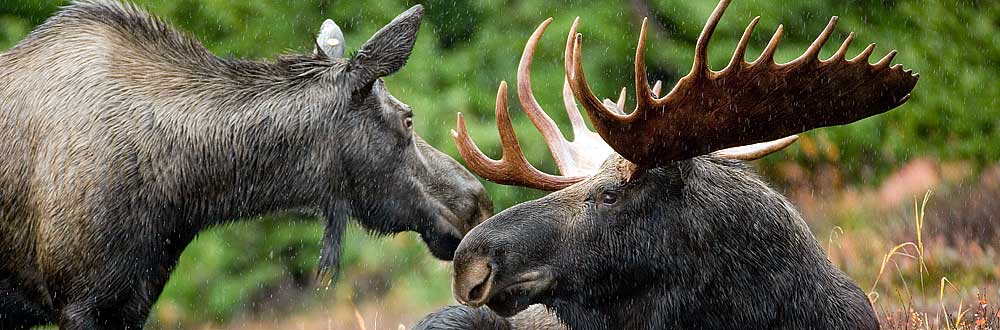
Etymology of Moose
The plural of moose is moose. The word’s roots are in the name of the animal in the Algonquian language Abenaki.
Duck Duck Gray Duck
Listeners who grew up playing the children’s game Duck Duck Gray Duck insist that this Minnesota version of Duck Duck Goose is more complicated and therefore more fun.
Accent Implying Intelligence
Why do so many Americans think British accents automatically connote intelligence?
Southern Sentence about a Dilemma
In parts of the South, it’s not uncommon to end a sentence about a dilemma with the word one, short for one or the other, as in “I’m going to quit my job or get fired, one.”
The First Dirty Word
How did the first person to say a dirty word know it was a dirty word? Geoffrey Hughes’ Encyclopedia of Swearing is a great source on this.
Books for Math Lovers
For the math lovers out there: Listeners on our Facebook page recommend Fermat’s Enigma by Simon Singh, and In Pursuit of The Unknown: 17 Equations That Changed The World by Ian Stewart.
Origin of “Thrown for a Loop”
The idiom thrown for a loop most likely derives from boxing and the image of someone knocked head over heels.
Waiting for a Bone Riddle
A riddle: What runs over fields and woods all day, under the bed at night sits not alone with its tongue out, waiting for a bone?
This episode is hosted by Martha Barnette and Grant Barrett, and produced by Stefanie Levine.
Photo by U.S. Fish and Wildlife Service Headquarters . Used under a Creative Commons license.
Books Mentioned in the Episode
| The Surname Detective by Colin D. Rogers |
| Dictionary of English Surnames by Colin D. Rogers |
| Encyclopedia of Swearing by Geoffrey Hughes |
| Fermat’s Enigma by Simon Singh |
| In Pursuit of The Unknown: 17 Equations That Changed The World by Ian Stewart |
Music Used in the Episode
| Title | Artist | Album | Label |
|---|---|---|---|
| Caretera Panamericana | Piero Umiliani | To-Day’s Sound | Liuto Records |
| Truck Driver | Piero Umiliani | To-Day’s Sound | Liuto Records |
| Green Valley | Piero Umiliani | To-Day’s Sound | Liuto Records |
| Mellow (Version) | Karl Hector and The Malcouns | Sahara Swing | Stones Throw |
| Tidal Stream | Piero Umiliani | Il Corpo Soundtrack | Sound Work Shop |
| Princess | Piero Umiliani | Il Corpo Soundtrack | Sound Work Shop |
| Softly Sonora | The Cabildos | Crossfire | Vroommm |
| Mystical Brotherhood | Karl Hector and The Malcouns | Sahara Swing | Stones Throw |
| Borderland | The Cabildos | Crossfire | Vroommm |
| Habana Keynote | The Cabildos | Crossfire | Vroommm |
| Let’s Call The Whole Thing Off | Ella Fitzgerald | Ella Fitzgerald Ella Fitzgerald Sings The George and Ira Gershwin Song Book | Verve |


I never thought about it, but my parents (Deep South, y’all) added that post-dilemma “one” in my hearing as I was growing up in San Diego! I suppose it’s short for “one or the other.”