A highly anticipated children’s book and the epic history behind a familiar vegetable: fans of illustrator Maurice Sendak eagerly await publication of a newly discovered manuscript by the late author. And speaking of children’s literature, some wise advice from the author of Charlotte’s Web, E. B. White: “Anybody who shifts gears when he writes for children is likely to wind up stripping his gears.” • When is a mango not a mango? If you’re in Southern Indiana, you may not be talking about a tropical fruit. • The longest f-word in the dictionary has 29 letters, and is rarely used — partly because pronouncing it is such a challenge. Also, Limestone Belt, I swanee, gorby, fluke print, pour the cobs on, and liar, liar, pants on fire.
This episode first aired October 14, 2017. It was rebroadcast the weekend of August 26, 2019.
Transcript of “Pants on Fire (episode #1479)”
You’re listening to A Way with Words, the show about language and how we use it. I’m Grant Barrett.
And I’m Martha Barnette. We talked a couple of weeks ago about the Smile Belt, which is a region of the United States that’s defined if you go down one coast and across the bottom and up the other coast. And marketers talk about marketing to the Smile Belt, the fast-growing regions of the U.S.
And we asked what other belts there are in the country besides the Bible Belt and the Pine Belt. And we heard from Wendy Sterling in Pennsylvania who points out that in Pennsylvania they have the potato belt because there are a lot of potatoes grown in Pennsylvania.
I did not know that.
And, in fact, it’s sometimes called the potato chip belt because there are a lot of snack foods produced in Pennsylvania.
I think I knew that.
Bags of potato chips will often say that they were made in Pennsylvania.
In Pennsylvania.
Yeah.
In fact, sometimes they call that part of Pennsylvania the snack belt.
We heard from Carolyn in Brattleboro, Vermont.
She says people from up in northern Vermont call us the banana belt because to them we’re so much warmer.
Is it really that different?
You know, apparently it is.
And what’s interesting is we also heard from Howard in Fairbanks, Alaska, who said that the same thing happens there, that they frequently refer to the area south of the Alaska Range, that is Anchorage in that area, as the banana belt because it’s warmer there.
Just enough warmer.
Yeah.
Wow.
So they go there on holiday in their shorts and flip flops.
Right.
Right.
Like all those people from Oklahoma who come here to…
You’ve got to find that one week between the snow and the bugs, right?
Yeah, yeah.
The banana belt.
That’s cool.
Well, we know there are a lot more belts where you come from and not onion belts like Grandpa Simpson used to wear.
Give us a call, 877-929-9673.
Email us.
All your language questions, anything.
words@waywordradio.org or talk to us on Twitter @wayword.
Hello, you have A Way with Words.
Hi, this is Emily. I’m calling from Indianapolis.
Hi, Emily. Welcome. What’s going on?
Thanks. Well, I was at a cousin’s graduation party, and my uncle and I got into a little bit of an argument about the origin or the correct ending for the phrase, liar, liar, pants on fire.
He seems to think that it is your nose is longer than a telephone wire, and I had always heard hanging from a telephone wire.
So I did a little research.
Well, I checked it out on social media and put out a call for some answers.
His version seems to be the most popular of those who responded.
But I got some really weird variations.
Okay.
Yeah, let’s hear those.
I got sitting on a telephone wire.
Hang your nose from a telephone wire.
Your nose looks like a telephone wire.
And then my cousin was the weirdest.
She said, stick your head in boiling water.
So liar, liar, pants on fire.
Stick your head in boiling water.
That doesn’t rhyme.
Right.
Her sister seems to think she got it through the phrase, wash your face in dirty water, which is what she had heard.
So your version is, what is it, hanging from a telephone wire?
Right.
Okay.
Why did this come up?
Who was the liar?
Yeah, what was going on?
Oh, I don’t even remember.
Oh, okay.
And he doesn’t either.
Oh, one of those parties.
One of those arguments.
How many arguments have become about the argument and you don’t even remember the point?
Well, I was all in good fun.
All right.
Here’s the little that we know about this.
First, it doesn’t appear to be that old.
Any version of this, Liar, Liar, Pants on Fire, we first find firmly in print in the 1930s.
The researcher Barry Popik, P-O-P-I-K, has done some digging on this.
And he found a slightly similar version of something about Liar, Liar, da-da-da from 1840s.
But I don’t think that’s the origin of it because there’s a giant gap of 90 years.
And between the two.
So it’s probably just a coincidence and it’s not about Pants on Fire.
That said, the earliest versions that we know of this rhyme where you rhyme liar, liar, pants on fire with something else is from 1941 and it is liar, liar, pants on fire, nose is as long as a telephone wire.
Okay.
And that’s his version, right?
Your uncle’s version?
Great.
Yeah, and he and my mom both said that it came from their mother who would sing it to them.
Yeah, it’s definitely a children’s rhyme.
Okay.
And occasionally in the early years, it would be telegraph wire when the telegraph was common.
But since the telegraph doesn’t really exist for us anymore, that’s now a telephone for anyone who knows the rhyme.
Right.
And do you know the melody that she would sing?
I don’t know that.
Oh, too bad.
Okay.
Because there is a kind of a taunting-ness to it, right?
Yeah.
And so the image is like Pinocchio, right?
Yeah.
The one’s a telephone wire? Okay.
Yeah.
The other thing about this is there are more elaborated versions of the rhyme that some people know that are beyond the two lines that we’ve been talking about so far.
And one of the kind of canonical ones is, liar, liar, pants on fire, hanging by a telephone wire.
While you’re there, cut your hair and stick it down your underwear.
Oh.
That’s pretty cool.
Yeah.
And so the ones that you said about, what is it, hair, water, I don’t even know.
What were yours?
Stick your head in boiling water or wash your face in dirty water?
Yeah, it sounds like there’s some lines missing there.
Interesting.
Anyway, so there we go.
The best that we can do is the earliest version that we know of is of the whole rhyme, or some version of the whole rhyme is from 1941.
Great.
Well, thank you so much.
Yeah, our pleasure.
And what are you going to do now that you’ve proven your uncle right?
Well, I’ll call him and tell him because I’m a good sport.
Oh, there we go.
That’s the way.
Start some new argument, though, just so he has something to talk about.
And then call us about it.
Oh, we have plenty of those.
All right.
So we’ll hear from you again.
Thanks for calling.
Thanks, Emily.
Thank you.
Have a good day.
Bye.
Bye-bye.
Do you know, I never heard the last part of that at all.
I’ve never heard anything beyond liar, liar, pants on fire.
Oh, really?
Yeah.
It’s sort of like happy as a clam, right?
What, you never heard telegraph wire or telephone wire?
Nope.
Nope.
What?
Nope.
I’m not lying either.
Preacher’s daughter.
They kept it from you.
So call us, 877-929-9673, or send your questions about language to words@waywordradio.org.
We had a voicemail from Kate Patrick in Indiana who said that when she was growing up and her mom walked into her room and it was a mess, she would say that this room looked like it was sent for and couldn’t go.
Oh, yeah. I’ve heard that one.
Have you?
As a Southernism, maybe?
I don’t know if it’s a Southernism or folk saying.
I’ve seen it back as far as the 19th century.
Yeah.
I heard it in the 1970s from comedian Jerry Clower.
Oh, I remember him. Sure.
Talk about somebody who was a Southerner.
He looked like he was sent for and couldn’t come.
Right.
Like I could just imagine somebody like spinning around in a circle with indecision or not knowing what to do or where to go.
Yeah, the sense I have of, and her phrase was sent for and couldn’t go.
That’s what I’ve seen mostly is, you know, like you’re all dressed up, but you can’t go someplace.
Or it describes people who are sort of like forlorn or at a loss, you know.
Like the one that I saw referenced to it from 1863 where people were on a ship and were seasick and they had this whole meal set before them, but they just look kind of sad, you know, like they were sent for and couldn’t go.
Hello, welcome to A Way with Words.
Hi, my name is Katie. I’m from Tallahassee, Florida.
Hello, Katie. Welcome to the show.
Hi, Katie.
What’s up?
Well, I have a question about a word that my grandfather used to use a lot, al-swani.
And I just found out lately that another close friend of mine’s parents used to say it too.
And I was just wondering what the origin of that word is and what it means.
And you said it was a grandparent of yours?
Yeah, my grandfather used to use it.
He used to live up in the mountains of Virginia.
-huh.
And our family friend’s parents lived in Alabama.
So I don’t know where this region is.
Is it a regional thing?
Oh, okay.
So it’s I-Swanee?
Mm—
And what kind of context, Katie, would you hear your grandfather say it in?
He’d say it all the time.
You know, if he got frustrated with my grandmother or me, he’d go, I’m just going to go to my room or, you know, everything like that.
Was he a particularly conservative person?
Yes, he was a gospel singer.
He used to be in quartets and sang in gospels and stuff.
So he was kind of conservative.
He didn’t talk a lot.
Okay.
All right.
So he’s conservative with his language, too, then.
I see where you’re going with this.
You do see where I’m going.
Yes, yes.
Because Swanee is a kind of mild oath.
It’s a way of exclaiming without saying anything naughty, without taking the Lord’s name in vain or anything like that.
It may actually go back to a Northern English dialect expression, I shall warrant, meaning basically I swear.
But I don’t know about your grandfather, but my mother wouldn’t swear.
She was a Southern Baptist.
No, my grandfather would never swear.
My grandfather, he would never swear.
There you go.
So the Northern English dialect version of it was I shall warrant.
So W-A-R-R-A-N-T.
And so this is just a consolidation slash corruption slash condensation of those words?
Yeah, I shall warrant, meaning I shall swear, but without saying swear.
But yeah, my mom was a Southern Baptist from the Blue Ridge, and so she wasn’t about to swear.
And it sounds like your grandfather was sort of the same.
Yeah, that’s really interesting.
Isn’t that cool?
Do you say it yourself now, Katie?
Yeah, I say it sometimes.
Do you say it just unconsciously or kind of ironically?
Sometimes I’ll say it unconsciously because he used to say it a lot.
And then, you know, I picked it up because I was around him a lot.
Aw, I love that.
Carry it on.
And he, by the time it got to him, he had hundreds of years of history anyway.
Right.
And if you carry it on, it’ll just keep going.
Right.
That’s great.
And thank you, guys.
I was just really curious what it was, the origin and what it meant.
Yeah.
Yeah, that’s it. It’s a way of swearing without swearing.
And it’s what we call a linguistic heirloom in that you’re going to be carrying on your grandfather’s expression.
Oh, that’s really cool. Thanks, guys.
Katie, love to talk to you. It’s great. Thanks for calling. Really appreciate it.
No problem. Goodbye.
Take care.
Bye-bye.
So in this country, even now, it’s still used mainly in the American South, right?
Maybe kind of bleeds a little bit into some of the surrounding areas, but still showing that settlement pattern of people from the Scots-speaking regions and so forth, right?
Scots-Irish, yeah.
Scots-Irish even.
Or join us on our Facebook group.
Just look for A Way with Words.
We were talking at the top of the show about belts, geographical areas defined by a certain characteristic.
And we left out the Indiana Stone Belt.
We heard from Mark Kimmel, who lives in southern Indiana, and he was talking about the fact that there’s this narrow line of limestone that Indiana is famous for.
And it’s either called the Limestone Belt or the Indiana Stone Belt.
He’s very proud of their stone there.
It’s used all over the world.
That’s cool.
I didn’t know that.
Oh, yeah.
Now I do.
Yeah, in Grand Central Station, for example, a lot of the stone there is Indiana limestone.
And you may remember the 1979 film Breaking Away, which is about the bicycle competitions.
And there were these guys who rode bikes, and there’s a big race scene at the end.
But they were called cutters.
They weren’t the students there in central Indiana.
They were the cutters, and that has to do with limestone cutting.
Oh, I love it.
It all kind of clicks, right?
Click, click, click.
You’ve got a film.
You’ve got bicycle racing.
You’ve got a school.
You’ve got the Indiana Stone Belt that Mark Kimmel is very, very proud of.
He’s in the stone business.
Thanks, Mark.
I feel educated now.
Email us, words at wewordradio.org.
Or talk to us on Twitter, W-A-Y-W-O-R-D.
This show is about language examined through family, history, and culture. Stick around.
You’re listening to A Way with Words, the show about language and how we use it.
I’m Martha Barnette.
And I’m Grant Barrett, and we’re joined by our quiz guy, John Chaneski in New York.
Hi, John.
Hi, Grant. Hi, Martha.
Hi, John.
What is up?
Well, I have a letter change puzzle for you today.
We’ve done these before, but this is admittedly one of the strangest letter change quizzes I think I’ve ever done.
I’ll give you the name of a breed of a dog.
Then I’ll describe a new version of that breed that has one letter changed in its name, and you tell me the new name.
Okay?
Okay, for example?
For example, start with a Rottweiler.
The new breed can live on carrots, parsnips, turnips, and the like.
That means you’ve got a…
Carrotweiler.
That’s a good guess, but no, we’re changing a letter, not adding letters.
Oh, just one letter.
So Rottweiler needs a letter changed.
Right.
And how about a Rootweiler?
Yes, a Rootweiler.
Yeah, look for a word within the name of the dog and then change one of the letters.
Now, quite often, these new breeds have some very useful characteristics, as you’ll soon see.
Here’s a tip.
Write the name of the starter dog down, and then, like I said, look for a word within that name, okay?
Gotcha.
Here are some more.
Start with a pug.
The new breed can tap a keg of beer and pour you a pint.
A mug, a plug.
A glug.
No, just change one letter.
Oh, change it.
Oh.
Yeah.
Why can’t we get this?
That’s okay.
Where do you go for a mug and a pint?
That’s right.
A pub.
A pub dog.
Yeah.
Start with a Labrador retriever.
The new breed is very useful for hailing a taxi.
Labrador Retriever.
Yeah.
Cabrador.
Yeah, Cabrador.
Yeah, Cabrador Retriever.
Yeah.
Useful in New York and Chicago.
Start with a bulldog.
This new breed gives off light you can read by.
A bulb dog.
A bulb dog, yes.
You can save a lot of energy that way.
I’m imagining a bulldog with a firefly butt.
Yeah.
It glinks on and off.
I think it’s a great idea.
Start with a beagle.
The new breed is large and floats and can sink a ship.
A bargle?
No.
No, a bargle.
Close, though.
Beagle?
It’s large and cold and can float and can sink a ship.
Burgle.
A burgle, yes.
An icebergle, yes.
Oh.
Start with a chihuahua.
The new breed is always in style.
A chihuahua?
A chihuahua?
Yes, a She-Qawa, yes.
Start with a Great Dane.
The new breed is very at home on the beach.
Great Dune?
A Great Dune, yes.
Start with a Yorkshire Terrier.
The new breed can be trained to use eating utensils.
A Forkshire Terrier.
Yes, a Forkshire Terrier.
I’d like to see a picture of that.
Why not?
Start with a Pomeranian.
The new breed can give Babe Ruth a run for his money as the Sultan of Swat.
Homeranian.
A Homer Indian, yes.
Oh, we’re on a roll now.
Start with a Springer Spaniel.
The new breed can instantly tell you the price of an item at the supermarket checkout.
Really?
I just imagine walking around with these little barcode scanners.
There you go.
Springer Scaniel.
A Springer Scaniel.
Yes, very good.
Now, finally, start with the Dalmatian.
The new breed, hardly any change at all.
It’s still man’s best friend.
Palmation.
Yes, a palmation.
Palmation.
That’s great.
That’s so sweet.
I’ll see you guys next time.
I’m loving all these mental pictures.
So great.
Bye, John.
Thanks, buddy.
Bye, John.
Thanks.
Bye, Martha.
You know, we love to goof with language on this show.
Join us on the line and tell us your goofy thing about language, 877-929-9673.
Or if you’re a little reticent, just put it in email to words@waywordradio.org.
Or talk to us on Twitter, W-A-Y-W-O-R-D.
Hello, welcome to A Way with Words.
Hi there, this is Beth Harris and I’m calling from Mandeville, Louisiana.
Mandeville, Louisiana. Welcome to the show, Beth.
Thank you.
My grandfather used to say this funny thing and I’ve never understood where it came from.
If you had a full gallon of ice cream in the refrigerator and then you woke up the next morning and most of it was gone, he would always say that the Gorby got it.
Or if you were offered a cookie, but you took three or four as a little kid because, you know, you were greedy, then he would tell you to not be a Gorby.
What was he like? What was his background?
He was born in 1911, and his surname was McNeil. We grew up in Maine and very near the Canadian border.
So I’m thinking it’s maybe some sort of a Scotch-Irish kind of thing.
Yes, good instincts.
And so I always envisioned the Gorby as some sort of little gremlin who snuck in and ate whatever was yummy while you weren’t looking.
So like a mythical character, a monster or something, or a gremlin.
And then it could also sort of be used as a verb, too, that, you know, well, what happened to all the M&Ms? Well, so-and-and-so-and-so gorbied them all up.
Fascinating.
I’ve never heard this word before, but it’s in the dictionary of the Scots language. Gorb means a gluttonous person.
Hey. How about that?
Well, that’s so cool.
Yeah. It may go all the way back to Scots word gorb, which means an unfledged bird that is a really, really young one.
You know how they have their little mouths open and the mother bird comes and feeds them? When they’re in the nest.
Yeah, just really little and ravenous.
Well, that is pretty cool. I’ve always wondered.
I mean, I looked it up and the only thing I could find for Gorby was Mikhail Gorbachev. That was his nickname, which obviously has nothing to do with this.
Yeah, yeah, different Gorby, but G-O-R-B or G-O-R-B-I-E. It’s a Scots word. Gorby.
The Maine connection is interesting to me on this.
So McNeil connects to the Scots that you found in the Dictionary of the Scots Language, Martha, right? But in Maine, we have another dictionary, the Dictionary of American Regional English, which says that a gorby is a Canadian jay.
And jays are known to be greedy, kind of rapacious animals.
A bird. A bird, yeah, the bird.
And most of the citations for gorby in the Dictionary of American Regional English are from Maine.
Very interesting.
So I wonder if there’s some kind of interplay here between the idea of the jay bird being greedy and also the old Scot’s term for a greedy person or thing possibly connected to baby birds.
That’s interesting.
So the gorby is the bird who comes and eats all the bird seed and shoves the other birds out of the way.
Yeah, you’ve seen jays kind of have way too much dominance over a bird feeder, right?
Interesting.
I grew up in Maine, but I’ve never heard anyone call a blue jay a gorby.
Well, it’s the Canadian, it’s the Canada jay. It’s not exactly the blue jay.
Oh, that’s entirely possible, too. I mean, where he lived was way up in northern Maine, so there was a great deal of Canadian influence there.
Aha.
So do you use it now, Beth?
Yeah, I still do sometimes. My kids look at me like I’m crazy.
But it’s one of those things you hate to see fall out of youth.
Well, exactly. And I wonder how it goes over in Louisiana, too.
Well, it’s funny. There are a lot of ties between Louisiana and Maine, too.
Of course. Yeah, yeah, yeah. With the Cajuns and the Acadians.
Sure.
So I’ve seen a lot of names and a lot of words that are the same, but no one here has ever accused me of being a Gorby.
Well, congratulations, Beth. We’re glad you called.
Thank you so much. I really enjoy your show.
Oh, thank you.
Thank you. Take care.
We’ve talked before about how English has a certain poverty of terms when it comes to kinship compared to other languages.
And that prompted a note from Diane Barentine. She lives in Farmer’s Branch, Texas.
And she says, it reminds me of a funny experience. I went with my husband to the funeral of the husband of the late sister of the late mother of his late first wife.
No blood relation to either of us. People asked me our relation, and when I tried to explain, their eyes glazed over.
My husband was married to the daughter of Big Gus’s first wife’s sister-in-law. And everybody said, what?
And she writes, so the daughter-in-law of the deceased took my arm and led me around the room, introducing me as our cousin from Dallas.
Years later, we’re still the cousins from Dallas.
Old-time Texans have long used the word cousin to describe a difficult-to-explain relationship.
Absolutely.
And it is that way around the world. I’m thinking of Hawaii, for example.
Cuz can just be your literal cousin or just close friend of the family who’s kind of in your peer group, kind of your age.
Yeah, it’s sort of like our discussion about aunts or aunts. An uncle, right.
Yeah, and many calls. We got so much email and so many phone calls, and we talked about calling people uncle or aunt out of respect, not because they’re blood related to you or marriage related to you.
Yeah, that’s a lot easier than my husband was married to the daughter of Big Gus’s first wife’s sister-in-law.
But that’s a real connection. That’s what’s interesting to me is like it sounds strange to say, but when you’re living that relationship, it’s real and authentic.
And you are a part of the family.
Yeah, you just need a chart or something.
Hello, you have A Way with Words.
Hi, this is Sarah calling from Missoula, Montana.
Hi, Sarah. Welcome to the show. What can we do for you?
Thank you.
Well, I’m calling to see about the expression don’t know from, when people use it really to mean that somebody doesn’t know about something.
I don’t hear it said too much here in Montana, but I think I’ve heard it on movies.
And I recall maybe like two people that I’ve heard say it in real life, and I think they were from the East Coast.
So I’m just wondering where people say it and where that from comes from.
So can you give us an example or two? Usually people, I think, use it to mean like, you don’t know anything about this.
So, you know, why’d you let Jim work on your computer? He doesn’t know from hard drives.
Or my friend Kathy says she has too many wrinkles, but she’s only 30 years old. She doesn’t know from wrinkles.
You don’t know from wrinkles. And so the movies you saw with people on the East Coast, would it happen to be places like New York and Boston?
Yeah, I think so. I think I’ve heard it in like a Woody Allen movie or something.
Of course, yes. There you go.
That’s like the Ur source for these kinds of expressions.
Yeah, not so much Montana.
Yeah. No.
The thing is, it comes from Yiddish. It’s a cow kind of a direct borrowing word for word from a Yiddish phrase, which literally means he doesn’t know anything about anything or he doesn’t know anything about nothing.
He knows nothing about nothing with the double negative kind of reinforcing there.
And in Yiddish, there’s a few versions of it. I know that all my Yiddish speakers are going to correct me, and please do. I welcome that.
But generally, like a lot of these kinds of expressions, it’s kind of like you throw it on at the end of a sentence when you’re kind of scoffing at what someone else is saying, and it’s kind of a tag on the end of it.
He doesn’t know anything. He doesn’t know from nothing.
And the fun there is from.
Yeah, yeah.
And so the from is a direct translation of the preposition from Yiddish.
And what’s really interesting, you find this again and again when you learn other languages.
Prepositions do not track very well from language to language, even when you’re comparing, say, romance languages or where they look alike, like there may be Germanic languages.
It just doesn’t always work.
And so this is a case of a mistranslation. But it sounds interesting.
So because it kind of came, it’s catchy, it’s almost a catchphrase, it’s stuck and nobody corrected that from to about.
Okay.
He doesn’t know from nothing. I was wondering.
Yeah.
One last thing I want to share with you, Sarah.
The earliest version that I know of in print of You Don’t Know From Nothing or He Doesn’t Know From Nothing comes from a Rube Goldberg cartoon in 1931.
And you’ve probably heard of Rube Goldberg devices, these strange constructions where you, say, drop a penny in the top and a boot kicks a bowling ball and magical things happen at the very end of it.
So it’s not that old in print, although I’m sure it was spoken for much longer before that in English.
Well, that’s a lot of good information.
Thank you so much for helping me out.
Yeah, sure.
Our pleasure.
Thanks for calling, Sarah.
Bye, Sarah.
Thank you.
All right.
Bye-bye.
Call us 877-929-9673.
I came across a cool word the other day, fluke print.
This is the record of all the times I accidentally get a crossword clue correct.
So they’ve recorded my flukes.
No.
No.
I’m not even going to say that’s a good guess because it’s not.
Is it fluke related to fish or sea creatures that have fins?
How about whales?
Whales.
Yeah.
Yeah.
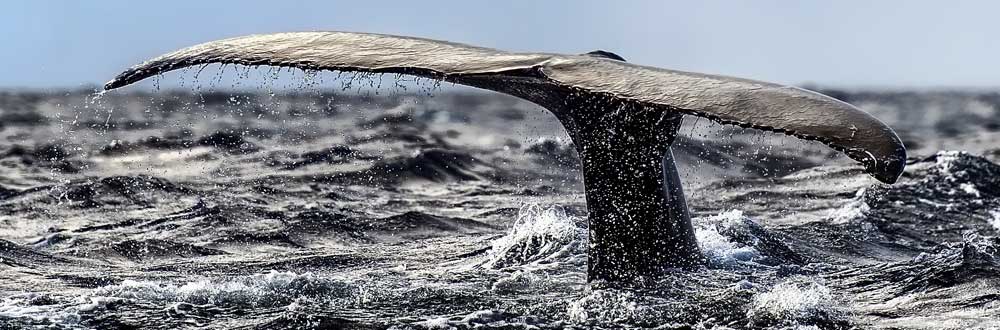
Fluke prints are the circular patterns that whales leave on the surface of the ocean when they go under.
Oh, so like.
That sort of hydraulic process.
So is that weird, you can tell that something went down there because the surface of the water looks different?
Yeah.
Yeah.
Fluke print.
Isn’t that nice?
We’re going to have to take a whale tour, Martha.
Okay.
Five hours on the water?
We can do that right here in San Diego.
We can, actually.
Blue whale’s coming by every day now.
That’s right.
Hi, you have A Way with Words.
Hi, this is Bryce from San Clemente, California.
Hi, Bryce.
What’s up?
What can we do for you?
Well, I got a question.
It’s one that’s been puzzling amongst my friend group for quite a while,
In terms of which is the proper word.
I can tell you the scenario if you’d like.
Yeah, please do.
So when you’re with at least one other person and you have some sort of smoking device, whether it’s a pipe or another type of device,
And when whatever you’re smoking in there is finished, some people say the bowl is cached and other people say the bowl is cacked.
And there’s kind of been like two disciplines of people always arguing that, no, it’s cached, no, it’s cacked.
So I’m kind of curious on how that came and which one’s the right word.
Let me clarify a little bit here.
So we’re talking about a group of people smoking a bowl together.
The laws are different in California, so we all know what you mean.
And some people say when that bowl is nothing but ash, that it’s cached.
And some people say that it’s cached, C-A-C-K-E-D.
Which do you say?
I would say cached.
I think they’re actually saying cached, like C-A-C-T-E-D, cached.
Oh, interesting.
So it’s either C-A-S-H-E-D or C-A-C-T-E-D or K-E-D.
I am 100% sure that it’s C-A-C-K-E-D because we can trace the word CAC through a variety of different slang mechanisms back to its point of origin.
All right?
And we can actually do that with Cached as well.
So they both are in current use to mean that something is finished, completed, exhausted, done.
So they’re both currently used in a variety of contexts to mean that.
Cacked comes ultimately from a word meaning poop or excrement.
And so it goes back in both American English and Australian English.
It’s particularly common in Australian English to a variety of slang uses, usually cacked out.
If something is cacked out, it means tapped out, exhausted, done.
You might say that we were out till 3 a.m. I am cacked out.
There’s no way I’m going to make it to brunch, right?
It just means you’re finished. You’re exhausted.
It’s the same exact use that you hear in people who smoke bowls together.
Cashed, more interestingly to me, comes from gambling because you cash in your chips means you are finished gambling.
You are done.
And we have a huge number of uses of cash in or cash out or just to cash over, I’d say, 150 years easily.
All of them referring to giving up or dying or completing or finishing and all of them having to do with like the expiration of the current activity.
And by the 1980s, we have in print slang uses of people saying this pipe is cached.
And they’re literally talking about smoking tobacco or they’re talking about smoking marijuana.
So it can be either one from completely different origins.
Yes, that’s right.
They’re different cultures.
So what you’re getting here, Bryce, is two different slang cultures colliding in San Clemente.
Yeah.
Oh, that’s pretty crazy.
Right?
You know, both people swear that they’re right.
So I guess they are.
They’re totally, completely right.
And they both have long histories behind them.
It’s just, it’s a coincidence, I think, that they sound alike.
There they are, right next to each other, having this kind of disambiguation problem.
Well, that’s good to know.
Yeah.
I mean, both of them make sense now that you’ve explained them.
Yeah.
Yeah.
Okay.
Well, thank you for that.
Yeah.
No worries.
Thanks for calling.
Really appreciate it.
Bye.
I love the idea of a great slang collider on the coast there in San Clemente.
That’s how we power California.
That’s right.
It’s a green electricity powered by slang collisions.
Yeah, very green.
Well, what word have you been kicking around with your buddies?
Call us, 877-929-9673, or send us an email.
The address is words@waywordradio.org.
I’d like to buy him for what he’s worth and sell him for what he thinks he’ll bring.
Oh, that’s good.
That’s good.
You want to save that one, right?
I know, right?
That one you need for like the floor of Congress or when you’re debating your biggest opponent on national television.
It seems like the more common version is I’d like to buy him for what he’s worth and sell him for what he thinks he’s worth.
But I like the other one.
What he thinks he’ll bring.
You’re listening to A Way with Words, the show about language and how we use it.
I’m Grant Barrett.
And I’m Martha Barnette.
Fans of the children’s book author and illustrator Maurice Sendak, myself included, are eagerly awaiting his new book.
Now, of course, he died in 2012, but the director of the Maurice Sendak Foundation was going through some of his old files last year and found an unpublished manuscript that Sendak had worked on with his longtime collaborator, Arthur Yorinks.
And the book is called Presto and Zesto in Limbo Land.
And it’s illustrated.
How great is that, right?
So the book itself was in limbo land for about 30 years, and it was just tucked in a drawer and forgotten.
But the great news is it’s coming out next year.
Cool.
It’s going to be published.
Nice.
And, you know, in Sendak’s last televised interview, he was asked about writing for children.
And what he said was, I don’t write for children.
I write and somebody says, that’s for children.
And that reminded me of a quotation that I saw from E.B. White, the author of Stuart Little and Charlotte’s Web.
E.B. White said on the topic of writing for children,
Anyone who writes down to children is simply wasting his time.
You have to write up, not down.
Children are demanding.
They’re the most attentive, curious, eager, observant, sensitive, quick, and generally congenial readers on earth.
They accept almost without question anything you present them with,
As long as it is presented honestly, fearlessly, and clearly.
I handed them, against the advice of experts, a mouse boy,
And they accepted it without a quiver.
In Charlotte’s Web, I gave them a literate spider, and they took that.
And I’m sure that you can appreciate that as well, right?
You read a lot of children’s literature.
We do, and my son is very accepting of things,
And that honesty part in there, that’s the most important thing to him.
There have been some books that we’ve read, and I won’t tell you the title because I don’t want to ruin it for you,
But there was one where 99% of it was a pretty great story about a bunch of kids in New York City having typical kid dramas
And kind of conflicts with parents and school and so forth.
And then at the very end, it turns out it’s all about time travel.
And he was so angry at that book.
Oh, yeah.
He felt so cheated that the signs weren’t there for him.
There wasn’t the signal that this was going to be that kind of book.
I think you have to leave the trail for them.
Right.
I think it’s about respecting your reader, right?
Presenting it honestly, fearlessly, and clearly.
Clearly.
Yeah.
White was also asked, do you change gears?
Do you shift gears to write for children?
He said, if you shift gears, you’re going to strip your gears writing for children.
You’ve got to be honest.
So the books we enjoy, for example, we’re currently reading the third book in the Philip Pullman, His Dark Materials series.
This is a hard book.
It’s a lot of big words.
It’s stuff that we don’t necessarily understand on the first read.
But my son’s into it.
Oh, really?
Because he feels like it’s the taste of the world to come, where I will be an adult and people will challenge me like this all the time.
Oh, super cool.
Well, speaking of to come, I can’t wait for the new Marty Sendak book.
Outstanding.
Tell us about the books that you’re reading, what you like about them, and share the particularly wonderful passages.
Send them to words@waywordradio.org or call the voicemail 877-929-9673.
Hello, you have A Way with Words.
This is Rosemary from Evansville, Indiana.
Hey, Rosemary, welcome.
What can we do for you?
Well, I have a question about an expression that my southern Indiana mother-in-law used.
Talking to other folks from the same town, they remember their parents using this expression.
I actually grew up out east but relocated to southern Indiana and married a fellow who was raised up here in a small town.
The first time his mother was talking to me about making her family’s favorite chili sauce, she asked me to bring in some tomatoes and mangoes from my garden.
And I was kind of confused because you don’t grow mangoes in southern Indiana.
No, you don’t.
Yeah, not typically.
And I thought that would make a rather interesting chili sauce.
Mangoes, what are you talking about?
And she said, you know, mangoes, mangoes.
And I said, well, I don’t have mangoes in my garden.
She said, yes, you do.
Peppers.
Green peppers.
And I was like, oh, I never heard a green pepper called a mango.
And I’ve never been anywhere else where people have heard it.
But people here, the older generation, and I mean older because I’m no spring chicken, they refer to green peppers as mangoes.
Is it only the older generation, or is it being passed on to the kids and grandkids at this point?
It seems to me like it’s mostly the older generation.
Because when I’ve talked to my husband’s cousins and stuff, who also grew up up there, we all had the same thing.
It was kind of like, yeah, we don’t know where they got this from.
And it’s not like it says mangoes on the shelf in the grocery store.
It says green peppers.
It’s kind of a really odd phenomenon.
And we were just curious about if you guys had any idea where that came from.
We sure do.
We do.
As a matter of fact, it is a story of 400 years of British history in India.
So pull up a chair.
I’ll make it brief.
But when the British first went to India, they encountered a wide variety of edible things that they could not bring home because there was no refrigeration.
So the way that they brought them home, they would pickle them or spice them up according to the local traditions.
And in that way, you could have a little sample of what it was like to eat food in India.
However, one of those fruits was the mango.
And there was a particular way, kind of like making a chutney, that you would prepare a mango.
And this is how most British people encountered mangoes for a very long time, as a kind of sauce, almost like a relish of a sort.
That particular name, mango, began to be applied to the pickling technique itself, or to the preparing technique.
It’s a preservation method, a preserving method.
Oh.
And so you can find a wide variety of recipes over the centuries where people talk about mangoing different kinds of fruit and vegetables, like you might mango a melon or you might mango a cucumber, that sort of thing.
But then it transformed one more time, and the pickling technique name, which came from the fruit name, then was reapplied to a couple of different vegetables, including green bell peppers, and it took the noun form of the verb, which had been verbed from a noun before.
That’s amazing.
Yeah, and we can trace this through cookbooks and journals and letter articles.
It’s a wide variety of written stuff where we can find copious evidence of this transformation of the word mango until it arrived in the New World, and for some reason, that particular noun mango, referring to green bell peppers, which for a long time were preserved using the mango pickling technique.
It stuck in the Ohio River Valley, including Indiana and neighboring states.
And that’s where we are.
That’s where you are.
Yeah.
It’s an incredible story.
Like the deep history that goes into this one, this single dialect feature has always amazed me.
That is really amazing.
Absolutely fascinating.
I’m so glad I called you guys and asked.
Oh, yeah.
We are, too.
I mean, I could write a book on this one word, and I would love to do it, but nobody would read it except for me, and maybe that would be enough.
I don’t know.
But I wanted, Rosemary, I wanted to say you said something about it not getting, it’s not named mango in the store.
We have talked about this at least once before on the show, and we got a message from a guy who works in the grocery business, and he told us that in order to make sure there’s no confusion in his business, they do label mango fruit and mango peppers on the boxes to make sure that people understand what they’re getting in that part of the country.
Oh, isn’t that funny?
Yeah.
So, Rosemary, you’ve just confirmed what we talk about all the time on the show, which is that there’s a world inside of every word.
And what a great history encapsulated in the word that you brought to us.
Mango, meaning green peppers, has got the whole tale behind it.
Well, that is just amazing.
And I am so glad I called you guys and that you shared that with me.
And I hope there’s other people that will smile like I am and say, oh, I’m so glad to know that.
Yay!
Thank you very much.
It was delightful to talk with you.
Thank you so much.
Thanks, Rosemary.
Bye-bye.
Like we say on the show all the time, the intersection of food and language is wonderful.
If you’ve got a food language question, give us a call, 877-929-9673.
Email words@waywordradio.org.
We had a conversation not long ago about the term hilltopping, which applies to butterflies’ mating behavior.
Well, we heard from Frida, who listens to us in Fairbanks, Alaska, and she wrote us about the behavior that’s also called hilltopping, the behavior of sledheads.
They’re snowmobile riders.
Snowmobile riders.
Yeah, they’re called sledheads.
And Frida writes, in Alaska and maybe elsewhere, snowmobile riders compete in hilltopping.
They ride as far up a slope as possible or as far as they dare before turning around or tumbling down.
The paths are narrow loops straight up the slope with a narrow turn at the top, then straight back down, hopefully.
And it’s sometimes called high topping, but they also refer to it as hilltopping.
So it’s sort of another kind of way of showing off for people you’re interested in.
That sounds exciting and dangerous.
I bet it’s both.
And cold.
I bet there are videos on YouTube of snowmobiles hilltopping.
Snowmobile slang.
We love slang from all different walks of life, whether it’s baseball, medicine, your workplace.
Let us know about it.
877-929-9673 or send it to us in email.
The address is words@waywordradio.org.
Hi, you have A Way with Words.
Hi, this is Mark from Indianapolis.
Hi, Mark.
Welcome to the show.
What can we do for you?
Well, I’ve got a question about a phrase which I first heard many, many years ago.
I ran high school cross-country, and this was back in the 70s.
And my grandmother would yell when we were on the course.
She’d say, it’s time to pour the cobs on, or it’s time for the cobs, which, you know, of course, we knew meant to run faster.
But we never really thought about it much at the time.
But this came to a head again not too long ago when we had a reunion.
And one of my teammates was wearing the T-shirts we had made back up in the 70s that had,
It’s time to pour the cobs on.
So we had not, you know, I really hadn’t thought of that in a long time.
And, of course, my grandmother’s passed away a long time ago.
And we were kind of trying to come up with what that might have come from or what it might have meant.
And, frankly, sort of came up empty.
We speculated, you know, maybe it has to do with, you know, you’re almost out of food.
So all you have left to eat is cobs.
But it didn’t really make any sense for us,
And we thought, you know, maybe you could help us on it.
So you’re thinking cobs as in corn cobs, C-O-B-S.
That’s what we were thinking, yes.
Okay, pour the cobs on, meaning give it a little extra juice, a little more energy?
I’m sure that was the context, yes.
Oh, boy, this is a good one.
The first theory that leaps to my mind is,
Have you ever burned a corn cob, a dry one?
They burned really great.
They’re fantastic.
I can’t say that I have.
Yeah, throw them on a fire and you’ll get a nice, good, rich flame there.
So that was one theory that, I don’t know, I’m guessing here.
I’m holding something in reserve that I’ll tell you in a minute.
But my first theory was that it had something to do with throwing cobs on, say, a train engine fire or, you know, on a fireplace or I don’t know.
Yeah, you’re down to the end of your meal and you just throw the cobs on.
Well, I wasn’t even thinking the meal.
I was just thinking, like, I’ve burnt the coal.
I’ve burnt the wood.
Oh, I see.
I see.
But to throw the cobs on, right?
Right.
Yeah.
That makes sense.
But the thing is, what I was holding in reserve, I will now reveal.
There’s a fantastic work called the English Dialect Dictionary, and they have a huge entry.
It’s like a page and a half of meanings of the word cob, C-O-B.
And a couple of those are really interesting here.
They refer to anything that’s kind of lumpy or something that might, you know, small stones.
Actually, it’s related to the word cobble, as in cobblestone.
So small or hard.
And one of those meanings is testicle.
And so what I’m speculating here that perhaps it was a more genteel way of saying to give it a little more testicular fortitude and run a little faster.
Oh, goodness.
I don’t like to think of my grandmother talking about it.
Well, that was my question.
Was she that type of gal?
Was she maybe a little bawdy or a little raunchy at times?
No, not at all.
Okay.
In fact, I think what you said earlier starts to make sense because I know that her father worked for the railroad.
Okay, sure.
So I wonder if maybe it does have something to do with, you know, putting something in a railroad engine.
It could be.
And then the other thing I wanted to tell you from the English dialect dictionary,
This is a six-volume work done in the late 1800s, early 1900s,
Kind of really doing a great job of summarizing the dialects of the United Kingdom.
There is a verb called to cob.
If you cob someone, it means you beat them at a contest or a race.
Oh, yeah.
But all of you all have T-shirts with this on it.
Well, yes, we did, you know, back in the day, because you always had training shirts.
Mine is long since gone.
But, yes, one of the guys could still squeeze into his high school shirt.
It was quite amazing.
To pour the cob on.
Well, the nice thing about this show, Mark, is that we have listeners all across the country,
In the world for that matter.
And if somebody else knows this expression, we’re going to hear from them, all right?
And when we hear from them, we’ll let everyone else know, too.
Well, good.
I’d like to know, and I think we at least have a couple leads here.
Mark, thank you so much for calling.
Well, I appreciate your help.
Thanks a lot.
Okay.
All right.
Thanks.
Bye-bye.
Bye-bye.
Pour the cobs on.
Give us a call, 877-929-9673.
Talk to us on Facebook.
We have a great Facebook group with a lot of cool people talking about language every day.
Hello.
You have A Way with Words.
Hi, this is June Gale from Virginia Beach, Virginia.
Hey, June. Welcome.
What can we do for you?
The longest F word in the dictionary has 29 letters,
And I can’t spell it right now because I don’t have it written down.
Yeah.
And I’ve had difficulty pronouncing it,
And my granddaughter couldn’t pronounce it.
And it means basically worthless or of little value.
And I’d like to know how to pronounce it.
And also, how could such a huge word mean, you know, of little value?
I bet I know the word you’re talking about.
Yeah, phloxenosa niolipilification.
Oh, I got it wrong.
Phloxenosa niolipilification.
I have been practicing.
Can I try it?
Yes, please.
Okay.
One second.
Bloxy, nausy, nihili, pillification.
Sure.
That’s pretty darn good.
That’s great.
Yep, that’s the word.
And it’s a stunt word if it’s going to make you feel any better.
It’s not like a word like this just pops out of somebody’s head as the word that they need for the moment.
No, it takes a lot of effort.
You should probably replace your electrolytes, Jean.
Well, I’ll tell you, I was looking online, and I came across this YouTube video where someone that belongs in Parliament,
I forget what they’re called, but in Australia, happened to use that word while he was addressing Parliament.
And people thought he was, you know, snooty and, you know, like that.
But I thought, oh, but I know what that word means.
They don’t give people that much credit.
Well, you know, I remember Senator Jesse Helms used it back in the day.
It’s a stunt word, though.
It really is.
It’s a show-offy word.
Well, if I could pronounce it quickly and use it in a sentence, I plan on showing off.
Okay, go for it.
Here’s the thing.
If you can pronounce this word fluidly without stumbling like I did, then you deserve and you have permission to use it.
So good for you.
Phloxynosinihilipilification.
There we go. Perfect.
And so what happened was this word was coined out of a bunch of words that mean nothing or very little.
So phloxynosinihilipilification, F-L-O-C-C-I, and nosin-A-U-C-I, and nihil-I-I-L-I, and pili-P-I-L-I,
And then fication just as a suffix that turns all those affixes into a noun, basically.
So it’s a noun about estimating something to be worth nothing.
The first use that we know of in print was by a guy named William Shinstone,
Who I have no idea what he’s known for, in 1741.
And he segments it out with hyphens between the syllable,
Or sorry, with the segments, the root segments of it,
Kind of indicating that he’s aware of the origins of this word.
Right. Okay. Okay.
Well, I sure do appreciate that.
Outstanding.
And I’m going to keep practicing that word.
There you go.
Yeah, thank you for your call. We really appreciate it.
Oh, thank you. Thank you very much.
Take care now.
All right, June. Bye-bye.
Bye, June.
You all said. Bye.
Want more A Way with Words?
Listen to years of past episodes at waywordradio.org
Or find the show on any podcast app or on iTunes.
Our toll-free line is always open,
So leave us a message at 877-929-9673 and we’ll take a listen.
We’d love to get your messages at words@waywordradio.org or hit us up on Twitter @wayword and look for us on Facebook.
This program would not be possible without you.
Grant and I are out to change the way we listen and think about language, and you’re making it happen.
Thanks also to senior producer Stefanie Levine, director and editor Tim Felten, director Colin Tedeschi, and production assistant Emma Kelman in San Diego.
In New York, we thank quiz guide John Chaneski and that master of keeping it real, Paul Ruist at Argo Studios.
A Way with Words is an independent production of Wayword, Inc.
From the Recording Arts Center at Studio West in San Diego, I’m Martha Barnette.
And I’m Grant Barrett.
So long.
Bye-bye.
More Belt Regions
 After we discussed the Smile Belt and other “belt” regions of the United States, listeners chimed in with more, including the Potato Belt and Potato Chip Belt in Pennsylvania, and Banana Belt, a term used for the southern regions of both Vermont and Alaska.
Liar, Liar, Pants on Fire Origin
The saying liar, liar pants on fire is part of a longer children’s rhyme that’s been around since 1841 or so. There are several different versions of what comes after the line liar, liar, pants on fire, such as “Hanging by a telephone wire / While you’re there, cut your hair / And stick it down your underwear.” A listener in Indianapolis, Indiana, reports finding other taglines, such as “Stick your head in boiling water,” and the milder “Wash your face in dirty water.”
Sent for and Couldn’t Come
To describe someone who is dazed, lost, or confused, you might say he looks like he was sent for and couldn’t go.
I Swanee
An 11-year-old in Tallahassee, Florida, wonders about a phrase her late grandfather used. Instead of swearing, he’d exclaim “I swanee!” or “I’ll swanny!” This mild oath, and its shorter version, “I’ll swan,” derives from an English dialectal phrase, “I shall warrant.”
Limestone Belt
The Indiana Limestone Belt has an abundance of this type of rock. The limestone industry figured prominently in the movie Breaking Away, in which affluent residents of Bloomington, Indiana, referred derisively to quarry workers and their families as cutters, as in stonecutters.
One Letter Makes a New Dog Breed
For this week’s puzzle, Quiz Guy John Chaneski is inventing new breeds of dogs by changing one letter in the name of an existing breed. If you take a Rottweiler, for example, then change one letter in the breed’s name, you’ll have a new mutt that can exist on carrots, parsnips, turnips, and the like.
Gorby
A woman in Mandeville, Louisiana, wonders about a term her grandfather used when someone hogged all the ice cream or took more of their share of cookies: “Don’t be a gorby!: This term may derive from the Scots word gorb, meaning “glutton.” Her grandfather was from northern Maine, where the term gorby also applies to a kind of bird called the Canada jay, known for swooping in and making off with food.
“Cousin” is a Word for Complicated Relationships
A woman in Farmers Branch, Texas, explains how the simple term cousin succinctly denotes a complicated relationship.
To Know From Something
The phrase he doesn’t know from (something), meaning “he doesn’t know about (something),” is a word-for-word borrowing, or calque, of a Yiddish phrase “Er veys nit fun.”
Fluke Print
A fluke print is the pattern a whale’s tail leaves on the surface of the water.
Cashed Bowl vs. Cacked Bowl
A man in San Clemente, California, and his friends are debating the term for when a substance you are smoking for pleasure is all used up. Is the bowl cashed or cacked? In this case, both terms work.
Buy Someone for What They’re Worth and Sell Them for What They Think They’ll Bring
For a clever way to describe someone as arrogant, you can always say, “I’d like to buy him for what he’s worth and sell him for what he thinks he’s worth” or “what he thinks he’ll bring.”
A New Sendak Book
A new Maurice Sendak manuscript, Presto and Zesto in Limboland, will be published in 2018, several years after the death of the beloved illustrator. E.B. White, author of Charlotte’s Web, had some wise advice about writing for children: “Anybody who shifts gears when he writes for children is likely to wind up stripping his gears.”
Where Bell Peppers are Mangos
A woman who relocated from the eastern United States to Evansville, Indiana, was confused when her mother-in-law there asked her to bring in some mangoes from the garden, since tropical fruits don’t grow in the Midwest. In that part of the country, the word mango means “bell pepper.” The reason involves a deliciously circuitous history.
Hilltopping/Hightopping on a Snow Machine
In an earlier episode, we talked about the butterfly mating behavior known as hilltopping, in which male butterflies try to appeal to females by flying as high as possible. A listener in Fairbanks, Alaska, reports that the term hilltopping is used among sledheads, or “snowmobile enthusiasts,” to mean a different kind of showing off — riding up a hill on a snowmobile as high as possible before falling back. This move is also called hightopping.
Pour the Cobs on
An Indianapolis, Indiana, man says that when his grandmother wanted to urge someone on, she’d say “It’s time to pour the cobs on” or “It’s time for the cobs.” What’s the origin?
Floccinaucinihilipilification
A woman in Virginia Beach, Virginia, wants to know the pronunciation of floccinaucinihilipilification, and why such a long word means “the habit of estimating something as worthless.”
This episode is hosted by Martha Barnette and Grant Barrett, and produced by Stefanie Levine.
Photo by Christopher Michel. Used under a Creative Commons license.
Books Mentioned in the Episode
Music Used in the Episode
| Title | Artist | Album | Label |
|---|---|---|---|
| Slacking Off | The Nassauvians | Daybreak 7″ | Cicada |
| Bacaloao Con Pan | Irakere | Irakere | Ariola |
| Hung Up | Salt | Hung Up 7″ | Choctaw |
| Killin It | The Egyptian Lover | Egyptian Empire Records | Egyptian Empire Records |
| Instant Funk | Merchant | Kaisoca Records Limited | Kaisoca Records Limited |
| April Fool | Isis | Isis | Buddah Records |
| Pass It On | Eddie Hooper and Storm | Pass It on 12″ | Tackle |
| Seduced | Egyptian Lover | 1984 | Egyptian Empire Records |
| Who Dun It? | Blue Mitchell | Collision In Black | Blue Note |
| Volcano Vapes | Sure Fire Soul Ensemble | Out On The Coast | Colemine Records |