

Don’t move my cheese! It’s a phrase middle managers use to talk about adapting to change in the workplace. Plus, the origin story of the name William, and why it’s Guillermo in Spanish. And a five-year-old poses a question that puzzles a lot of people: Why is the letter Q so often followed by a U? All that, and adynaton, an assonant quiz, do it up brown, salt of the earth, haven’t grown gills yet, wooling, a silly joke about the number one, a poem about regret, and hide-and-seek calls, such as Ole Ole Olson all in free!
This episode first aired June 12, 2021. It was rebroadcast the weekends of May 21, 2022, and April 13, 2025.
Transcript of “When Pigs Fly (episode #1571)”
You’re listening to A Way with Words, the show about language and how we use it. I’m Grant Barrett.
And I’m Martha Barnette. In English, if we’re talking about something that’s not going to happen, we might say it’s going to happen when hell freezes over or when pigs fly. But in Spanish, you can describe something impossible by saying it’s going to happen on the day when cows fly, el dia que las vacas vuelen.
And in Italy, it’s not cows or pigs flying improbably. It’s donkeys, they say, the equivalent of when donkeys fly.
And it turns out that there’s a fancy name for this rhetorical device. It’s called an atonaton. That’s A-D-Y-N-A-T-O-N. Adenaton. It comes from the Greek word that means impossible.
And atonatons go all the way back to antiquity. And you’ll find them in lots and lots of languages around the world today. Like in the Malay language, for example, they’ll say, it’s going to happen when cats grow horns. Cats get up to all kinds of trouble, but I wouldn’t put it past them.
Well, Grant, here’s one of my favorites. It’s from Bulgarian.
It translates as, oh, yeah, that’ll happen when the pig in yellow slippers climbs the pear tree.
Not just any pig.
Not just any slippers, the pig in yellow slippers.
The pig in yellow slippers.
That’s fantastic.
So all around the world, I guess you’ll share a bunch of these later.
How did you know?
Yeah.
My favorite, of course, is the French, which I have an affinity for when chickens have teeth.
Well, don’t wait until chickens have teeth to give us a call, 877-929-9673.
Email us, words@waywordradio.org, or talk to us on Twitter @wayword.
Hi there. You have A Way with Words.
Well, hello there.
Well, hello.
This is Kamala. I’m calling from Anchorage, Alaska, and I am so happy to be talking to you guys.
Hi, Kamala.
I’m a nurse, and I’ve been a nurse for, well, we’ll just say a long time.
We won’t say how long.
But I have been taking care of elder patients for quite some time.
I’m now in public health, but I took care of patients who had open heart surgery, pre and post surgery.
And a lot of my patients would come back to me after their surgery and we’d be so excited that they came through great and they were feeling great and looking great.
And, you know, I would go in and inevitably ask them on one morning, you know, how are you feeling today? Or, you know, how’s it going today?
And a lot of them would say, well, I haven’t grown gills yet, which I always thought was really funny. And, you know, I thought it was cute.
But a couple of months ago, a friend of mine who lives in L.A. was telling me about her elder neighbor who had gotten a vaccine, his vaccine, his COVID-19 vaccine.
And the first, he got really, really sick after the first vaccine, which, you know, it happens to quite a few people. And he’s an elder, so he was kind of down for a few days.
And so when he went to get a second dose, she said, well, you know, how are you feeling? And he said, well, I haven’t grown gills yet.
And so I thought, that’s got to be something. Where does that come from? It’s not a thing, yeah. You know, right. What is that? Where is it from?
Oh, I love that. You know, the one that I’ve been hearing when you ask people, you know, have you had any side effects from the COVID vaccine? Well, they were saying, when do I get my mutant powers or when do I get my superpowers?
So I’m wondering if it’s a generational thing. The young generation, they want to become X-Men or superheroes, and the older generation just is worried that they’re going to become a freak or a body snatcher or something, something out of an old black and white movie, you know?
Right, right. I know. I kept wondering if it was just a saying about reversion and evolution or devolution or something.
I wasn’t sure where it came from, but I couldn’t find anything about it. So I just wanted to turn to the people I knew would know.
Yeah, I’ve seen that come up. I don’t know if it’s a thing, but I do love that. I love the humor around serious situations.
I like how we can take a serious situation and put a little humor into it to put ourselves and the people around us at ease. That’s a real nice thing that we do for other people, isn’t it?
You probably see that a lot in your job as a nurse.
Yes.
I mean, a lot of people think that gallows humor is about dealing with really dark things in a way that we can process and handle for the moment.
And it does have, you know, after effects.
But, yes, with patients, you know, I want to be, you know, light, and I want to, you know, make sure I’m there for them and not, you know, making sure that they’re not taking anything too seriously or too darkly.
And I love it when patients make me laugh because that is, you know, that makes my day.
But the whole Gil thing was very funny.
Yeah, that’s just one of the great things about nursing and patients.
I wouldn’t mind gills, though.
Yeah, I’d love to swim with the dolphins for hours.
Yeah, if I could go underwater without panicking, that would be lovely.
That would be great.
I could spend hours underwater.
Kamala, while we appreciate you and your profession, we have a short list that we keep of people who we appreciate.
They include knitters, librarians, educators.
Who else is on that list, Martha?
Well, and knitters includes crocheters and people who sew.
Of course.
Hikers.
I think hikers are on the list.
Hikers are on there.
And that’s a lot.
There are many other people, lots of subcategories.
And nurses are on there for sure.
A Way with Words listeners.
Yeah.
A Way with Words listeners.
It’s a big group.
Nurses.
Medical professionals are on there for sure.
So we appreciate you and the work that you do.
Thank you, Kamala.
And good luck to you.
Be well.
Thank you so much.
Bye.
Bye-bye.
Bye, Kamala.
Thanks.
Well, I haven’t grown gills yet.
Oh, what do you say when somebody asks you how you’re feeling?
What’s the jocular response?
What’s the joke that you tell?
Let us know.
Email us with the funny line, words@waywordradio.org.
Been looking at adenotons around the world, those phrases that describe impossible events, and a couple of them involve animals and their tails.
In German, if you want to say that something is never going to happen, you might say the equivalent of, it’s going to happen when the hounds start barking with their tail.
And in Latvian, you would say, it’s going to happen when an owl’s tail blooms.
I’m trying to picture what that would look like.
What country is it where that will happen when a camel’s tail reaches the ground?
Oh, I have never heard that one.
Yeah, I’ve heard that one, but I don’t know which country it is.
It must be one of the camel-rich countries, though, right?
Yeah, I was going to say.
Share your ad-naughtons with us, 877-929-9673, or send it to us in email.
The address is words@waywordradio.org.
Hello, you have A Way with Words.
Hello, this is Alyssa from Dallas, Texas.
Hi, Alyssa. How are you doing?
Hey, Alyssa.
I started a new job about six months ago.
I’m a management consultant, and I’m a bit of a change agent in my role.
And so I’ve been speaking to several of our partners about things that we can optimize, things that we need to do differently, putting some new processes in place.
And in several isolated one-on-one conversations with these partners, so not with them together, I keep hearing this phrase with regards to change, which is we need to make sure people don’t feel like they’re moving their keys or be sure not to move that person’s cheese or something regarding change and moving cheese.
And the first time I heard it, I sort of thought that made sense.
And the more I thought about it, the more I sort of struggled to understand the meaning.
And so I thought I would give you a call to help me with this business jargon mystery.
This makes a lot of sense because this goes back to a book that is what we call a motivational fable or a business fable.
Have you heard of this book, Who Moved My Cheese?
No, I haven’t.
Well, it’s a very quick read.
It’s a very, very short book.
But I think you’re going to find this really helpful because this book was published in 1998 by a physician named Spencer Johnson. And this book, Who Moved My Cheese, landed on the New York Times bestseller list for almost five years. You couldn’t go to an airport without seeing it being sold. It was sold tens of millions of copies. And this fable is about two mice and two little bitty humans who are in a maze. And the mice are named Sniff and Scurry because that’s what they do.
And the humans are named Hem and Ha because one of them is thoughtful and the other one is stubborn.
And in this story, they come across some cheese. And for a while, everybody’s happy. The mice are happy and the people are happy.
But then change occurs and the cheese dwindles and disappears. And one of the humans yells the title of the book, Who Moved My Cheese? And so the rest of the story is about how they adapt to change or fail to.
Do they keep going? Do they reason things out? And the book contains a lot of morals to the story, like adapt to change quickly, because the quicker you let go of old cheese, the sooner you can enjoy new cheese.
And this is a book that managers picked up and used with their co-workers. Some people have criticized it for being something that management just trots out to justify things that everybody doesn’t like, like downsizing or cost-cutting measures.
But it goes back to this playful little book about change and cheese.
Well, that would make a lot of sense, and that was probably just a tad bit before I entered the workforce. So that would make sense as to why it’s going over my head.
And I wonder if they’re saying don’t move my cheese as a sequel to Who Moved My Cheese.
Yeah, they may be attached to their cheese. Yes.
OK, well, gosh, thank you so much. I will have to read up on that and start using the vernacular accordingly.
I bet there’s a ton of vernacular in the change management business.
Yeah. Yeah. I’m wondering if some of the workers who say that are from a generation before yours. Because this was a wildly popular book in its day.
They are. They’re the partners, primarily partners and principals. So they have anywhere from 10 to 20 years on me.
And I love a business book, but that one’s just a little bit older than I would have been reading in college and high school. So that makes a lot of sense, guys.
Thank you so much.
Thanks, Alyssa.
Take care.
Good luck.
Okay.
Bye-bye.
Bye-bye.
Email words@waywordradio.org.
And talk to us on Twitter @wayword.
Grant, quick, how do you make the number one disappear?
Eraser.
White out.
How about you add a G to the beginning?
Gone.
-ha.
That’s good. That’s probably something I should have learned when I was five, right?
Here’s some more numbers. 877-929-9673.
You’re listening to A Way with Words, the show about language and how we use it.
I’m Martha Barnette.
And I’m Grant Barrett.
And in the distance comes running along John Chaneski, our quiz guy. And in his hands is another quiz for everyone to solve.
John, what are you holding there today?
I’m so glad to finally be here. Yes, I have here for you a quiz. Let’s get to it.
I’ll describe for you guys a two-word phrase. Both words of the phrase have A as their only vowel. Now, for example, I’ve got my own private shaded spot next to the pool, but they only allow one type of fruit.
Won’t you join me in my…
Cabana…
Banana cabana.
Banana cabana. Yes, exactly.
Banana cabana.
Banana cabana. I knew you’d get that one, yes.
So once again, all of these are two-word phrases. The only vowel is A. And I have to tell you, each one has at least three A’s, okay? Each word.
Wow.
Okay.
Here we go.
I wonder if Mani Gandhi’s daughter, Illa Gandhi, and her brother, Arun Gandhi, ever called their most famous relative this.
Grandfather Mahatma.
Mahatma you got. Let’s see if you can find a word with three A’s in it that means the same as the word.
Grandpapa Mahatma.
Yes, yes.
Grandpapa Mahatma.
Yeah, why not?
They say making superficial changes or cosmetic changes to a product to disguise its failings is putting lipstick on a pig. But suppose all you have is an earth pig and eye makeup.
Art, Vart, Beauty Mark.
No, wait, that’s only two A’s and three words. Sorry. Not the first part.
I make up mascara, aardvark mascara.
There you go.
Yes, aardvark mascara.
Very nice.
Teamwork.
There you go.
Double A again, too.
Yeah.
Speaking of mascara, when puzzle people see the word mascara, we do a little wordplay and we think of it like this.
Do you now?
Yeah.
Mascara anagram?
Close.
Anagram.
We think of what instrument?
Maraca’s anagram.
Yes, Maraca’s anagram.
Nicely done, Martha.
Very good.
I wonder if this southernmost Central American country has a fleet of ships to defend its famous canal. What would that be?
Panama.
The fleet of ships.
Armada.
Armada.
Yes.
Again, teamwork works.
Panama Armada.
Now, Panama has a Servicios Nacional Aero Naval. It doesn’t have anything resembling an armada.
Many people know how sled dogs carried diphtheria serum from Nanana to Nome in 1925. Did you know they traveled together in a long line of sleds? It was the most famous…
Alaska caravan.
Yes, Alaskan caravan.
As my friend Fonzie would say, you guys, you did really well on that A’s puzzle. Good job.
Thanks, John, for the quizzes. We appreciate it. And we’ll see you next week. Give our best to the family.
You too.
Talk to you then.
All right.
Take care.
And you can goof around on the air with us as well. Just give us a call, 877-929-9673, or send your stories and questions about language to words@waywordradio.org.
Hello.
You have A Way with Words.
Hi.
My name is Justin from Dallas.
Hey, Justin. Welcome. What’s up?
Well, thanks for having me. Yeah, so my question today has to do with the translation of names between English and Spanish. I mean, a lot of them are really straightforward, but there are a few that really confuse me, and I wonder the roots of the translation.
The main one is my first name, William, which is translated to Guillermo. I have asked many people, scholars in Spain and in Central America, and no one’s ever been able to give me a real explanation for why William becomes Guillermo. And, you know, there are a few other names as well that kind of confuse me. But, you know, Lola being Dolores, for example, Santiago being St. James or just James. Why James and not another saint? But I was just wondering what you guys knew about this.
All right.
Yes, this is a huge question. And names are something I love to talk about. And Martha, for some reason, we don’t do a lot with names on the show. But boy, we should.
We should.
We should.
William is a cool name because it has so many relationships with other names in European languages. Here’s the thing about William, Justin.
So Justin is what? Your middle name? And William’s your first name?
My middle name, yes.
Yes.
The bank calls me William. I’ve gone by Justin for most of my life.
The bank calls you William.
Yeah.
The reason probably that you’re called William is due to William the Conqueror. So here’s a little story about the name William and why it’s in English. William the Conqueror was the man who led the Norman invasion of England to claim the kingdom for himself. So he was in Normandy in France. He had a claim to the throne, he said, and he defeated and killed Harold Godwinson at the Battle of Hastings.
And he set out this new lineage for the British Isles, but also brought to the British Isles this huge Norman French influence that created the English language as we know it today. After William the Conqueror came to England, not only did he create this new amalgam of the old English roots plus the French roots, but the name William became a hugely popular name in England, quickly became the most popular name in England. And it has really never receded, I think, from the top, I think it’s the top 1,000 names ever since. It is an incredibly common name.
And so forms of this name William, not because of him, exist in other languages. But it goes back further than that.
All of the forms of William in all of the European language that exists, and it’s in many of them, descend from a German name, Wilhelm.
And Wilhelm means, well, it comes from two words.
One, will, W-I-L, meaning will, as in the desire or intent.
Will, meaning desire, like I have the will to do this.
And helm, meaning helmet, the thing you put on your head to protect it.
And so together, these two words mean protection and defense.
So that’s what Wilhelm or William means.
And the name comes from around the 8th century at least.
Now, the reason this German name exists throughout Europe is because these Germanic tribes spread throughout Europe and spread this name as they conquered, as they traded with others, as they spread their language with them.
So they brought this language.
So that’s why you have Guillermo in Spanish, you have Guillaume in French, but you also have Wilemec in Czech and Walensky in Polish.
And there are many, many, many nickname forms, diminutive forms, and abbreviated forms of this, especially in French, which I think I counted 80 different forms of it in French.
And there’s quite a few in Spanish as well, and Italian.
They all have it.
So this all goes back to this Germanic root and the Germanic tribes since the 8th century, spreading this throughout Europe.
And so this is why you’re named William.
This is why this name was available in the inventory of English names to be used for you.
Interesting.
So I can see where, you know, in the French, you know, there’s a good bit of the spelling that’s common, right?
But was it just the translation of the W to a GU at the beginning?
Was that a phonetic difference?
So in historical linguistics, when languages change, and I can’t get too far into this because it’s beyond the length of this show, there are some specific rules about how sounds change.
For example, why do we say William, but in German it’s Wilhelm?
It’s because V is the voice sound where we use the vocal cords, and W is almost that same mouth shape with the lips, but we don’t use our voice for the W, right?
Say William and William, and your mouth is in the same place, but one uses the vocal cords and the other one doesn’t, right?
So that’s one way that language is changing.
And with Guillermo, that’s the sound moving to the back of the throat.
And the same with Guillaume.
So the sound changed numerous times to become Guillaume and became Guillermo.
And then it had different paths.
So these sounds can change multiple times.
So Guillermo probably is, I think it’s the fourth or fifth sound change for the V sound to become that G in Guillermo.
And you see the same kind of change between the English word for war and the Spanish word for war, which, as you may know, is guerra.
Yeah, guerra.
Yeah, and then the English words ward and guard both come from the same root and warranty and guarantee.
Sometimes those G’s and W’s interchange like that.
Interesting. You know, that is the best explanation I’ve ever heard.
This has been something I’ve been wondering about for so long, and this is a really convincing explanation.
There is a very readable book.
It’s an academic book, but it’s a very readable book nonetheless called Historical Linguistics.
I think it’s to the third edition by R.L. Trask, T-R-A-S-K.
I highly recommend it.
I mean, I think if it’s a college student or a high school student, you can definitely read it.
Again, Historical Linguistics by R.L. Trask.
I absolutely recommend it.
We’ll introduce you to the topic of this language change.
This is how we know what languages used to sound like and how we know that these languages are all related and go back to Indo-European and Proto-European.
And we know that Sanskrit is related to Latin, for example.
We know this is how we know that… and Greek.
And Greek.
This is how we know that the Indian languages are related to the European languages.
It’s amazing.
That is okay.
I will definitely pick up that book.
I absolutely will.
Thank you guys so much.
Take care.
Be well.
Glad to have you.
Bye-bye.
Thank you.
Bye.
You know, getting back to our conversation about expressions that describe an impossible event, like when hell freezes over, there’s actually a great example of this in a poem by W.H. Auden.
The poem, As I Walked Out One Evening, has this little passage in it that goes, I’ll love you, dear, I’ll love you till China and Africa meet.
And the river jumps over the mountain, and the salmons sing in the street.
I’ll love you till the ocean is folded and hung up to dry, and the seven stars go squawking like geese about the sky.
How great is that?
That’s fantastic.
That’s love.
He’s going to love his sweetie till impossible things happen, which basically is forever.
That’s very nice.
Hello, you have A Way with Words.
Oh, hi.
This is Sue from Santee.
I wanted to ask about the phrase, do it up brown.
It’s something I haven’t heard in a while.
I don’t hear it at all from my peer group, but I do hear it from older people.
And just recently I was watching Turner Classics and I saw Kitty Foyle and Old Black and White with Ginger Rogers.
And they mentioned Do It Up Brown.
And then another movie I saw, it’s like clearly it’s an older deal.
But I do hear it once in a while.
Do It Up Brown.
And in what context would you hear it?
I mean, what did the phrase mean exactly?
Well, to me, it means let’s pull out all the stops and really celebrate.
It’s like let’s have a bash.
Or like a couple has decided to get engaged and let’s do it up brown.
Let’s go out and get dressed up and do the town and look smashing, that kind of thing.
Yeah, that sounds about right.
Do it up brown.
Do something to perfection or thoroughly or excellently.
There’s also just to do brown or do up brown without the it in there.
The idea here, both versions or all versions of this phrase go back to the idea that you are cooking something, that you perhaps are perfectly cooking a cut of meat or baking a bit of pastry to perfection.
So it’s just the idea that you’re comparing what you’re currently doing to making food perfectly.
You’re browning exactly as it should be done.
However, there’s also negatives for this as well, where to do brown or do it brown was to beat somebody at their own game or to conquer them in a challenge or to cheat or to swindle them.
And that kind of cooking was maybe to roast them on a spit or to cook them until they were done.
It was a different kind, but still had the cooking metaphor in there.
Still the idea that they were singed rather than cooked to perfection.
So you do have the positive and the negative connotations.
The do it brown or the do it up brown was usually positive, but the do up brown or the do brown was sometimes negative but also positive.
And occasionally if you look, Sue, you’ll find do it up blue instead of do it up brown with the same kind of variation and meaning.
I would never have thought of a cooking metaphor.
I mean, I was thinking brown, what a dull color, you know.
Do it up spectacular doesn’t sound brown.
But cooking totally makes sense.
Sue, I’m really digging your description of getting gussied up and going out.
It seems like a long time since that’s happened.
Yeah, I mean, it was like doing the town, you know, or white tie and tail kind of thing, you know.
Yeah.
Cool. Well, thank you so much.
Well, Sue from Santee, California, thank you for your call.
We really appreciate it.
Take care.
Thank you.
All right.
Bye-bye.
Bye-bye.
Do it up around and do it up right.
Give us a call, 877-929-9673, or send your thoughts and observations about language to Words@waywordradio.org.
Hello.
You have A Way with Words.
Hi.
My name’s Leslie.
I’m calling from Dallas, Texas.
Hi, Leslie.
Welcome to the show.
Hey, Leslie.
Hi.
Thank you.
I was calling because we’ve all heard that expression, a person is salt of the earth, and it’s a decidedly good thing.
But there’s also the saying, someone salted the earth, and it’s decidedly negative.
And I was wondering where those expressions came from and how one can be so positive and the other is so negative.
I love the diametrically opposed sayings.
Salt of the earth, meaning someone is good, and salting the earth, meaning what? That they’ve ruined a thing or just spoiled a thing? That was how I had heard it. It was like they sabotaged it for the next person. So not knowing any of the context, I imagined it was the farming thing. Like they had to leave their farm, so they put salt in the earth to foil the next person’s attempts at growing something. But that’s my guess, because obviously I don’t know.
Well, that’s a very good guess. There are stories from the past, even in the Bible. There’s a story about Abimelech, the judge of the Israelites, who sowed his own town with salt after he quelled a revolt against him. But this might have been just a ritual. We really don’t know if in the past people literally took salt and poured it on land that they had conquered. But you’re right, that would be a very negative thing. It might have been just kind of a ritualistic thing that a victor might do, just throwing some salt. And somehow that was supposed to magically make the ground unusable. Although it kind of doesn’t make sense. If you’re the victor and you want to keep that land, why would you ruin it? But you’re right also that salt of the earth is something that’s very positive. In fact, that goes back to the Bible too in the Sermon on the Mount where Jesus says, you’re the salt of the earth, but if the salt has lost its flavor, with what will it be salted? That is, you’re really good, you’re really pure, and stay that way. Don’t get diluted by the influences of the world. So, yeah, they’re two very different ideas.
Yeah, there’s a fantastic book all about salt. It’s called Salt, A World History by Mark Kolanski. It’s got fantastic ratings everywhere and great reviews. I highly recommend it. You will find that salt and human history go hand in hand.
Well, that would make sense. I can’t wait to learn more about it. Thank you.
Yeah. Well, Leslie, call us again sometime and we’ll talk about pepper. And then cinnamon. Oh, man, you’re going to expand my culinary horizon so far. Take care and be well.
Thanks, Leslie. Thank you so much. All righty. Bye-bye.
877-929-9673. words@waywordradio.org.
You’re listening to A Way with Words, the show about language and how we use it. I’m Grant Barrett.
And I’m Martha Barnette. We recently had a conversation about the word regret, and it reminded me of a poem by David Ray called Thanks, Robert Frost. It goes, do you have hope for the future? Someone asked Robert Frost toward the end. Yes, and even for the past, he replied, that it will turn out to have been all right for what it was, something we can accept, mistakes made by the selves we had to be, not able to be perhaps what we wished or what looking back half the time it seems we could so easily have been or ought. The future, yes, and even for the past, that it will become something we can bear. And I, too, and my children, so I hope, will recall as not too heavy the tug of those albatrosses I sadly placed upon their tender necks. Hope for the past, yes, old frost, your words provide that courage. And it brings strange peace that itself passes into past, easier to bear because you said it rather casually as snow went on falling in Vermont years ago.
I’ve always enjoyed poetry that invokes or evokes poetry that we all know. So this lesser-known poem calls on the strength and power of the snowy woods, the poem that Robert Frost wrote that you probably learned in school.
Yeah, a couple of them, stopping by the woods on a snowy evening, and also the idea of two roads diverged in a yellow wood. I really like this as a rumination on regret. And a lot of Robert Frost poems were that, at least the ones that I know. They were thinking about what he had done and had not done. And I think maybe this is something that happens later in life, but the best poetry for me now is poetry that connects to my own thoughts about roads that I could have taken of jobs or lives or people that I should have known better or should have taken up or should have pursued.
The phrase hope for the future is such a cliche, but it’s jarring to hear somebody talk about hope for the past like that. You know, in this whole poem, the word albatrosses leaps out at me as being the only thing that’s really idiomatic. Everything else is idiom-free. He’s talking about putting albatrosses upon their tender necks.
Right. And, of course, that’s a reference to another poem, come to think of it, the Rime of the Ancient Mariner.
Yeah. So that’s why it leaps out at you. And you’re like, wait a second. Why is the word albatrosses in here? And yet there we are. It’s another poem. Thank you, David Ray, for your permission to use the poem. Thanks, Robert Frost. We’ll link to it on our website at waywordradio.org. And if you have a poem that you want to share with us, send it to words@waywordradio.org or send it to us on Twitter @wayword.
Hello, you have A Way with Words.
Hey, how are you? This is Kit B. Smith. I’m calling from Pulaski, Tennessee.
Pulaski, Tennessee. Well, what’s on your mind, Kit?
Growing up, we used to play hide and seek. And we used to, you know, when you have something that when the game’s over or you want to start over, you would call in and people would come in. And over the years, I’ve heard people say different things. Like some people say, Ali Ali Aksum free, or somebody said something about King somebody or other, whether they’re free, whatever. And I never heard it. But when we said it, we would say, all y’all come in free. All y’all come in free. And everybody would come in and we’d start over. The game would be over. So I’m just wondering, what are you really supposed to say? Is there something about an ox or something? Is there something about a king? So I’m just wondering, what is the real end of the game of hide-and-seek call?
All y’all come in free. I like that. I do like that a lot. It makes sense. Perfect.
Yeah. Well, it makes sense to us. Sure. And this is, gosh, Grant, how far back does this game go?
Hundreds and hundreds.
Well, the idea of hiding and finding people probably goes back to the beginning of humanity. But it’s a formalized game.
Yeah. Well, you know, with a children’s game like this, it gets passed by word of mouth. It’s not that often written down and spread that way. So it’s going to evolve. I mean, when I was growing up, we said olly olly in free or I had a friend who would say olly olly ump free. And I just thought that was the weirdest thing I’d ever heard. It was somebody who moved to that.
I’ve heard both of those.
Have you? Well, that girl was from Alabama, so I’m wondering. Originally, I’m from Miami. I’m from Miami, Florida. So that’s where I grew up.
Oh, so you were hiding behind palm trees and things like that.
Oh, we were hiding everywhere. We were hiding everywhere. But I got to tell you both, in my experience, we didn’t even play the version where you got to come in free. We played the version where you hid until you were found, even if it took hours.
Oh, really?
And you just hope that all the other kids never gave up. Otherwise, you would just have to wander out on your own to find out that they were doing something else entirely. There was no calling people in. So we didn’t have that shout. There was no shout at all.
But, Martha, I’m with you. I’m looking at the Dictionary of American Regional English. There’s dozens of versions of this. Oli Oli Auction Free, like A-U-C-T-I-O-N. And my favorite one is Oli Oli Olsen All In Free, like Oli Olsen, the famous jokey character in the Scandinavian parts of the country. There’s all these Oli Olsen jokes. And the obvious ones, like All Home Free. All of them have the idea that if you’re out there, you can now come in and the game can start over and somebody else is it, right?
Right.
Well, Kit, you are mashing the memory button for a lot of people right now.
I hope so. I hope so. Thank you very much for sharing those memories with us.
Take care now.
Call us again sometime, Kit.
We really appreciate it.
All right.
Take care.
Thank you.
Bye-bye.
Thanks, Kit.
Bye-bye.
So I guess to answer Kit’s question directly, there is no one canonical call for hide-and-seek. It’s been around, as you said, forever. They’ll let you know pretty quickly if they do it differently on the block. What were the catchphrases for your games? 877-929-9673 or email words@waywordradio.org.
Earlier we were talking about adenotons. Those are joking allusions to an impossible event like when pigs fly or when hell freezes over. And adenotin is a weird word. It’s spelled A-D-Y-N-A-T-O-N. And it comes from the Greek word for impossible. And if you break that word down, then you can see that the A, the first A means not. And then the dinaton is related to words like dynamic. It has to do with power.
But here’s another great one. Another great adenaton is from Hungarian. You say, yeah, that’ll happen when it’s snowing red. Oh, that’s a good one. But you know what my favorite one is? It’s the Russian. It’s something like when a crayfish whistles on top of a mountain. And another one of my favorites is when grapes grow on willows, which I think is Croatian or Serbian. When grapes grow on willows. That’s really good.
You know, you go all the way back to the Roman poets, and Virgil has something about when golden apples grow on oak trees, which is sort of doubly improbable. I like that idea of improbable fruit. Share Adonatans with us, the impossible thing that will happen. 877-929-9673 or Twitter @wayword.
Hello, you have A Way with Words.
Hi, this is Tabitha from Palmer, Alaska.
Hello, Tabitha. Welcome to the show.
Okay, well, my mom had a word she used when I was growing up, and I used the same word on my kids. And I thought everyone knew this word, but as an adult, when I used this word, I found that no one seemed to know what it meant. And that was the word wool as a verb, as in when the child would be sitting on your lap and squirming and just wearing you out with it, you would say, stop wooling me.
So tell us a little bit about the history of your family. Are you all from Palmer?
No, my mother is from southern Missouri around the Osage area, Ozark of Missouri. And the only other time I heard anything like that word is a friend from Indiana one time said to her kids, stop woollying me, which was very similar. But other than that, I’ve never heard anyone use it. And everybody I’ve asked is, I don’t know what this means. And my mom has passed away, so I can’t ask her. So I hope that maybe I could find a little family history here.
Just to be clear, you’re saying W-O-O-L-I-N-G, right, Tabitha?
Yeah, that’s how I interpret it anyway.
Okay. Because it’s outwooling me.
Yeah, it sounds like W-O-O-L. So the verb would be to wool someone, W-O-O-L.
Yes.
Well, I think Grant and I both had a light bulb go on when you talked about Missouri, because this is a term that you will hear, particularly in the South and South Midlands and Appalachia and the Ozarks, stop wooling me. And it has to do with, you know, roughhousing or tussling with or handling excessively, you know, like a dog with a toy or something. Is that your sense of it?
Yeah, because, you know, it’s when a child would be on your lap or something, especially if you had to keep them there for some reason. And they’re just restless and they’re wiggling and squirming and they’re just starting to wear you out with all that. And you just finally say, stop willing me.
That’s interesting because a lot of times you’ll hear it applied to the child itself. You know, like that baby’s been wooled around so much today at the family reunion that she’s going to sleep really well tonight. Wooling around. The etymology is a little bit murky. Some people have suggested that maybe it comes from processing wool, you know, like picking it at wool to get the little debris out. But it may well come from the idea of fleecing. You know, when you fleece somebody, you remove something valuable, like taking wool off a sheep. And the idea sort of transferred from fleecing to stealing to tricking to just being annoying in some kind of way.
Oh, I see. Yeah. It’s annoying you with wooling around on your lap.
Yeah, because my mom would say it. She did sound annoyed.
She did, yeah. And this has got, what, a century and a half of history or more, Martha?
At least in print, probably older than that still.
Yes, yes. And it’s particularly associated with areas of Scott’s Irish settlement.
Okay.
Yeah, my mom, well, there was some Irish in the family. So that’s one of your linguistic heirlooms that nobody up there in Palmer understands but you, it sounds like.
I like that linguistic heirloom.
Yeah. Tabitha, thank you so much for your call. We really appreciate it, and good luck with all those woolen kids.
Thank you.
Bye.
Great.
Take care.
Call us with your linguistic heirlooms, 877-929-9673.
Hello.
You have A Way with Words.
Hi.
This is Anna from Excelsior, Minnesota.
Hi, Anna. Welcome to the show.
Hey, Anna.
Well, I’m here with my daughter, Quinn, and she has a question for you. I’ll put it on right now.
Okay.
Hi.
Hi, Quinn.
Hi.
What’s up?
My question is, why does a Q always end with a U?
So I guess with a name like Quinn, that always comes up, right? You always wonder, why is there a U after your Q?
Yeah.
Any guesses?
Well, not really. I don’t know.
Well, first of all, tell us how old you are, Quinn.
I am five and three quarters.
Five and three quarters.
Oh, okay. So you’re almost six years old.
Mm—
Oh, that’s wonderful. Well, that’s very interesting that you asked that question because Q is a very special letter. And you’re right. Q has a best friend, and that best friend is the letter U. So you see Q and U together to make that quuh sound in your name, Quinn, Q-U-I-N-N. That’s how you spell your name, right?
Yes. And you also see it in words like quiet and quick, which both start with QU. And there are very, very few words at all in English where Q doesn’t hang out with its best friend, you. But even in those words, when the Q is away from the U, like in the name of the country Iraq, it still has a K sound. But it needs the U to make that qu sound. Can you hear the difference between the k and the qu?
Yes.
So there are a couple of other letters that give us a K sound. The letter K, like in kick, or the letter C sometimes has a K sound, like in the word C-A-T. You know what that spells, don’t you?
Qua.
Qua.
Exactly. Yeah, the C in that word has a K sound, but Q is a really special one that has a best friend that is the letter U, and that’s how it makes that qu sound like in your name. So without the U, then your name would just be Kin and not Quinn.
Yeah, that would be a funny name.
That would be a funny name.
It’s better as Quinn, I think. You sound like a Quinn to me. And I’m impressed with your spelling and reading abilities.
Thank you.
Can we talk to your mama?
This is Anna.
Anna, she’s fantastic. She sounds like a bright young thing.
Well, thank you.
Yeah, and she’s asking a question that actually has all kinds of historical linguistics behind it. So maybe she can call us again in another 10 years and we’ll have a deeper conversation about it.
Well, that sounds good. We will do that.
You two be well, all right?
Thank you. You two.
Oh, she was adorable, Martha, wasn’t she?
Oh, she sure was, and she asked a wonderful question.
She did. We’ve given the explain it like I’m five answer, so explain it like I’m 25 answer is a little deeper than that, isn’t it?
Yeah, it’s a little more sophisticated. You know, back in Old English, in Anglo-Saxon, there wasn’t a Q in the alphabet. You would spell the word quick, C-W-I-C, quick. And again, it was the French invasion, the Norman invasion, that gave us the Q and the U for a K sound. And the reason that the French had the Q-U indicating a K sound is because of the influence of Latin.
Which used a Q before a U to make a W sound, like in quid pro quo.
And that goes back to the Etruscans because they had three different K sounds.
Yeah, so the Etruscans had a variation on the Greek alphabet.
And they had a letter that is, a lot of people won’t know was a Greek letter because it was dropped.
The Kappa, the Q-O-P-P-A, right?
And that is where we got the Q.
So if you’re looking for the Q in the modern Greek alphabet, you won’t see it.
But if you can get a hold of that Etruscan alphabet, you will see something that looks very much like a Q with a straight up and down tail rather than the tail on the side.
And there are a couple of really wonderful books that we can recommend about the alphabet.
One of them is called Letter Perfect by David Sachs.
And then there’s the book by Michael Rosen called Alphabetical, How Every Letter Tells a Story.
And both of these are wonderful books that actually tell stories about every single letter of the alphabet.
And it’s great reading.
Well, we’d love to hear about your miracles of language.
What’s the thing that you learned about language that you’d like to share with us and the world?
And, you know, we do love talking to kids, whether they’re five and three quarters or 105 and three quarters.
Send an email to words@waywordradio.org or talk to us on that new fangled phone thingy on Twitter @wayword.
Thanks to senior producer Stefanie Levine, editor Tim Felten, and production assistant Rachel Elizabeth Weisler.
You can send us messages, subscribe to the podcast and newsletter, and catch up on hundreds of past episodes at waywordradio.org.
Our toll-free line is always open in the U.S. and Canada, 877-929-9673, or email us words@waywordradio.org.
A Way with Words is an independent production of Wayword, Inc.,
A nonprofit supported by listeners and organizations who are changing the way the world talks about language.
Many thanks to Wayword board member and our friend Bruce Rogow for his help and expertise.
Thanks for listening. I’m Grant Barrett.
And I’m Martha Barnette. Until next time, goodbye.
Bye-bye.
Thank you.
When Pigs Fly and Las Vacas Vuelen
 In English, if we want to say that something will never occur, we say it’ll happen when pigs fly or when hell freezes over. In Spanish, you can express this idea by saying it will happen “when cows fly,” or el día que las vacas vuelen. In Italian, the same idea is reflected in a phrase that translates as “when donkeys fly.” In Malay, that event will occur “when cats grow horns,” in French “when chickens have teeth,” and in Bulgarian “when the pig in yellow slippers climbs the pear tree.” This rhetorical device is called an adynaton, from a Greek word that means “impossible.”
Haven’t Grown Gills Yet
Kamela works as a nurse in Anchorage, Alaska. When she asked a patient how how he was doing post-surgery, the man responded with Well, I haven’t grown gills yet. It’s a jocular way of acknowledging that although he hadn’t recovered completely, things could definitely be worse.
More Impossible Events
Two examples of adynaton, the rhetorical term for playful exaggeration suggesting that something will never happen, involve animals’ tails. One German expression translates as “It’ll happen when the hounds start barking with their tail,” and a Latvian one translates as “It’ll happen when an owl’s tail blooms.”
The Business Expression “Moving Someone’s Cheese”
Alyssa from Dallas, Texas, is puzzled by some jargon she hears in her workplace. As a management consultant, she’s often warned by her bosses to make sure that employees don’t think that management is moving their cheese. The phrase references Spencer Johnson’s 1998 bestseller, Who Moved My Cheese? (Bookshop|Amazon) This motivational fable is the story of two mice and two tiny humans caught in a maze, and how they adapt — or don’t — when their usual food source is moved to another location.
Making One Disappear
How do you make the number one disappear? Hint: add a letter.
Two-Word A Puzzle
All the answers to this puzzle from Quiz Guy John Chaneski are two-word phrases, and the only vowel they contain is the letter A. For example, suppose John is lounging in a shaded spot where only one variety of fruit is allowed. Where is he?
How Are “William” and “Guillermo” Related?
Justin in Dallas, Texas, is curious about the origin of the name William, and why the Spanish version is Guillermo. Its popularity goes back to the days of William the Conqueror. Modern languages have several versions of this name, such as German Wilhelm and Dutch Willem. For a good explanation of the phonetic changes that led to these different versions, check out Trask’s Historical Linguistics by R. L. Trask, revised and edited by Robert McColl Miller. (Bookshop|Amazon)
W.H. Auden’s “As I Walked Out One Evening”
H. Auden’s poem “As I Walked Out One Evening” contains some lovely examples of the rhetorical device called adynaton, which are impossible things, including: I’ll love you, dear, I’ll love you / Till China and Africa meet, / And the river jumps over the mountain / And the salmon sing in the street.
Do It Up Brown
The phrase do it up brown can have two very different meanings: to “do something to perfection,” as in something that is perfectly cooked, and “to swindle” someone or beat them at their own game — metaphorically leaving them “cooked.”
Salting the Earth vs. Salt of the Earth
The phrase salt of the earth describes someone who is essential and pure of heart, a reference to the biblical Sermon on the Mount. To salt the earth usually means to render the ground useless, whether metaphorically or literally.
David Ray’s Poem, “Thanks, Robert Frost”
Following up on our discussion about the many meanings of the word regret, we share David Ray’s poem “Thanks, Robert Frost,” which addresses hope for the past as well as hope for the future. This poem was read with permission of the author.
All Out Are in Free Hide-and-Seek Call
Kit from Pulaski, Tennessee, recalls that when he played hide-and-seek as a youngster in Miami, Florida, the call he and his friends used at the end of the game to draw everyone out of hiding was All y’all come in free!. However, he’s aware of other versions and wonders if they’re all variations of one original phrase. There’s no written record of an original version, and since this phrase tends to get passed along more often by word of mouth more than in written form, it can be highly variable. The Dictionary of American Regional English lists dozens of versions, including Ole Ole Olson all in free and all-ee all-ee ump free and all home free.
Adynaton Origin and Meaning
The word adynaton, which refers to a jocular phrase that emphasizes the idea of impossibility, was adopted into English from Greek, where adynaton means “impossible,” a combination of a- meaning “not” and dynatos, which means “possible.” This Greek word derives from a root that means “to have power,” the source also of the English word dynamic. One Hungarian adynaton translates as “when it’s snowing red.” A Russian version translates as “when a crayfish whistles on top of a mountain.” In Serbian and Croatian, the same idea is expressed by a phrase rendered in English as “when grapes grow on willow.” The Roman poet Virgil expressed the idea of something doubly improbable with the idea of “when golden apples grow on oak trees.”
Stop Wooling Me!
Tabitha from Palmer, Alaska, remembers her mother used to exclaim Stop wooling me!, a phrase used in parts of Appalachia, the Southeast US, and the Ozarks to mean “stop bothering me,” “stop roughhousing,” or “stop tussling.”
Why is Q Followed by U?
Quinn from Excelsior, Minnesota, is five years old — well, five and three-quarters, as she points out. She wonders why the letter Q is so often followed by U. In Old English, the alphabet didn’t include the letter Q. The word quick, for example, was spelled cwic. The QU combination was introduced as a result of the Norman invasion, when many French words and language custom reflected the influence of Latin and helped create modern English. Latin, in turn, had been influenced by the Etruscans, whose alphabet included the letter qoppa. Two wonderful books about the evolution of the letters we use today are Letter Perfect by David Sacks (Bookshop|Amazon) and Michael Rosen’s Alphabetical: How Every Letter Tells a Story (Bookshop|Amazon).
This episode is hosted by Martha Barnette and Grant Barrett, and produced by Stefanie Levine.
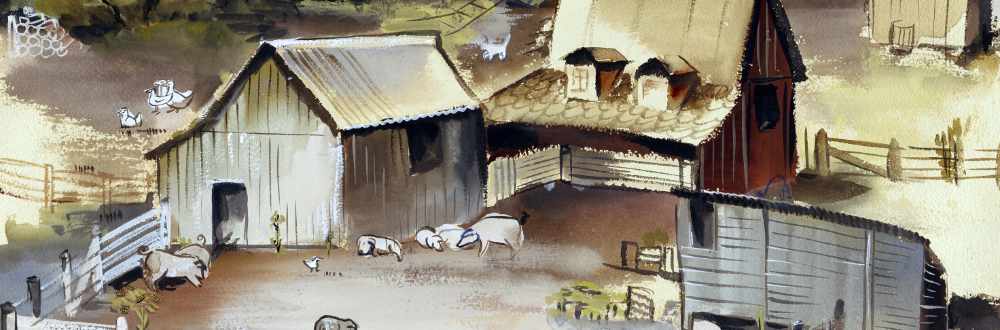
Photo credit: Ruth Ziegler, “Iowa Farm,” n.d., watercolor on paper, Smithsonian American Art Museum.
Books Mentioned in the Episode
| Who Moved My Cheese? by Spencer Johnson (Bookshop|Amazon) |
| Trask’s Historical Linguistics by R. L. Trask, revised and edited by Robert McColl Miller (Bookshop|Amazon) |
| Letter Perfect by David Sacks (Bookshop|Amazon) |
| Alphabetical: How Every Letter Tells a Story by Michael Rosen (Bookshop|Amazon) |
Music Used in the Episode
| Title | Artist | Album | Label |
|---|---|---|---|
| Funky Lady | Teddy Chisi | Funky Lady | Motaxis Muisc & Arts Promotions |
| Love and Death | Ebo Taylor | Love and Death | Strut |
| Tropicoso | Jungle Fire | Tropicoso | Nacional |
| Theme From The Anderson Tapes | Quincy Jones | Smackwater Jack | A&M Records |
| Culebro | Jungle Fire | Tropicoso | Nacional |
| The Revolution Will Not Be Televised | Gil Scott Heron | Pieces of A Man | Flying Dutchman |
| Volcano Vapes | Sure Fire Soul Ensemble | Out On The Coast | Colemine Records |

