


A pint-sized mad scientist, a green-haired girl with a contagious sense of wonder, and a 10-year-old detective. They’re all characters in the books on Grant’s latest list of recommended books for children. Also, what’s the word for a female octopus? How about a male kangaroo? A colorful book for younger kids has those answers and more. And the debate over “on accident” versus “by accident”: Which one you use probably depends on how old you are. Plus, if you hop on a merry-go-round, are you moving clockwise or counterclockwise? The answer depends on which side of the pond you’re on.
This episode first aired June 21, 2013. It was rebroadcast the weekends of January 13 and November 24, 2014.
Transcript of “Ride the Merry-Go-Round (episode #1373)”
You’re listening to A Way with Words, the show about language and how we use it.
I’m Grant Barrett.
And I’m Martha Barnette.
Grant, I have a little quiz for you.
Yes, please.
We know that an adult female deer is a…
Doe.
Right.
We know that an adult female lion is a…
A nala?
I don’t know.
What?
How about lioness?
Lioness, of course.
There we go.
Now, here’s the big question.
An adult female octopus is called a…
It’s a hen.
A hen.
An adult female octopus is a hen.
Some of them do actually make little nests, don’t they?
Octopus nests?
I think so.
They put their eggs in.
I don’t think they brood or anything.
I don’t know what they do, actually.
Where are you reading this stuff?
I am reading this in a children’s book, actually.
Oh, that’s cute.
Look at that little cover there.
Yeah, it’s called I Love You.
E-W-E.
E-W-E.
It’s an ode to animal moms, and it’s by Aaron Zenz.
Z-E-N-Z, right?
Z-E-N-Z, yes.
And it’s a picture book, and it has illustrations of this little calf.
It starts out with a little calf, and the calf says, my mom’s a cow.
I bet you knew that.
Turn the page.
But did you know that not all cows moo?
And then it has all these different animals that are also called cows, technically, like elephants, for example.
So all the other female parents have names in all these species.
Yes.
Of course they do.
For example, from the 18th century on, lobsters and crabs were also called hens.
Okay, I’ve heard that.
And this book is, you know, a children’s picture book.
So I was doing a little bit more research in addition to it.
But I really enjoy it.
He’s also done another one called Hug a Bull, like huggable, which is an ode to animal dads.
And I’m really enjoying these.
I’m going to pass them along to you.
Great, I’ll share them with Guthrie.
Yeah.
But we’ll talk a little bit more about other animal words in the show later.
So it’s I Love You, E-W-E, by Aaron Zen, Z-E-N-Z.
And the other one is Love a Bull, B-U-L-L, right?
Huggable.
Huggable.
You’re huggable.
All right.
So we’ll talk about animals and children’s books.
Yeah, some of the stuff I’ve been reading to Guthrie at home.
Excellent.
Give us a call, 877-929-9673, or email us, words@waywordradio.org.
Hello, you have A Way with Words.
Yes, this is Bart Ingraham.
Hi, Bart, how you doing? Where are you calling from?
I’m calling from Sutton’s Bay, Michigan, which is in Little Nile County, up in the northwestern corner of Michigan.
Oh, okay. Welcome to the show.
Thank you.
You’re in Copper Country?
No, no, no, not quite that far north.
That’s about another hundred miles, but that’s what my question has to pertain to.
Oh, really?
Yeah.
Let’s hear it.
I was in a play that was written by Jeff Daniels, and the play is kind of a regional favorite called Escanaba in the Moonlight.
And one of the main characters uses the expression, holy wah.
And I thought it was a writer’s license and something that was kind of made up.
Until I was in at one of my neighbors’ houses one day, and they had a visitor, and I just stopped in briefly to ask a question, made my statement.
She said, holy wah, and I said, what part of the UP are you from?
And so the question is, is what does holy wah mean?
So they use it in the Upper Peninsula of Michigan?
They do.
And how did she use it?
The character in the play, to paraphrase it, says, I was on my way to deer camp, and I was thinking about all of the things I had to bring, when all of a sudden, holy wow, right there in front of me, it’s a 30-point buck.
That’s pretty good.
A 30-point buck.
That’s solid, Bart.
A 30-point buck.
I’d make you my leading man if I ever write a play.
So I have no idea where it came from, but I’ve always been very curious.
This is what happens when people are surrounded by too much water.
To get their own way of speaking.
Yeah, that’s true.
It is. It’s literally called the peninsula effect.
It happens in economics and other disciplines as well.
People tend to behave differently when they are geographically limited.
It’s not easy to go to the next county or state.
I always wondered what was wrong with us.
It explains Manhattan as well.
Yeah.
And actually, Chesapeake and a few other places.
-huh.
Holy wah.
I have never heard holy wah associated with any place else but the Upper Peninsula.
There’s all other kinds of ways to express astonishment or excitement or amazement, right?
Yeah.
This one, I think it’s got a fairly prosaic origin.
We think it’s probably just a corruption of wow, holy wow.
Yeah.
Or wow.
Yeah.
Or maybe what just happened.
Do you ever hear wow sounding like wah, just wow on its own?
No, but given the accents and the proclivity to speak differently in the Upper Peninsula, I could understand where it came from.
Yeah, there’s a tremendous Finnish population up there, right?
That’s correct.
Yeah, so that would be my only other guess, but I don’t know of any direct connection.
So you’re not from there.
You’ve just encountered people from there, from the Upper Peninsula of Michigan.
That’s correct.
That sometimes happens to us when we live in the lower part of the peninsula, the other peninsula, if you will.
I see.
So you’re not a troll.
No, I would be a troll because I live under the bridge.
Gotcha. There we go.
But not the bridge between the two parts? Okay.
Right.
So we don’t have much on Holy Wall.
We know that it’s youpers use it, but that’s it.
We don’t know the origin.
It’s been around for at least 30 years, probably older than that.
And I think they’re really proud of that as they are of other aspects of their dialect.
I mean, it’s almost a kind of marketing tool.
You know, you see it on T-shirts and mugs.
Oh, you betcha.
Yeah, exactly.
Yeah.
Because it’s such a mecca for tourists.
All I know is that when you get around the right people, you can tell where they’re from.
It’s true. It’s true.
Bart, you’ve been a lot of fun. Thanks for giving us a call, all right?
Well, thank you so much for having it.
Take care. Bye-bye.
You betcha. Bye-bye.
Hey, Youpers, we want to hear from you.
If you know something about Holy Wa, 877-929-9673, or email us, words@waywordradio.org.
More adult animal words, Grant.
An adult male cat is called a tom, right?
A tom cat.
And an adult female cat?
Biddy?
Sweet kitty that needs to be petted?
Something like that.
Or you can use the name Queen.
Queen.
Yes.
Oh, I didn’t know that.
How appropriate for some cats.
Isn’t it?
Regal.
Regal, yeah.
Some of them.
Some of them are just rascals.
They like to knock things off counters.
True.
Email words@waywordradio.org.
Hello.
You have A Way with Words.
Hi, Martha.
This is another Martha.
Hey, Martha.
Hi, Grant.
Hi, Marthas.
I’m calling from Sacramento this morning.
How are you?
Great.
How are you doing?
How’s Sacramento?
Well, I have a question that has been in my mind for more years than I would care to admit, because it dates back to when I was taking French in high school.
And my very wonderful French teacher, Madame Coudert, insisted that there was a difference between a merry-go-round and a carousel, which in French, of course, is carousel.
But she said that a merry-go-round travels counterclockwise, and a carousel travels clockwise.
And I’ve noticed that in this country it seems to be that if you have a merry-go-round and you want it to sound really fancy, you call it a carousel.
It doesn’t have anything to do with direction.
So is there any truth to this, or is this just a French convention, or what?
Really great question. I want to clear something up first, okay?
For me, a merry-go-round is only the playground equipment that kids push and then climb aboard so they can spin and get sick.
And for me, the thing with the horses or the animals that go up and down is never called a merry-go-round.
I know that other people don’t have that experience, and a lot of people use the terms merry-go-round and carousel interchangeably to refer to the giant musical machine with the animals that go up and down for a couple of months.
The mirrors, yeah.
Yeah, mirrors and lights and all that.
Right.
I know that there is the little thing that goes around in a playground, and that generally is called a merry-go-round.
But the big one with the music and the horses can be called either a merry-go-round or a carousel.
For example, at the boardwalk in Santa Cruz, California, it’s a merry-go-round.
And it does travel counterclockwise.
And I think you’re right that carousel, at least to me, sounds more elevated somehow, fancier, bigger.
So your French teacher said that the merry-go-round goes which way?
Goes counterclockwise, and a carousel travels clockwise.
You know, there’s no basis in reality for that.
There’s a geographic difference.
In the United States, they almost always go counterclockwise.
Correct.
And in the UK, they almost always go clockwise.
In France, they do both.
And actually, most of Europe, they do.
It just depends where they bought it from.
But really, it does.
Because in Paris, there are at least three carousels that I’ve ridden, and two of them go clockwise and one of them goes counterclockwise.
You remember that?
Yes.
Wow.
I have video.
I have pictures.
Oh, okay.
And they were all called carousels?
Yes.
Carousel.
Yes, exactly.
Carousel.
Yeah, carousel.
And they have the cool ones with the stairs that go up to the part in the middle.
Right.
So there’s no basis in reality that the name somehow is connected to whether or not they go counterclockwise or clockwise.
It’s simply a geographic difference.
Huh.
So perhaps her insistence was based more on her geography as opposed to her French.
Right.
And she may have been under the impression that somehow the merry-go-round was more exclusively related to the United States, that we didn’t ever call them carousels.
Maybe that was part of her. I don’t know.
There’s a really interesting thing that happens with the merry-go-round and carousel, though, is that there are a lot of disputes about whether or not there’s a difference between the terms.
And the other distinctions that people make is that one, for some reason, has only horses.
Like some people say that a carousel is the one with horses.
If it has anything but horses, then it’s not a carousel.
Like, for example, the one at the Bronx Zoo in New York City has bugs.
You can climb aboard a giant grasshopper and ride around in it.
It was awesome. It’s amazing. I loved it.
It’s my favorite one in the world, actually.
And with my son, we’ve probably ridden 15 or 20 carousels here and there.
And some people say the color of lights or whether or not there’s music, all just different stuff like that.
So it sounds as if really the difference is how fancy the owner wants it to be.
If he wants it to sound really, really fancy and tarted up, he calls it a carousel.
If he just wants it to get a lot of people to ride on it with horses up and down, it’s a merry-go-round.
You know, I’ve never heard a carousel called a merry-go-round.
All the ones that I’ve ridden with my wife and son, I’ve never heard it called a merry-go-round.
I’ve never heard a merry-go-round described as tarted up either.
I love this.
Anyway, it’s all—
Who knew there was so much to say about this stuff?
So there’s no distinction between that.
But, you know, there are a lot of other terms for this device, or traditionally there have been.
Some people used to call them whirly gigs.
You ever heard that one?
Yeah, I’ve heard that.
Whirly gigs.
Let’s see.
Now, I’ve heard that for the thing on the playground.
Whirly gigs.
Oh, you have?
Yeah.
Okay, a whirly-go-round.
Yeah.
Anyway, I hope we’ve helped a little bit, Martha.
Well, Grant, I just invite you to go to the Santa Cruz Boardwalk and ride the merry-go-round there.
All right, will do.
I’ll have to add that to my list.
Yeah, we’ll post pictures through the website when we do that.
Whee!
Thank you very much.
I appreciate it.
Bye-bye.
Bye, Martha.
You know, we probably have opened up a whole new vein of conversation here where the carousel fanatics are about to come out of the woodwork.
We welcome you.
You are our people.
Email words@waywordradio.org.
Knock, knock.
Who’s there?
To.
To who?
To whom?
Oh, good Lord.
Oh!
Email words@waywordradio.org.
That one comes courtesy of Alex Zobler, by the way.
Take a whirl on the carousel of words as A Way with Words continues.
You’re listening to A Way with Words.
I’m Martha Barnette.
And I’m Grant Barrett.
And we’re joined once again direct from New York City by John Chanesky, our quiz guy.
Hello, John.
Hi, Grant.
Hi, Martha.
Hi, John.
What’s up?
You’re atop the Empire State Building, right?
I am atop the Empire State Building.
It’s raining today in New York City, so I’m in danger of any second being shook by lightning.
Swatting at airplanes.
Yes, I’m spotting at things and holding a gorgeous blonde.
Don’t tell my wife.
A gorgeous blonde quiz, I hope.
Yes.
You guys know homophones, two words that are spelled differently but sound the same, like no, N-O, and no, K-N-O-W.
Sure.
And you know, K-N-O-W, phrases.
Let’s say one word of a two-word phrase is a homophone.
It would change the meaning of the phrase.
For example, what would you call a single, solitary ocean predator?
Any guess?
A single, solitary.
A loan shark.
A loan shark, yes, very good.
Very good.
It’s a guy who fronts you money at an exorbitant interest rate, or a fish that fronts you money at an exorbitant interest rate.
Got it.
A lot of clams.
It’s very good.
Right, so we’ve got loan shark, L-O-N-E, shark, or loan shark, L-O-A-N, shark.
Let’s do some more.
In each case, the uncommon phrase comes first, and the actual well-known phrase comes second.
Here we go.
This is a rather redundant way to describe the most widely grown crop in the Americas, but it’s really a seasonal attraction at some farms that you may not be able to find your way out of.
Corn maize.
Corn maize, right. Can you spell the mazes for me?
M-A-I-Z-E and M-A-Z-E.
Yes, very good.
This is something that lawyers who specialize in wills have to think about, whether or not the person who is to receive inheritance is of sufficient character.
But it’s also something that asthmatics in Los Angeles have to think about.
Air quality.
Air quality.
Very good.
Can you spell the airs for me?
Oh, well, there’s A-I-R and H-E-I-R.
Very good.
Now, if you suspect that a container of liquid contains a strong alkaline substance used to make soap, you can find out by using a device designed to identify it.
Or it could just be a…
Yeah, go ahead.
A lie detector.
A lie detector.
It could just be a polygraph.
Good.
L-Y-E, L-I-E.
Good, a lie detector.
This might describe a picture of a person from the U.S. just lounging on his couch.
Or it’s a popular singing competition TV show.
American Idol.
American Idol.
I-D-O-L and I-D-L-E.
Very good.
Whenever I travel by air, I always wear the same outfit.
Or this describes a policeman who doesn’t wear a typical uniform.
Now, remember I said when I travel by air, I was sort of avoiding a certain word.
Plain clothes?
Plain clothes.
There we go.
Yes, very good.
This could be something you inherit from your parents that makes your eyes a pretty shade of azure, or it could be a pair of leaf eyes.
Blue jeans.
Blue jeans, yes.
This could be a way of describing a male domestic who cleans the house, or describing something that is created or constructed by human beings.
Man-made.
Man-made, yes.
I’ll bet the mannies, the mannies and the manmaids get together on weekends.
Yeah.
Finally, this might describe the tenure of the ice king or another name for sleet.
Rain, rain, ice rain.
What kind of rain?
Snow rain.
I’ll take it.
It’s freezing rain is what I was looking for.
Freezing rain.
Oh, there we go.
Okay, you guys did fantastic on homophobic phrases.
That was fun.
Thank you very much, John.
That’s very good. Thank you.
Thanks.
If you’d like to talk with us about any aspect of language, you can give us a call at 877-929-9673 and find us on Facebook and Twitter.
Hello, you have A Way with Words.
Hi, Grant. Hi, Martha.
This is Lauren calling from La Crescenta, California.
Hi, Lauren. Where in California?
La Crescenta.
What’s going on, Lauren?
Well, actually, I’m excited to talk to fellow word nerds.
We always are.
I’m glad you called.
Yeah.
My grandfather is going to be 98 this year, and he has shared a wonderful phrase with our family.
And I’ve never heard anybody else use it other than us.
And I was wondering if you might shed some insight into what it means and how we got it.
We will try.
98.
98 years old.
That’s a good run.
He’s very happy and healthy.
And we’re just lucky to have him.
That’s fantastic.
What’s the expression?
The phrase is called crocheted gdodi.
And what it means is we’ll use it.
If I ask him, he’ll say it means a nothing.
And so we’ll say, like, for example, if we’re at the dinner table discussing something,
And if I say the answer is A and my sister says the answer is B,
And I look it up and I’m right, he’ll say, oh, well, then you win the crocheted gdoti.
Gdoti?
Yeah.
Do you have any idea how to spell that?
No.
G-A-D-O-T-E-D-E?
I’m not sure.
It sounds like gdoti, though.
It’s hard for the American pronunciation.
T’s, though.
It could be T’s or D’s, right?
Yeah.
Gdoti.
You had to have asked him about this before.
Yeah, I did.
And he says he doesn’t know where he got it from.
He doesn’t remember if his mother said it or anything like that.
The other thing is he’ll sometimes say that it, you know, like I said, it’s a nonsense prize.
You know, you win it.
It’s nothing.
But sometimes he’ll say that it’s also used maybe to politely infer that someone’s telling a big whopper or a lie.
So if they say a big lie, then he’ll say, oh, that’s a crocheted gdodi.
Oh, that is wonderful.
And what is your family’s heritage?
We are Jewish, so he grew up speaking Yiddish.
That doesn’t sound Yiddish, though.
Did he spend time overseas?
He did serve in World War II, and he was in Germany.
Interesting.
G’doti, g’doti.
Well, the first part we can dispense with crochet,
Meaning using the needles to, you might make a hat.
Or a rug or Afghan or something, right?
Right.
Yeah, and I think there might be a key there too
Because there are lots of other crocheted items
That are given as sort of booby prizes.
Oh, really?
Yeah, like you win the crocheted bicycle,
You win the crocheted tub,
You win the crocheted pot.
I like the crocheted bathtub.
That’s my favorite.
So the whole idea is that you’re getting a prize
That’s completely useless.
Yeah, yeah.
But somebody spent a lot of time on it
Because they crocheted it.
Exactly.
Sort of like a submarine with screen doors,
But not exactly.
But it’s more of a little trinket.
It’s a booby prize.
That’s the best way to put it.
So it’s not really a prize.
Right.
It’s not a prize.
Exactly.
It’s silly.
But gadoe.
For some reason, everybody in our family wants to win one.
Gosh.
I mean.
But the gadoe part, that’s the mystery.
Yeah.
I’ve got nothing.
I’ve got nothing, Martha.
I’ve got nothing.
I mean, all I’m thinking of is the French word for gift, you know.
Cadeau.
Yeah.
That’s possible.
Crochet.
Crochet cadeau.
And with a little bit of corruption over the years could become gadoe.
Yeah, but, you know, it could just as well be thingamabob.
Yeah, it might be doohickey or it might be just like a generic thing,
Like a generic pronoun for the thing unnameable.
It’s got a nice sound.
It does, doesn’t it?
Crochet gadoe-dee.
Crochet gadoe-dee, yeah.
It’s almost musical, like a little riff, a little stinger in music.
Yeah.
Just that one little mark.
Yeah.
Well, we have a lot of fun with it, so hopefully somebody else could win one.
Well, here’s what we’ll do for you, Lauren.
We’ll find out.
We’ll definitely find out.
People will email us and call if they know this term.
Or maybe somebody will send us a crocheted gadoti.
Maybe it’s an actual thing.
And then we’ll know what it is.
Yeah.
Yeah, we’ll post a picture on Facebook.
Sounds good.
We don’t know where to wear it on our bodies.
Maybe it doesn’t go on your body.
But Lauren, we’ll put the word out to see if people know what a crocheted gadoti is.
And if we find out, we’ll tell you.
All right?
All right.
Sounds good.
Thank you.
Give our best to your grandpa.
All right?
I will.
Bye-bye.
Bye-bye.
Bye-bye.
If you know what a crocheted gadodi is, we don’t know how to spell it.
Just listen to it.
It’s gadodi.
Maybe D’s, maybe T’s.
If you know what a crocheted gadodi is, give us a call, 877-929-9673.
Email us, words@waywordradio.org.
Hello, you have A Way with Words.
Hi.
Hi, who’s this?
This is Miles Turner from Manteno, Illinois, in the land of Lincoln.
Very good.
What can we help you with, Miles?
Well, I have been an English teacher here in Illinois for the last 32 years,
And in the last 10 years, I’ve noticed a trend that has really continued to grow,
And it’s a problem with some pesky prepositions.
The children in my class are saying they did something on accident instead of by accident,
And I correct them, and I don’t know, of all the aints and all the other words that are out there
That English teachers are supposed to hate,
That is the one on accident that just seems to drive me crazy.
And I was wondering, is that a trend?
Is it, I don’t consider it acceptable, and I correct them,
But should I just not fight the fight anymore and let it go?
Boy, good question.
And are you, what level do you teach?
Well, I teach everyone’s favorite subject, freshman English.
Everyone remembers their freshman English teacher.
It’s the one who had to nail grammar into their head.
You sound pretty memorable. So ninth grade then?
Ninth grade, and then I also teach seniors.
Okay. And what do the students say when you correct them?
They look at me like I’ve grown two heads, which is, of course, a very common look they give me most of the time.
I was going to say, what else is new?
Nonetheless, they look at me like, what’s wrong with that?
And do they admit to even knowing that by accident is the form that other people use?
No, there’s this puzzled, disconcerting expression that flits across their face like I’m from another planet.
That I think they’re hearing it at home.
And that’s what I’m saying.
In the last five years, it’s really gotten bad.
But I started noticing it about 10 years ago.
About 10 years.
That was my next question.
Oh, very interesting stuff.
Well, you’re definitely not the only person noticing it.
Oh, really?
Yes, you asked if it were a trend, and I’m being really careful about my English now.
Oh, stop it.
I thought I should use the subjunctive there.
Oh, please, please.
I’m just wondering if on accident is one of those evolutions in the language, for example, like who and whom.
Whom is virtually disappearing.
Yeah, we can talk about that one.
Who is becoming both the nominative and the objective.
And then, of course, let’s not even get into I and me.
No, let’s not.
Let’s stick with on and by accident.
When I hear that, it just grates so badly in my ear that I cannot help but correct them.
And again, they look at me like I’m crazy.
This is fascinating, isn’t it, Grant?
It is, yeah.
And do you mind if we ask how old you are?
Oh, well, I’m fast approaching the threshold of age.
Almost 40, then.
I have one more year to go and I retire. I’m 58.
Okay, very good. 58.
Okay, wow, good. Lots to chew on here, but we can get to the bottom of this.
Yeah, definitely. There’s a linguist in Indiana named Leslie Barrett who’s done a study of this,
And she surveyed children from all over the country, in Georgia, in California, in Michigan.
Pretty wide geographic sample, sufficiently wide to give us some confidence in her results.
Yeah.
And some reliability then.
And so what she found was that if you were born after 1990, you are far more likely to say on accident than you are to say by accident.
It was really interesting.
If you were born in 1970, the year I was born, you’d probably say both.
And if you were born prior to 1970, you’d probably only say by accident.
Okay, well, I guess, you know, I have one more year to teach, and I’m going to continue to fight the good fight for appropriate use of that pesky preposition.
I should share that one of the things that the reason I asked this question earlier about whether or not your students knew the by accident form.
No.
One of the things that this researcher pointed out is that many of the research subjects who were younger didn’t even know that by accident was a way that anyone else actually said it.
Yeah, they had no idea.
They had no idea.
Exactly.
Yeah, that accounts for the look of stupefaction on their face.
But you could consider yourself a field worker, as we say on the show.
You are in the forefront.
Are witnessing language change. You have some removed because you are educated and older,
But you can witness the language in the mouths of these young people that will one day become
Standard. And this is one of those things. Well, perhaps it’s a teachable moment. I mean,
Maybe you could just stop things down and say, did you know that? Oh, I do. Oh, you do? Every
Time. And have a conversation about language changing. Well, we do that as well. It’s amazing.
Technology has interjected so many new words that they use on a daily basis that weren’t around 15 years ago.
And how with the changes in society, certain words that used to be taboo have become far more acceptable and widespread.
Of course, I wail those changes as well, but that’s an offshoot of my decrepit age.
Well, Miles, we’re really grateful to you for calling and sharing these thoughts with us.
And we wish you a great retirement.
And good luck with the students.
Thank you.
I appreciate it.
I listen to you guys all the time.
You’re awesome.
Keep up the good work.
Thanks, buddy.
Really appreciate it, too.
All righty then.
Bye-bye.
Bye-bye.
What have you been noticing?
Grant, an adult male possum is called a Jack. Can you guess what an adult female possum?
Jane?
Jane?
I don’t know.
Jack and?
Jill.
Yes.
Yeah, nice.
Call us to talk about language, 877-929-9673, or send your email to words@waywordradio.org.
Hello, you have A Way with Words.
Hi, this is Eric. How are you?
Hi, Eric. I’m doing well. Where are you calling us from?
I’m calling from Dallas, Texas.
Well, welcome to the show, Eric. How can we help you?
Sure. I have a quirky saying that my coworker, who is a 7-year-old nurse here in Texas,
She uses it every once in a while.
She uses it when someone’s being very slow to get something done,
And she’ll say that they’re moving like dead life stripping off of you.
And I was wondering if you guys had ever heard of this before or if you were originated from,
Because I’ve Googled it, and I could not find anything regarding it.
Like dead lice dripping off of you.
Yeah, like lice, L-I-C-E.
So she’s a nurse, you said?
She’s a nurse.
She’s 70 years old.
She’s still practicing, and she’s from Seminole, Texas, which is outside of Lubbock.
She’s always got these quirky stories and these funny sayings,
And that’s something that her parents used to use,
And she’s used it before here in the clinic describing someone.
You?
I’ve never…
No, not at all.
Quite the opposite.
No, quite the opposite.
So a 70-year-old nurse from Seminole, Texas,
And this is a second-generation term,
Which is really interesting to me
Because that may actually antedate
The earliest date that I have for this.
I know that it goes back to at least 1899 in Virginia.
Really?
When it was published in a collection of Virginia folklore.
And it just popped up again and again.
Let me ask you, is she African-American?
She is not.
She’s not.
Okay, because it does frequently pop up in the writing and plays and folklore of African-Americans,
Although it also shows up in just Southern American folklore as well.
I find it in 1928 in North Carolina.
It pops up again in a play called The Natural Man by Theodore Brown,
Who I believe was a man of color from 1937.
But usually, probably the reason you had difficulty Googling it,
It’s usually like lice dropping off of you instead of like dripping off of you,
Although I’ve seen both variants.
So you’re moving so slowly that lice are dropping off.
They’re giving up or are they dead?
You’re moving so slowly that it’s like you’re dead,
And then the lice are starving and they’re dying too,
And therefore dropping off of you.
That’s great.
That’s awesome.
That’s basically what it is, yeah.
Because when an animal, you know, the lice can’t feed, the lice die.
Okay.
It’s like you’re moving so slow you might as well be dead.
Oh, sure.
That’s amazing.
Well, Eric, you’ve got to bring us more of her expressions.
I will.
It was really quick.
Her mother actually came from Mississippi, took a train.
The last month of her pregnancy, she came over here by train by herself
To make sure her daughter was born in the state of Texas.
So she’s got amazing backstories.
I’m still trying to get her to at least blog her life,
But I’m thinking I might just take over that
And see if she’ll sell me the rights at some point.
That’d be fantastic.
Yeah, you’d be doing the world a favor to find out more about this colorful woman.
Absolutely.
She’s amazing.
Her name is Kathy.
She’s amazing.
Eric, tell Kathy that we’d love to hear from her directly if she ever wants to share any of her language stuff with us.
All right?
I will.
Absolutely.
Thank you guys so much.
Thank you for calling, Eric.
Really appreciate it.
Of course.
Have a good one.
Bye-bye.
Bye.
Here’s a great definition of oratory from someone named H.I. Phillips.
Oratory is the art of making deep noises from the chest
Sound like important messages from the brain.
Oh, nice.
877-929-9673 or send your inspirational quotes to words@waywordradio.org.
More of your questions about language.
Stay tuned.
You’re listening to A Way with Words. I’m Martha Barnette.
And I’m Grant Barrett.
I was raised in a house where reading was considered doing nothing.
You’d be reading a book and somebody would say, you’re not doing anything. Come help me with this.
I’m like, no, I’m reading. This is a thing.
Yeah.
And books weren’t a priority in my house.
We had just a handful, an old encyclopedia set, I think Ann Goodman’s Sun Signs or whatever her name was.
You read Little House on the Prairie.
I did.
I read all my sister’s books, but the books that we actually owned were few.
Okay.
My wife and I, however, we are both big readers.
And despite having it kind of ignored while I was a kid, our house is an explosion of books.
We read all the time.
And we love to read paper books because we want to demonstrate to our son that reading is a thing.
So he totally loves books.
And what I’m starting to find in his reading and the things that we’re checking out from the library for him
And the stuff that we’re buying him because we’ll go to thrift stores and used book sales,
Just any place that we can find books very inexpensively,
I find that he’s attracted to a certain type of character.
And you won’t be surprised to find that the kind of character he likes in his books is the character that’s just like him,
Only a little better, a little bolder, a little smarter, a little braver, maybe a little more style.
He likes, for example, he likes Yatsuba.
Yatsuba is a Japanese manga character.
She’s five or six, depending which book you read.
She has green hair with four sprigs sticking out, kind of four ponytails.
Yatsuba means four leaf in Japanese.
And she lives with her adopted dad in Japan.
And there’s a whole cast of neighbor characters, her dad’s friends.
And she encounters life with a kind of enthusiasm that most of us have missed since we were five or six,
Where we had the chance to see things with fresh eyes, to love, for example, just seeing cows
And thinking seeing a cow was an amazing thing.
And so Yatsuba, we are now working, I think, on our eighth book.
So these are Japanese manga books.
You start from the back and you read right to left, but everything has been translated into English.
And he loves her because she’s funny and cute and a lot like him.
Cool.
Yeah.
And there are more, I mean, of course, we could talk about Pippi Longstocking.
She’s a great character.
We could also talk about Encyclopedia Brown, who’s a little older than my son, but he’s a detective.
He is respected by his father, which my son likes to see in the book.
I mean, I respect my son, but he’s looking for models of behavior.
And he’s understanding that Encyclopedia is not only respected by his father, but trusted by the people around him.
And I love the fact that he likes Sally Kimball, Encyclopedia Brown’s tough, attractive female friend.
So there’s another female character he likes as well.
And this may be the most interesting of the bus.
I mean, I love Yatsuba.
I think she’s cute and funny.
And this is Franny K. Stein.
Do you know Franny K. Stein?
No, I don’t.
Does that sound like a word to you?
Oh, yes.
Does it sound a little like Frankenstein?
Yes, I’m picturing what she must look like.
Yeah, Franny K. Stein is a really interesting character.
She makes creepy, weird inventions in her attic laboratory.
She makes strange machines that transform people.
She makes things that require lightning and electricity.
And she has problems with the way the world works.
Everybody else thinks things are cute.
She might think they’re disgusting.
She makes something and brings it for show and tell.
Everybody is afraid of it.
And so she has this kind of discrepancy about the way she sees the world and the way she feels that she’s being treated.
The book is funny on one level, right?
But on another level, this is what my son sees in these books.
He feels misunderstood.
He is the least powerful person that he knows in his world.
He doesn’t, of course, realize that all of his classmates in kindergarten are also not very powerful.
And so through Franny K. Stein, he can see that somebody else is having this difficulty of not being believed or not being trusted or not being admired for the things that they think are awesome and nobody else buys into.
And then she overcomes them.
She does, yeah.
So the Franny K. Stein books written by Jim Benton are really instructive for us.
Plus, of course, she makes wicked inventions, just amazing, funny stuff that you would never think of.
And that’s fun, too.
The Yatsuba books are written by Kiyohiko Azuma, A-Z-U-M-A.
We’ll share a link to that.
We’ll talk about Franny K. Stein.
And I’ll throw some other things in there as well.
He loves Calvin and Hobbes, and he loves the Captain Underpants books.
I want to hear your books that I should be reading to my son.
He’s six, just so you know, and I think he’s kind of bright.
So just tell me if you’ve got any books for a kid like that.
877-929-9673 or email us, words@waywordradio.org.
I think I’m going to try to put together a big list.
So your recommendations will go on my list, all right?
Very cool.
You can put them on Facebook and Twitter, too.
Yeah.
Hello, you have A Way with Words.
Hello.
This is Nate.
I’m here with my sister, Lydia.
I’m Nate and Lydia.
Welcome to the show.
Hi, guys.
Where are you calling from?
We’re calling from my sister’s school in Boston, Massachusetts.
Boston, Massachusetts.
Welcome to the show.
How can we help?
Olivia, do you want to explain the question?
Yeah, so I was looking at the word knots, as in the speed of a boat, the other day,
And I was wondering, I know it had something to do with nautical miles,
But it wasn’t spelled like nautical, so I was wondering where the word came from.
Knots, K-N-O-T-S versus nautical?
Mm—
So, like, the speed of a boat, then.
Right.
Do you have any experience with boats yourself?
Not really, but my brother sails.
Yeah, and I seem to remember some story.
I can’t remember what term it went with.
If it was with knots or I thought maybe it was with leagues.
I’m not sure where that comes from.
But about tying physical knots on a rope.
Yep, that’s exactly right.
There’s no etymological relationship between knots and nautical miles, for one thing.
So even though they sound alike, they’re completely different words.
But you’re right.
Using knots in a rope to reckon the speed of a boat or a ship has gone back to, gosh, I think the 1500s.
And it’s what you described.
They had what they called a chip log or a common log that was tied to a long rope that had knots at regular intervals.
And one sailor would drop the chip log over the side of the boat.
And then the vessel would keep moving.
And they would let out the rope with the knots in it.
And they would time it for, oh, 30 seconds or so.
And, of course, the log would be floating in the water.
And they would stop it and count up the knots that had stretched out between the log and the ship as the ship kept moving away.
So, ultimately, the word knot became a unit of speed, a measure of speed.
And one knot equals one nautical mile per hour.
But, you know, what I think is really cool about this, too, is the fact that this log that had a special shape so that it would float in the water correctly and help measure gave the name to a log book where you recorded those measurements and then gave us the term log, as in Captain’s Log, or Web Log, which became blog.
So the old log floating in the water eventually ended up in the blogosphere.
Very interesting. How about that?
How crazy is that?
That’s very interesting.
So knot, K-N-O-T, actually you originally referred to a real knot and a rope.
Yeah.
How about that? I never knew that myself.
Do you know anything about the term league, as in like 20,000 leagues under the sea?
Or is that totally unrelated?
I know something about the Justice League.
Yeah, those are two different leagues, actually.
The league, like the Major League Baseball League, is a completely different word,
Even though they’re spelled exactly the same way.
I think league just comes from an old Latin word that came to us through French that means a certain measurement.
And I think it’s about three miles.
And I remember the light bulb going off in my head when I realized that 20,000 leagues under the sea isn’t 20,000 leagues down.
Did you know that?
No.
Because the Earth would have to be something like six times bigger if it was going to be 20,000 leagues under the sea.
Oh, so it just meant they traveled that distance under the sea, but it wasn’t straight down.
Exactly.
It’s around the earth under the sea.
That was a big light bulb for me.
I have one of those now myself.
We’re learning a lot today.
Excellent.
All right.
Well, thank you for calling.
We really appreciate it, and good luck in school, all right?
Okay.
Thank you very much.
Thanks, guys.
Okay, bye.
Bye, Lydia.
Bye.
Bye.
Bye.
877-929-9673, or email us, words@waywordradio.org.
Grant, I have some more names for adult animals.
You know, a sheep is a ewe, a female sheep.
A female goat is a nanny.
And a kangaroo is…
Oh, I used to know that.
The baby is a joey, but I don’t remember the mama.
Well, that’s the…
Yeah, the baby is a joey.
What’s the mama?
The mama is a flyer.
Oh, nice.
Flyer.
Yeah, yeah.
F-L-Y?
Yeah, F-L-Y-E-R is the female adult kangaroo.
And the adult male is either a boomer or a buck.
Boomer or a buck.
Very good.
Email words@waywordradio.org.
Hello.
You have A Way with Words.
Hi, Martha.
How are you?
Doing well.
Who’s this?
My name is Aaron Maddy.
I’m calling from Turley, Oklahoma.
Turley, Oklahoma.
Turley, Oklahoma.
It’s just north of Tulsa.
Okay.
Welcome to the show, Aaron.
Thank you very much.
How can we help?
Well, I’m calling you today to pose a question on behalf of my mother
And the women of the federal Carswell Medical Facility in Fort Worth, Texas.
And their question is, where did the word chow, as in reference to food or chow hall, where did it originate?
They thought it was some type of military origin, but they don’t know any more than that.
Not a bad guess. Not a bad guess at all, actually.
And why were they curious about it?
Well, they have time on their hands, I suppose, and they listen to your show every weekend.
-huh. Great. That’s fantastic.
And they just were excited. They emailed me and asked me to contact you, and here we are.
Ciao. That’s a good one.
It’s got an interesting history. It goes back to the British experience in Asia in the 1700s.
This is 300 years ago.
Wow.
The British were in Asia, and they picked up a term that was probably a variety of pidgin.
In the seaports of the world, there have traditionally been these mixed languages that are, you know,
A little bit of English, a little bit of Chinese, a little bit of Portuguese.
And in this particular dialect spoken in some of the ports of China, chow chow referred to these mixed dishes that were kind of not one thing and not another. You know, it wasn’t like a standard dish. It’s kind of a little bit of whatever you have on hand.
And this term chow chow probably, unfortunately, this is speculation, not for sure, came from the common joke that what you were eating was dog.
Well, I had wondered that because, you know, when you think of chow, you think of chow chow, you know, the Chinese breed. And I had heard that it could possibly have a Southern California connection during the immigrants, but that was way before the 1700s.
Oh, yeah. The Oxford English Dictionary has a citation from 1795 from a document related to the British embassy there at the time. Possibly related to the dog, the word for dog gets used for the food. It gets reduplicated. That is, instead of just being chow, it turns into chow chow. It sometimes refers to very specific pickled dishes, and sometimes it just refers to food in general.
Then we reshorten it in English. It turns into chow, just referring to any food. It’s always had a slang connotation or an informal connotation. And then it starts to be used for things like chow hound and chow line or chow wagon. Chow down is a verb. Chow down, yeah, the verb to chow.
And here we are talking about it on the air. It’s still got a life. It’s the wonderful—so in that word is this tiny bit of history of the British experience in China. That’s pretty amazing that it goes back that far.
Yeah. You know, like I said, I had originally kind of thought maybe military, but then they referred to it as mess hall. You know, I thought chow may be referring to bad food. So that makes sense. It’s a little bit of everything, so it’s not a specific dish.
No, I can’t. I mean, you’ll find sometimes people say, this is the official recipe for chow chow, but then you’ll get somebody else going, no, this is, and they’re very different from each other.
Well, that’s very interesting. I know it means a lot to the women of the facility that you took this question.
Hey, no problem. They should feel free to pass questions through you any time they’ve got something on their minds.
Oh, we’ll love to hear that very much. Thank you so much.
Our pleasure, Aaron. Thank you so much, Aaron. Give them our regards, okay?
Okay, I sure will, and thanks for talking to me. Bye-bye. Take care now.
All right. Bye-bye.
Yeah, the thing about eating dog, which is really funny, it was a joke. This is funny to some people. It’s an opportunity to bring up the fact this is why we call hot dogs hot dogs.
I was going to say, what’s the latest research on that?
No, well, it’s still the same old research, but we call them hot dogs because that was the joke, was that these sausages made from the remainders in scraps, somehow that there was a domestic animal in there. And so you were literally eating a hot dog, and you can find old cartoons from the late 1800s that show little dog ears and noses sticking out of the hot dog bun.
Yep. Head organ.
Yep. 877-929-9673.
You know, Grant, earlier we were talking about measuring the sea in knots.
Mm—
Do you know why it’s really measured in knots?
No.
To keep the ocean tied.
He laughed.
He laughed.
It was really funny to me in third grade.
877-929-9673 or send us email. That address is words@waywordradio.org.
Hello, you have A Way with Words.
Hello.
Hi, who’s this?
This is Nikki Leary. I’m calling from Live Oak in Swanee County, Florida.
Well, welcome to the show, Nikki. What can we do for you?
Recently, I heard somebody say short-lived. What is the difference between short-lived and short-lived?
Oh, interesting. I think they both last for the same period of time. Did it strike you as wrong or preferable? Which one sounds correct to your ear?
Short-lived.
Short-lived, yeah. What about you, Martha? Did you say short-lived?
You know, I tried to train myself to say short-lived because I said short-lived most of my life until I read some linguistic authorities who said that actually it comes from short life rather than live. But there’s almost nobody except the utmost peevers in the English-speaking world who say short-lived.
Yeah.
Well, it strikes me as being just strange.
Mm—
Yeah, I think it’s the traditional pronunciation, but I almost never hear it.
Yeah, no, it’s something like 98% of the country says short-lived all the time, anytime they say it. The other 2%, most of them are battling, like Martha described, to try to say it one way, when all of their experience and instinct tells them to say it the other way.
Yeah.
Yeah, so I guess we could say that short-lived is short-lived. How about that?
Because at the bottom of this, what we have, Nikki, is this etymological fallacy that the origin of an expression somehow still has to control its pronunciation. And it’s simply not true for English.
We have made short-lived conform to what we know about these past forms of a verb. And it is very consistent with all the other pronunciations of the verb live, to live. So it just really follows standard orthographic principles. I mean, standard morphological principles in English.
Language is so fascinating, isn’t it?
It is, isn’t it now? And what would we do without it?
That’s very true. We have an hour of silence on the radio each week.
Thanks, Nikki. Call us again, all right?
Thank you.
Take care now.
Bye-bye.
Bye-bye.
If you’ve got a question about something that you heard that didn’t sound right or sounded great, give us a call, 877-929-9673, or email us, words@waywordradio.org.
We were talking earlier about animal names. We know that a doe is an adult female deer. We know that a buck is an adult male deer. But do you know what animal is also referred to with those terms?
No.
An adult male gerbil.
Gerbil.
Can you imagine?
Is a buck?
Yeah, can you imagine calling a little gerbil a buck? Like related to a jackalope, right?
Right.
A five-point gerbil.
Things have come to a pretty past. That’s all for today’s broadcast, but don’t wait until next week to chat with us. Join us on Facebook, Twitter, iTunes, or SoundCloud.
Check out our website, too, waywordradio.org, where you’ll find a dictionary, a newsletter, a language blog, mobile apps, and a discussion forum.
And you can listen to hundreds of episodes of past shows for free. And you can leave us a message anytime at 877-929-9673.
Share your family’s stories about language or ask us to resolve disputes at work, home, or in school.
You can email us, too. That address is words@waywordradio.org.
Our production staff includes Stefanie Levine, Tim Felten, and James Ramsey.
A Way with Words is independently produced and distributed by Wayword, Inc., a nonprofit supported by listeners and organizations who believe in lifelong learning and better human communication.
The show is recorded at Studio West in San Diego, California.
Thanks for listening. I’m Martha Burnett.
And I’m Grant Barrett. Adios.
Ciao.
You like potato and I like potato.
You like tomato and I like tomato.
Potato, potato, tomato, tomato.
Let’s call the whole thing off.
But oh, if we call the whole thing off, then we must part.
And oh, if we ever part, then that might break my heart.
So if you like pajamas and I like pajamas, I’ll wear pajamas and give up pajamas.
For we know we need each other, so we…
Animal Kingdom Moms and Dads
 Tuna may be the chicken of the sea, but octopi, lobsters and crabs are the hens. That is, the females of each those species is called a hen. Aaron Zenz’s lovely book for children I Love Ewe: An Ode to Animal Moms offers a little lesson about female names in the animal kingdom. He does the same for the males of the species in Hug a Bull: An Ode to Animal Dads.
Holy Wah
Holy wah, a Yooper corruption of “wow”, is specific to the Upper Peninsula of Michigan. Evidently, it comes in handy when spotting a bear.
Toms and Queens
An adult male cat is called a tom. What’s the female called? A queen.
Carousel vs. Merry-Go-Round
Martha Geiger of Sacramento, California, says her French teacher told her that the difference between a carousel and a merry-go-round is that one goes clockwise and the other counterclockwise. True? Actually, there’s really no difference between the names, although in England and much of Europe, these rides usually go clockwise; in the U.S., it’s the opposite. And to some Americans, a merry-go-round is simply that spinning playground fixture for kids.
“To Who” Knock-Knock Joke
Alex Zobler from Stamford, Connecticut, sent along this joke: Knock knock. Who’s there? To. To who? You see where this one’s going, right?
Homophone Word Quiz
Our Quiz Guy John Chaneski phones in a game of homophones. For example, what two-word phrase could either be described as a redundant way to name a common crop, or a seasonal attraction at state fairs?
Crocheted Gidote
Lauren from La Crescenta, California, says her 98-year-old grandfather uses a rather obscure saying. As a kid, if Lauren or her sister won a meaningless contest, he’d award them an imaginary prize he called the crocheted gidote. Or maybe that’s gadoty, gadote, guhdody, or gadodie — we’ve never seen the term before. Similar phrases include “You win the crocheted teapot” and “You win the crocheted bicycle,” all suggesting winning a prize that’s as useless as, say, a chocolate teapot.
“On Accident” or “By Accident”
A high-school English teacher asks which is correct: It happened on accident, or It happened by accident? A survey by linguist Leslie Barratt at Indiana State University indicates that most people born after 1990 use on accident, and weren’t even aware that by accident was proper, while those born before 1970 almost always say by accident.
Jacks and Jills
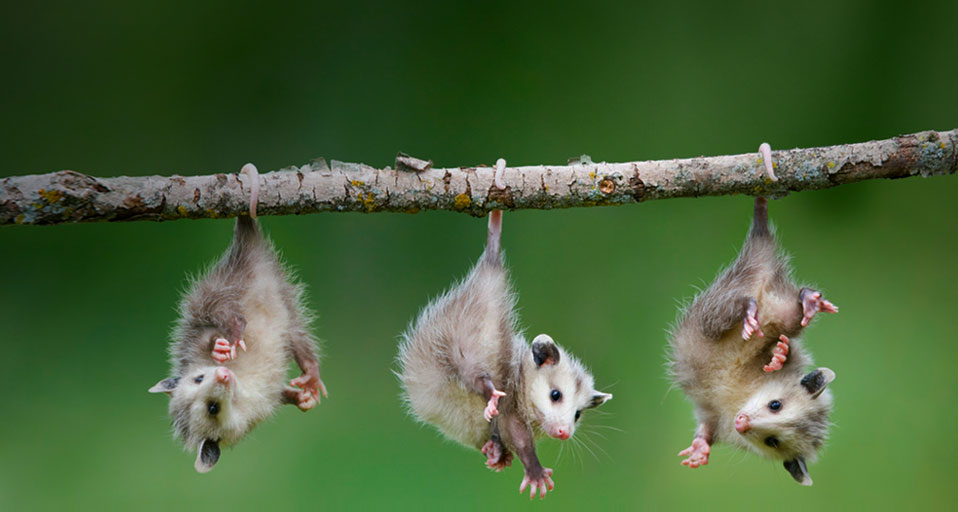
An adult male opossum is called a jack, while the female’s called a jill. A baby opossum is simply known as cute.
Dead Lice Expression
A Dallas listener says that if someone’s moving especially slowly, his co-worker exclaims “It’s like dead lice dripping off you!”” This phrase, found in Southern and African-American literature from the early 20th century, probably reflects the idea that the person is moving so slowly that they’re already dead and any lice on them have starved to death.
The Art of Oratory
As composer and writer H.I. Phillips has observed, Oratory is the art of making deep noises from the chest sound like important messages from the brain.
Grant’s List of Children’s Books
Grant offers of a list of children’s books he’s been enjoying with his six-year-old son: Yotsuba&!, the energetic, curious Manga character; Pippi Longstocking; Calvin and Hobbes; the mad scientist Franny K. Stein; and the venerable Encyclopedia Brown.
Sea Knots
Why are distances at sea measured in knots? In the 1500s, sailors would drop a chip log off the side of the boat and let out the rope for about thirty seconds, counting how many knots on the rope went out. Eventually, one knot came to mean one nautical mile per hour. Incidentally, this same log gave us logbook, weblog, and ultimately, blog.
Ewes, Nannies, and Flyers
A female sheep is an ewe, a goat is a nanny, but what’s a female kangaroo? A flyer.
Chow Chow
The word chow, as in chow hall or chow down, goes back to the British presence in Chinese ports during the 1700s. Chow chow was a pidgin term referring to a mixed dish of various foods, namely whatever was on hand. The joke was that it often contained dog, which is the same joke behind our encased sausage scraps known as hot dogs.
Measuring The Sea Joke
Why do we measure the sea in knots? Why, to keep the ocean tide!
Short-Lived Pronunciation
Although a few sticklers cling to the traditional pronunciation of short-lived with a long i, the vast majority of Americans now pronounce short-lived with a short i. Long live the latter, we say.
Does and Bucks
Does and bucks are female and male deer, respectively. But what do you call female and male gerbils. Why, they’re does and bucks, too.
This episode is hosted by Martha Barnette and Grant Barrett, and produced by Stefanie Levine.
Photo by Rob Pongsajapan. Used under a Creative Commons license.
Books Mentioned in the Episode
Music Used in the Episode
| Title | Artist | Album | Label |
|---|---|---|---|
| The Secret Is Out | Cascadia ’10 | Cascadia 10 | Cascadia ’10 |
| Moon Cabbage | Polyrhythmics | Moon Cabbage | KEPT |
| Super Bad | Suburban Soul Crew | Shafted! – 70’s Instrumental Funk Classic | Warner |
| Apophistry | Cascadia ’10 | Cascadia 10 | Cascadia ’10 |
| Ethiopino | Jungle By Night | Hidden | Kindred Spirits |
| The Past Is History | Jungle By Night | Hidden | Kindred Spirits |
| Yo Slick | Suburban Soul Crew | Shafted! – 70’s Instrumental Funk Classic | Warner |
| Car Crash | Polyrhythmics | Labrador | Polyrhythmics |
| Moonroof | Polyrhythmics | Labrador | Polyrhythmics |
| Labrador | Polyrhythmics | Labrador | Polyrhythmics |
| Let’s Call The Whole Thing Off | Ella Fitzgerald | Ella Fitzgerald Sings The George and Ira Gershwin Song Book | Verve |

One reason for counterclockwise rotation of US merry-go-rounds is that the rider would try to catch the brass ring with the right hand. Judging by pictures, I don’t think this means of gaining a free ride is used in UK. The discussion of terms left me wondering what the carney term might be. It always grates on my ears that carnies pronounce the steam or pneumatic keyboard instrument as cally ope, rather than like the muse.
Ferrets come in hob and jill. Modern goatherds claim it is buck and doe, not billy and nanny, but both consider young as kids, with the standard joke as to whether a noisy pregnant doe is kidding or kidding. Queen seems to be a relatively recent term from cat breeders. while the traditional term is puss or pussy. A castrated tom becomes a gib and 1970s Vancouver area had the term gibbled for a situation all messed up. Finally, what is a male octopus?
Children’s books: Don’t forget Mordekai Richler’s “Jacob Two Two and the Hooded Fang”, a great two level story, a fairy tale for kids and an allegory for adults. I had the fortune to hear Richler read this book prior to publication, on CBC radio.
I would like to make a remark on ‘Crocheted Gidote’.
In Dutch we call a small present ‘cadeautje’, which sounds a lot like ‘gidote’.